Guides · Treadmill sprint speed
Treadmill sprint speed: does the belt ever get there?
Your recovery walk sits at 3.0. You press 12.0, a 5:00 mile, and run hard for thirty seconds with your eyes on the clock before you press back down. How much of that half minute did you really spend at 12.0?
There is no set treadmill sprint speed. The belt climbs toward whatever number you press over several seconds, so a short sprint from a walking recovery can end before it arrives, and a machine short of power can fall below the number you press.
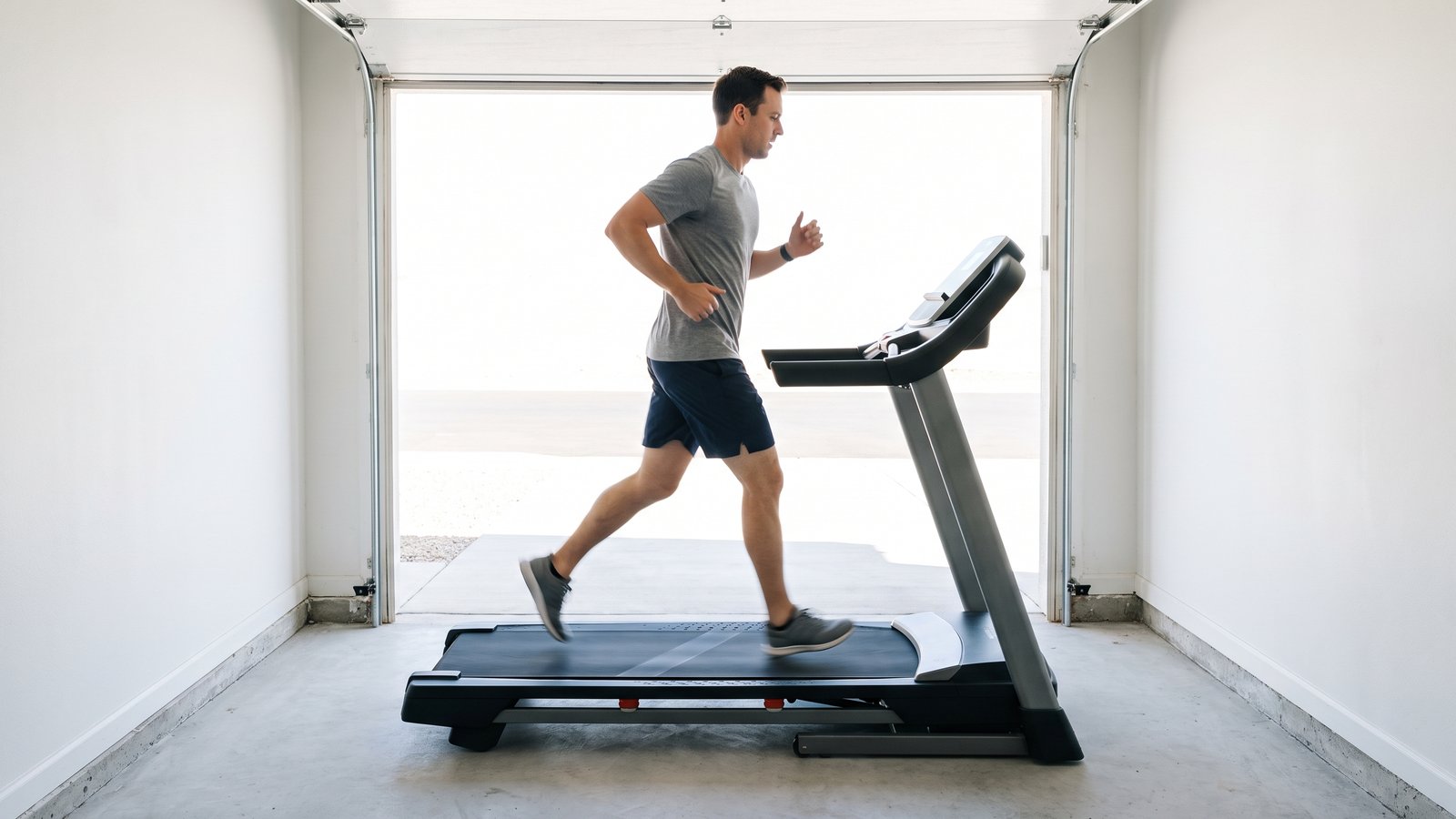
A sprint is the biggest jump a workout usually asks of the belt
The number you press is a target. The belt takes several seconds to climb to it, and the guide to treadmill fartlek covers why the belt climbs and what the climb costs a surge. A sprint is about the longest climb any workout asks for, because you send the belt from a walk to your fastest setting in one jump. So the rep that is shortest on the clock is the one with the most ground to cover.
Picture a phone on a charger. A phone at 90 percent fills up in a few minutes. Plug in a phone at 5 percent for those same few minutes and you unplug it far short of full. The charger did its job the whole time, and the stop was shorter than the gap. A sprint from a walk is the nearly empty phone.

What a 30 second sprint averages in one example
Take the walk at 3.0 and the sprint at 12.0. One rehabilitation treadmill's maker sets its climb at 3 seconds for every 1 mph by default, so going up 9 mph takes a 27 second climb on that machine.
Time spent at 12.0 in each rep
A made-up example: one maker's default rate on an imaginary machine, every rep timed from the button press, and nobody ran it.
| Rep length | Time at 12.0, and the pace you averaged |
|---|---|
| 20 seconds | None. The belt is still climbing at 9.7 when you press back down. |
| 30 seconds | 3 seconds, for an average 7:33 mile |
| 45 seconds | 18 seconds, for an average 6:27 mile |
| 60 seconds | 33 seconds, for an average 6:01 mile |
This assumes an even climb from the press. Your machine may climb faster or slower.
At double that rate, 6 seconds per mph, the climb lasts 54 seconds. A 45 second rep then ends with the belt at 10.5, and 12.0 never comes at all.
In this made-up example, the 30 seconds you logged as a 5:00 mile were run at an average 7:33 mile. The climb took speed away from the rep. A climb up to a higher setting can only do that, no matter how fast the belt climbs.
Even once the belt has finished climbing, it may not sit exactly on your number. In one lab test of four treadmills run at up to about 10 mph, the belts averaged roughly 98 to 103 percent of the number set, and that error rides on top of the climb.
A machine short of power can fall below the number you press
On two models from one maker, weak household power leaves the belt well below the number on the display. On a belt held below the numbers you press, the higher the number, the bigger the gap can be, and your sprint is your highest number. If your belt falls short like that, ask whoever looks after the treadmill, or a technician. The guide to a treadmill that speeds up and slows down covers a belt that surges or wanders instead.
What a treadmill sprint actually is
The fastest 100 m races on record pass 12 meters a second, about 27 mph, in parts of the run. The 12.0 in the example above is less than half of that. A treadmill sprint is a hard run at your own fastest setting. It has little to do with track speed.
Getting honest numbers out of your sprints
Start each rep's clock when the belt stops picking up speed under you, not at the press, and compare sprint sessions only on the same treadmill. A jogging recovery or a longer rep shrinks the share of each rep lost to the climb.
In the example above, a 30 second rep spent only 3 seconds at 12.0, so the sprint number is the setting you hold least. Learn what the settings you hold longest really deliver, the jog between reps and the warm-up, so the pace you write down comes from the belt rather than the button.
Find out what your regular settings are worth
Treadwell measures the belt itself, using the camera and LiDAR on an iPhone Pro. Stay on the floor with the deck empty and read the settings you hold the longest, like the jog between sprints and your warm-up, once the belt is up to speed. The reading shows what each of those settings gives on that machine. It says nothing about the climb, so your rep clock still starts once the belt is done climbing, not at the press.
Put a real pace on the settings you run most
Read the belt at your jog and warm-up settings and log the pace each one actually gives you. Treadwell needs an iPhone Pro, since every reading uses its LiDAR.
 Scan with your iPhone Pro to get the app
Tested: in our tachometer tests the app read within about 2 percent of true belt speed.
Quick answers
What is a good sprint speed on a treadmill? There is no set treadmill sprint speed. The belt climbs toward whatever number you press over several seconds, so a short sprint from a walking recovery can end before it arrives, and a machine short of power can fall below the number you press.
Is 8 mph on a treadmill fast? A belt that really runs 8.0 mph gives you a 7:30 mile. Whether that is fast depends on you. Whether the belt is doing 8.0 depends on the machine, and a short rep from a walk can end before a slowly climbing belt gets there.
Is sprinting on a treadmill as good as sprinting outside? A pooled review of the research found sprint performance on a motorized treadmill was not significantly different from sprinting over ground, which is not the same as showing they are equal. Results varied a lot between studies.
Sources.
- Gradual speed changes: owner's manuals for the XTERRA TR260 (2023) and Spirit XT685 (2011) warn that a speed change is not instant. The NordicTrack T Series 5 user's manual (model NTL17624.0, 2024, retailer-hosted copy) says the walking belt moves gradually to the selected setting.
- The 3 seconds per mph climb: Spirit Fitness MT200 (ReCare) rehabilitation treadmill user manual, 2020. The climb rate there is a setting with a factory default of 3 seconds per 1 mph. This is one rehabilitation model, used to show the climb is real and can be slow. It is not a typical gym figure.
- The belt falling below the number on the display on weak power: Spirit XT685 owner's manual (2011), which lists a belt reaching only about 7 mph while the display shows a higher speed, and Spirit CT850ENT manual (2020), which lists the same symptom at about 12 mph. Both put it down to low household voltage.
- Lab belt accuracy: Willwacher and colleagues (2021), Scientific Reports 11, article 2244. Across four treadmills located in labs, tested up to about 10 mph, average belt speed across machines, speeds and runners came to 98 to 103 percent of target. The range does not cover faster speeds or treadmills as a group.
- Elite sprint speed: Krzysztof M and Mero A, "A kinematics analysis of three best 100 m performances ever," Journal of Human Kinetics 36 (2013), 149 to 160. Speeds above 12 m/s (12.05 to 12.34) in some 10 m sections of three 100 m races. The mph figure is my own conversion.
- Treadmill against ground sprinting: Miller and colleagues, Sports Medicine 49(5), 763 to 782 (2019), a systematic review and meta-analysis. Sprint performance varied considerably and was not significantly different between motorized treadmill and overground running.
- The 3.0 walk, the 12.0 sprint, both climb rates, the table and the phone charger are my illustrations. I worked out the paces myself on the basis that the belt climbs evenly from the instant you press.