Guides · Treadmill 800m repeats
How accurate are your treadmill 800m repeats?
You are three reps into six by 800, the screen has held 10.0 the whole way, and each rep has felt exactly like the one before it. That steadiness is real. It is not the same thing as the pace being right.
Your treadmill 800m repeats are accurate against each other, because the belt hands every rep the same speed and the same error. As an absolute pace they are only as accurate as the machine. Two things shorten every rep: the belt’s own error, and the seconds you spend climbing up to speed.
What your repeats can honestly tell you
Whatever your belt is really doing, it does the same thing on rep one and on rep six. The error does not reroll itself between efforts, so anything you learn by comparing one rep against another survives it.
That changes what a repeat even is. On a track you read the stopwatch. On a belt the machine has already decided your time, so your reps come back nearly identical whether you were flying or dying. Fade shows up instead as the moment you knock the speed down to 9.7 to get through rep six. Hold 10.0 for all six this month after needing 9.6 last month, and that is progress you made.
Think about finishing position in a race. Position tells you who was stronger that day, and it tells you honestly, whatever the conditions were. It cannot tell you whether the field was fast. Your repeats give you position. They do not give you time.
The clock is on your side too. A three minute rep really is three minutes. What the belt did during those three minutes is the open question.
The seconds before the rep starts
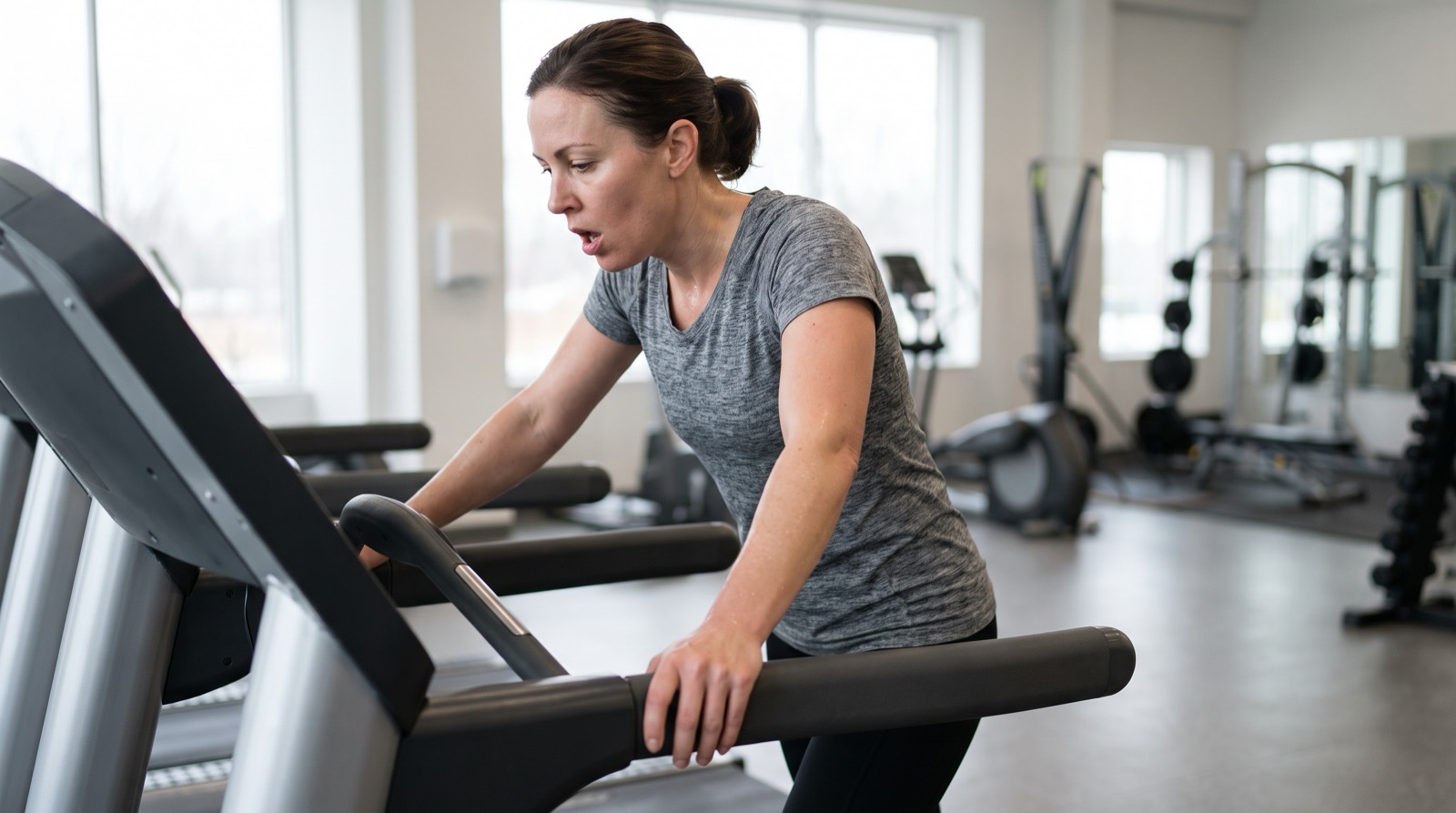
There is a second error on every rep, and this one you can watch happen. Press the speed up and the belt does not arrive at 10.0. It climbs, and the first stretch of the rep runs slower than the number you set.
That matters more on short reps than on anything else you do indoors, because the climb is a fixed cost and the rep is short. It also lands on every rep equally, so like the calibration error it cancels out of any comparison you make inside the session. How long your machine takes to get there is not a number anybody publishes, so the only way to know yours is to watch the display on the way up.
A three minute rep at a displayed 10.0, meant to cover 805 m
Two things take metres off it. Only one of them is visible.
| What takes the metres | The rep covered | Short by | Can you see it? |
|---|---|---|---|
| A belt running 2% slow | 789 m | 16 m | No |
| Ten seconds climbing from a 4.0 recovery | 791 m | 13 m | Yes, on the display |
| Both, on the same rep | 775 m | 29 m | Only the climb |
This is worked arithmetic on one typical setup, not a machine I measured. Machines differ enough in how fast they reach a set speed that yours may cost more than this, or less. The difference that matters is not which number is bigger. You can watch the climb happen and fix it tonight by starting the rep when the belt arrives. The belt’s speed you cannot see, cannot feel, and cannot fix from the rails.
What your repeats cannot tell you
Comparing repeats against each other is only half of what you do with them. You also bank them. A set of 800s at a given pace becomes the evidence that a goal is realistic. That is an absolute claim, and it is exactly the claim the number on the screen was never making. You dialled in 10.0 and the machine holds what you asked for. The screen shows the order, not the receipt.
The argument about whether a one percent incline evens out indoor running is a real one, and it is a different one. No incline setting fixes a belt that is not running the speed it claims.
Six by 800 at a displayed 10.0, three minutes a rep
The screen calls 10.0 a 6:00 mile. This is the same session run on four different belts, and it sets the climb aside.
| If the belt runs | Your real pace | A 3:00 rep covered | Six reps came up |
|---|---|---|---|
| 1% slow | 6:04 | 797 m | 48 m short |
| 2% slow | 6:07 | 789 m | 97 m short |
| 4% slow | 6:15 | 772 m | 193 m short |
| 6% slow | 6:23 | 756 m | 290 m short |
In one laboratory study the belts of four machines ran at 98 to 103 percent of what was asked of them. Rows one and two sit inside that band, which is to say they describe a treadmill nobody would look at twice. Rows three and four fall outside it. I have run a machine worse than either.
Look at the distance column and the session seems fine. Ninety-seven metres across six reps changes nothing, and no coach would care.
Now look at the pace column, because that is the one you carry home. Seven seconds a mile is the difference between a workout that says you are ready and one that says you are close. Take the first to a start line and you find out on the day.
The trust resets when you change belts
Because the error is an offset rather than a wobble, it survives the week. Your Tuesday session on a given machine really does compare with the Tuesday before it on that same machine, and progress you see there is progress you made.
I took a handheld tachometer to one machine, then went back nine days later. Not one of the settings I checked had shifted by more than six tenths of a percent. A rep session on that belt in June still lines up against one in July.
Then your machine is busy and you take the next one along. The new belt carries its own offset, and nothing on either machine reports its error, so there is no way to carry what you learned from one to the other. A session that comes back faster than last week might be a fitter runner or a quicker belt, and your log records the two the same way.
What to do about it
Start the rep when the belt arrives at the number, not when you press the button. That one costs you nothing, and on a rep this short it is worth real metres.
For the belt itself, note which machine you used. Most gyms number them, and a machine number in your log separates a block you can read from a pile of sessions you cannot. When your usual one is taken, judge it on the rep you normally judge yourself on, rep three or rep four, at your usual displayed speed, and watch your breathing and heart rate instead of the screen. Rep one always feels easiest and your heart rate lags on it, so it tells you nothing. If that same rep feels easier or harder than it does on your machine, the belt is running differently, and you have a direction without a figure.
What none of that gives you is the figure. For that the belt has to be measured.
That is what Treadwell does. With the belt already up at your rep speed, you hold an iPhone Pro over it for a few seconds and the app reads the belt’s real speed off the surface itself. The treadmill is never consulted, so the next machine along, the hotel one, and the loaner while yours is out for service all start the session as a known belt instead of a new baseline.
On a hotel machine I had never used and had never calibrated, my tachometer and the app agreed to within half a percent, at the lower settings I could check against the instrument that day. Measure it at the speed you actually run your reps at, and the pace you held becomes a number you can write down. If the app cannot get a clean read, it tells you that rather than handing you a number.
Know what your repeats were really run at
Measure the belt at your rep speed, on any machine. Treadwell needs an iPhone Pro.
Quick answers
How accurate are treadmill 800m repeats? Rep against rep they are as accurate as you need, because the belt hands every repeat the same speed and the same error. As an absolute pace they are only as accurate as the machine, and nothing on the machine is watching the belt. On a belt running two percent slow, a three minute rep at a displayed 10.0 covers about 789 metres instead of 805. The climb up to speed takes off more again, and how much depends on how quickly your machine gets there.
Why do all my treadmill repeats come back the same time? Because the belt sets the pace, not you. Once the speed is dialled in the machine decides how long a given distance takes, so your repeats land almost identically whether the session felt easy or dreadful. Fade shows up somewhere else on a treadmill: in the rep where you knock the speed down, or in your heart rate and breathing at a number you held last week.
What happens if I do my speed work on a different treadmill? You lose the comparison, not just the absolute number. The new machine carries its own offset, and nothing on either machine reports its error, so there is no way to carry a figure from one belt to the other. A session that looks faster than last week's may be a faster belt rather than a fitter runner, and nothing in your log records the difference.
Can I use treadmill repeat times to predict a race? Not safely, because a race prediction is exactly the kind of absolute number a treadmill cannot give you. The repeat time you would feed into it came off a machine that was never measuring the belt. Use the session to see whether you held the speed and what it cost you in effort, and take your race pace from ground you have actually covered.
Sources.
- Our claim that no part of a treadmill is positioned to watch the running surface rests on having read the motorized treadmill manuals we can obtain and finding no such part described in any of them. Two examples of what those documents do describe: Precor part 20039-180 rev A05 sets out a motor whose speed follows its drive frequency and therefore carries no sensor for speed at all, while Horizon and Matrix service documents cover a magnet or a slotted disc spinning at the front roller or beside the drive motor. Each document belongs to the product line it was written for. What we report here is a gap in the papers we hold. No manufacturer has stated it, and it cannot speak for machines whose manuals we have never seen.
- That a one percent treadmill grade was matched to the energetic cost of outdoor running comes from Jones and Doust 1996, Journal of Sports Sciences 14(4):321-7. That study covered trained runners across a limited speed range, and the page cites it only to say the question exists and is a separate one, never to endorse one percent as a universal setting.
- The 98 to 103 percent range comes from Willwacher et al. 2021, Scientific Reports 11:2244. Seven people walked and ran while the speed of the belt underneath them was measured on four different machines. All four were laboratory equipment and two were force-instrumented research treadmills, so the range describes known machines in a lab rather than a sample of gym treadmills.
- Both tables are arithmetic worked from a display reading 10.0 miles per hour, including the 805 m a three minute rep is meant to cover. Every figure in them is a constructed case picked to be an ordinary one. None of the belts described is a machine we put an instrument on.
- The repeat tachometer check is ours, run on treadmill #2 on 28 June and again on 7 July 2026. All three settings came back inside 0.6 percent of what the first visit recorded. It was run to test whether that belt had drifted, and it showed that it had not. One machine across one nine day window is what it is: evidence that a machine's error can hold still, not a figure describing how long any treadmill stays calibrated. The long run guide cites the same test for a different point.
- The half a percent describes how closely OUR READING agreed with a handheld tachometer on one hotel machine, taken the same day, with no calibration for that machine beforehand. The settings we could grade against the instrument that day were the machine's lower ones, which is why the page says so rather than implying the figure covers rep speed. It says nothing about whether that treadmill's own display was telling the truth, and one machine is not a range.
- That a rep's duration is trustworthy is ordinary electronics rather than a claim about treadmills, and no manual we have read publishes a timer accuracy figure either way. The page relies on the narrow version: elapsed time is the one quantity in a rep that does not depend on knowing the belt's speed.
- The climb from recovery speed up to rep speed, and the 13 metres it costs a three minute rep, is worked arithmetic on a ten second climb from a 4.0 recovery. Machines differ and we publish no figure for how fast any of them accelerate. It is an illustrative case, chosen as an ordinary one.
- The claim about rows three and four is first hand. Bryan has run a machine that displayed five miles against a real four, which is wider than anything else we hold on record and nothing like a typical machine. It is a reported run rather than a saved capture, and how that machine was graded was never written down, so we claim nothing about the method.
- That a different machine's offset cannot be carried over from your usual machine's is a statement about what you can know rather than a measurement. Nothing on either machine reports its own error, so there is no way to carry a figure from one belt to another.