Guides · Treadmill accuracy
Is your treadmill's distance accurate? Here's how to check
You have never actually known your treadmill pace. Nobody has. The number on the display is what the motor was aiming for, not what the belt is really doing under your feet.

Most of the time the two are close. Sometimes they are not close at all. The problem is that you can't tell which kind of machine you're on, because the display looks exactly as confident either way.
What the research actually says
A 2021 study in Scientific Reports tested treadmill belt speeds against their set speeds and found the machines ran between 98% and 103% of their target on average. So a well-maintained treadmill is usually within about 2 to 3 percent.
That same study found something more interesting. Every time your foot lands, it brakes the belt. During those braking moments the belt slowed by 4% to as much as 17% below the set speed. The display never shows any of that.
There is no reliable published average for how far off treadmills run in the wild, because worn belts, aging motors, and bad calibration all push machines away from spec, and nobody audits gym equipment. What we can say from our own testing is that the range is wide. Some machines are nearly perfect. Some are not even close.
What we've measured ourselves
We test treadmills against a handheld tachometer, a tool that reads the belt's true surface speed directly.
- One gym treadmill displayed 2.3 miles for a run that was really 2.0. That machine inflates every run by about 15%.
- On another run, the treadmill and an Apple Watch both said 5.6 miles. The real distance was 5.0. The watch agreed with the treadmill because indoors a watch has no GPS and largely echoes the machine's error.
- One machine's display read 5 miles for a run that was really 4.
- A hotel treadmill we had never seen before matched the tachometer within half a percent.
Same workout, different machine, and your "5-mile run" can be anywhere from honest to a full mile short. That is the real issue: not that every treadmill lies, but that you can't tell which ones do.
Why your watch can't settle it
It feels like your running watch should be the referee here. It isn't. Indoors, a watch has no GPS, so it estimates distance from your arm swing and stride. Outdoors with GPS, a study of eight popular sport watches found distance errors of 3% to 6%. Indoors it's guessing on top of that. When your watch and your treadmill disagree, the honest answer is that neither of them is measuring the belt.
How to check your treadmill
The track method (free, rough). Do a timed mile on a measured track and note the effort. Then match that effort on the treadmill and compare what the display claims. This catches big errors but not small ones, and effort is a shaky ruler.
The belt-measurement method (free, tedious). Measure the belt's length, pick out a spot you can recognize as it passes (the belt's seam or logo works), run the treadmill at a set speed, and count belt revolutions over a timed minute. Length times revolutions gives true belt speed. It works, but you're counting belt laps with a stopwatch, and you can't do it while actually running on the machine.
A tachometer (accurate, but it's a tool purchase). A contact tachometer reads belt surface speed directly. This is what we use for ground truth. It's the right tool if you own one treadmill and want a one-time answer.
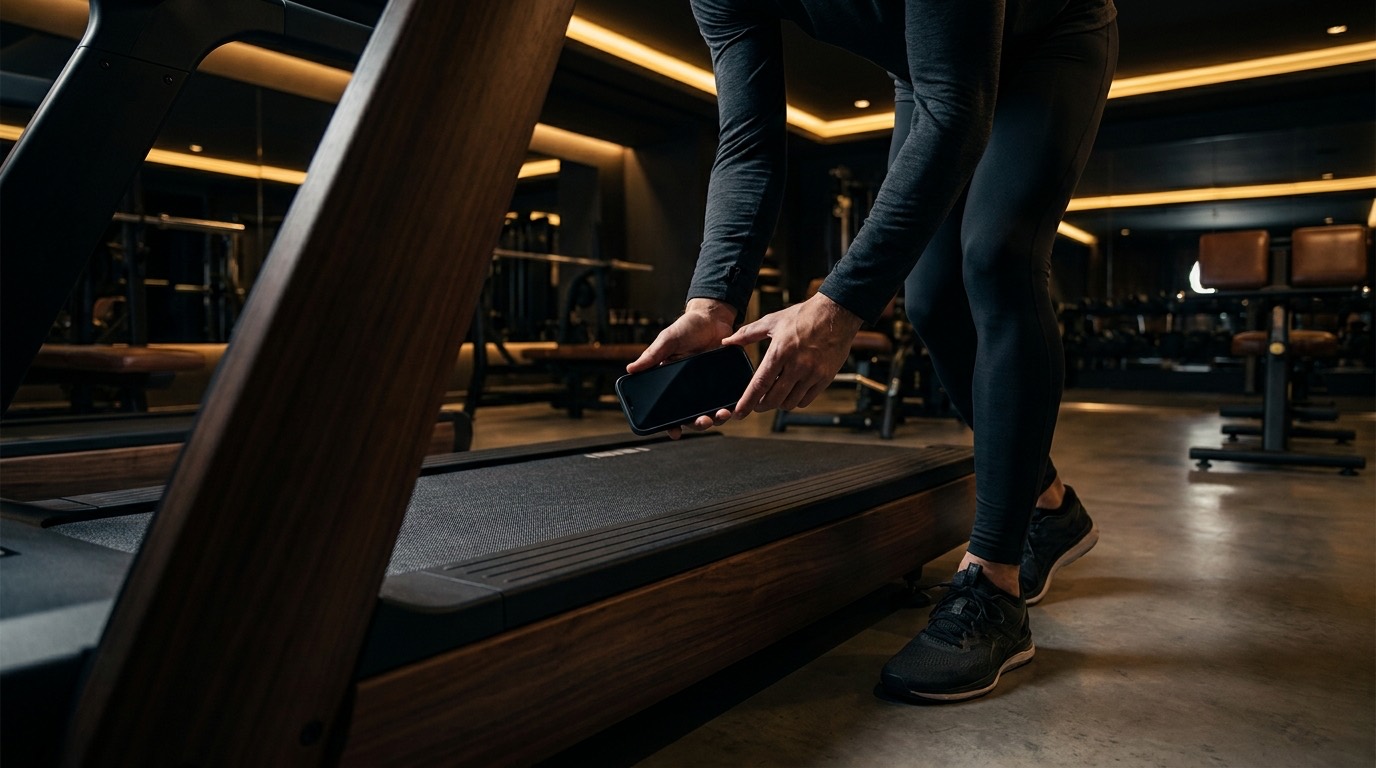
Your phone's camera (what we built). Treadwell measures the belt's true speed with your iPhone's camera and LiDAR. You hold the phone over the running belt for a few seconds and it reads the belt itself, not the display. In our tachometer tests, readings on a machine it had never seen landed within half a percent. It needs an iPhone Pro (12 Pro or newer) because it uses the LiDAR sensor.
Know your real pace
Measure any treadmill's true speed in seconds, with just your iPhone.
Quick answers
Are treadmills accurate? A well-maintained treadmill runs within about 2 to 3 percent of its set speed, but machines in the wild vary far more. In our own tachometer testing, one treadmill overstated distance by about 15 percent while another matched within half a percent.
Do treadmills overestimate distance? Often, though not always. The belt slows every time your foot lands, by 4 to 17 percent during the braking phase, and the display never accounts for it. Wear and bad calibration push machines further off in either direction.
Is my watch or my treadmill more accurate indoors? Neither measures the belt. Indoors a watch has no GPS and estimates from arm swing; outdoors, eight popular sport watches showed 3 to 6 percent distance error. The treadmill shows its target speed, not its real one.
How do I check my treadmill's real speed? Count belt revolutions against a timed minute, use a contact tachometer, or measure the belt with an iPhone Pro's camera and LiDAR using Treadwell.
What to do if your treadmill is off
If it's your machine, check the manual for a calibration procedure; many home treadmills have one. If it's a gym machine, you can't fix it, but you can know its real number and train by that instead. A treadmill that reads 10% long isn't useless once you know it reads 10% long.
The number you train by should be real. However you check, check.
Sources.
- Belt speed vs set speed and braking-phase dips: Willwacher et al., Scientific Reports 11:2244 (2021).
- Watch distance accuracy: JMIR mHealth & uHealth (2020). Eight positioning-enabled sport watches, 3.2% to 6.1% mean error outdoors.
- Treadmill measurements described are our own tachometer-verified tests.
Related reading: Why your watch and your treadmill never agree (and which one is right) · All guides