Guides · Apple Watch treadmill accuracy
Apple Watch treadmill accuracy: what your watch is really doing indoors
You step off the treadmill and check your wrist. The display says one distance, the watch says another, and you would like to know which one to write down. The uncomfortable answer is that your watch never had a way to know. Indoors it cannot reach a satellite and cannot see the belt, so it works out your distance from your arm going back and forth.
An Apple Watch estimates treadmill distance from your arm swing and a stride length it learned outdoors, so it never sees the belt and cannot catch a machine that reads long or short. The only real check is measuring the belt itself.
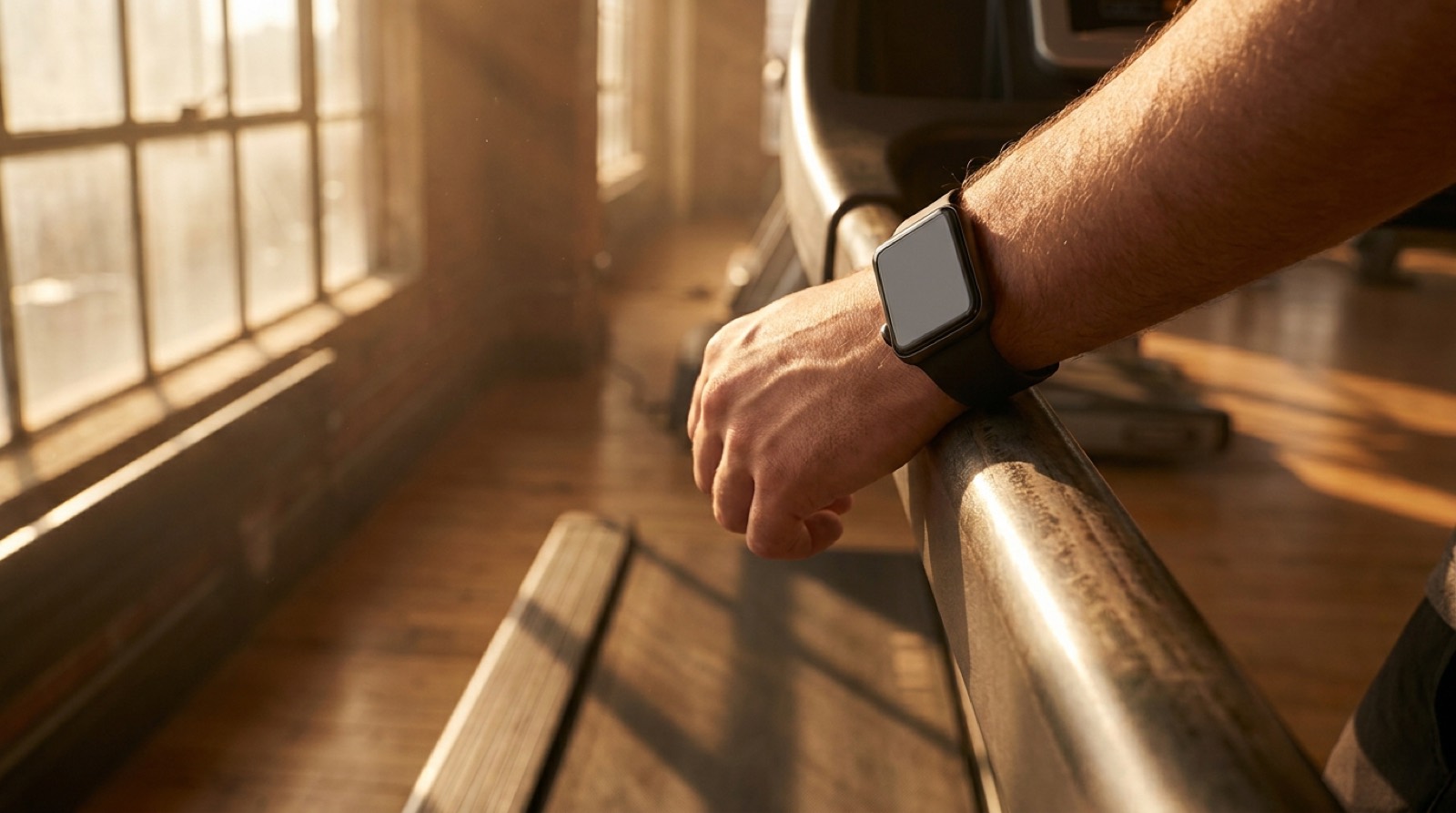
Your watch never sees the belt
Outdoors your watch has a real reference. Satellites tell it where you were, then where you are, and the distance between those two places is a fact about the world.
Step indoors and that reference is gone. On a treadmill the watch turns GPS off and works out speed and distance from its accelerometer, the part that feels your arm move.
Your arm is not the belt. The watch cannot tell how far the belt travelled underneath you, because nothing on your wrist ever touches it. One watch manual even warns that holding the handrails reduces accuracy: take your arm out of the run and the watch has less to count.
What your watch learned, it learned outside
So where does the number come from? Your watch carries a model of you. It knows roughly how long your stride is at a given effort, and it multiplies that by how many strides it felt. That model gets built outdoors, and none of it happens on a treadmill.
How your indoor distance actually gets made
The calibration steps, in the order you would do them.
- 1You go outside. You find a flat, open area with good GPS reception, start an outdoor walk or run, and go at your normal pace for about 20 minutes.
- 2The watch watches you run. It keeps learning your stride length at different speeds every time you walk or run outside this way.
- 3You step onto a treadmill. It has no satellites and no view of the belt. The watch replays what it learned on the road and counts your arm.
Every step of the calibration happens outdoors. The belt is never part of it. Your indoor distance is your road stride, applied to a machine your watch knows nothing about.

That is a reasonable piece of engineering. It is also a guess with no way to check itself, built from a surface it will never run on again.
Do the outdoor calibration anyway. A better model of you makes a better estimate indoors. It just cannot make a measurement, because the belt still is not in the room as far as your watch is concerned.
Garmin asks you for the answer
Garmin takes a different route. The first time you save a treadmill run, a Forerunner asks you to calibrate the distance: you read the number off the treadmill's display and type it into the watch.
Think about what you just handed over. That display is the machine's own account of the run, checked by nobody. If it reads long, you have just told your watch that a long mile is a mile.
What happens when you calibrate to a machine that reads long
This is an illustrative example, using a machine that reads 4% off. Nobody logged this run.
This is arithmetic on a made-up machine, not a test we ran. The point is the direction. A calibration is only as good as the ruler you calibrate against, and the ruler here is a display nobody has checked.
None of this means Garmin is doing something careless. Asking you for a reference is more honest than pretending to have one. The problem is that the only reference in the room is the machine, and the machine is the thing in question.
Pairing the watch to the machine does something else entirely
Some gym equipment talks to your watch directly, and when you end the workout, the machine's data lands in your summary. It is easy to hear that as a fix. What you actually gained is the treadmill's own version of the run, with nothing checking it. Pairing does not add a second opinion. It adds the treadmill's.
Agreement is not evidence. Two numbers matching only tells you they came from the same place. On one of my own runs the display and an Apple Watch both read 5.6 miles for a run that was really 5.0. They agreed with each other all the way through, and both of them were wrong by the same six tenths of a mile.
What I found when I measured
I check belts against a handheld contact tachometer, which reads the belt's true surface speed instead of asking the machine what it thinks. Sometimes that is a reading taken on the day, and sometimes it is a tachometer table measured on that machine earlier. The sources at the end say which one stands behind each number.
On one gym treadmill, the display claimed 2.3 miles for a run that was really 2.0. The next day, the same machine read 5.6 against a true 5.0, with an Apple Watch sitting at 5.6 alongside it. On one of the machines I run on regularly, the display said 5 miles when I had really run 4. I definitely under-ran my marathon training.
Those are three runs on two machines, each off by its own amount. On the two runs where I wore my watch, it sided with the display both times, which is what you would expect from a device that cannot see the belt.
| What you are looking at | What it is actually based on | Does anything check the belt? |
|---|---|---|
| Apple Watch, Indoor Run | Your arm movement, multiplied by a stride length learned outdoors with GPS. | No |
| Garmin, indoor run | The accelerometer, plus whatever distance you typed in off the treadmill. | No |
| Watch paired to the machine | The machine's own figures, appearing in your workout summary. | No |
| The treadmill display | The speed the machine was told to hold, run through its stored settings. | No |
| A handheld tachometer | The belt's surface, touched directly. | Yes |
What the lab tests used for truth
Lab tests of wrist trackers on treadmills have found large distance errors, but the detail worth keeping is the yardstick: to decide who was right, even the researchers used the treadmill's own calibrated output. Outdoors the picture improves, because satellites give a watch something real to work with, and against a known outdoor distance, errors run about 3% to 6%.
So when someone tells you a watch is accurate to some percentage on a treadmill, ask where that figure came from.
What about a foot pod?
A foot pod moves the sensor off your wrist and onto your shoe, so it reads the thing that is actually doing the running. The belt is still out of its reach. A pod counts your foot, works out your stride, and multiplies, which is the same kind of estimate as the one on your wrist, taken from a better seat.
How to actually find out
Every option above ends in the same place, which is a number nobody checked. The way out is to stop asking devices what they believe and measure the thing itself. The belt carried you a real distance at a real speed, and that speed is measurable in seconds.
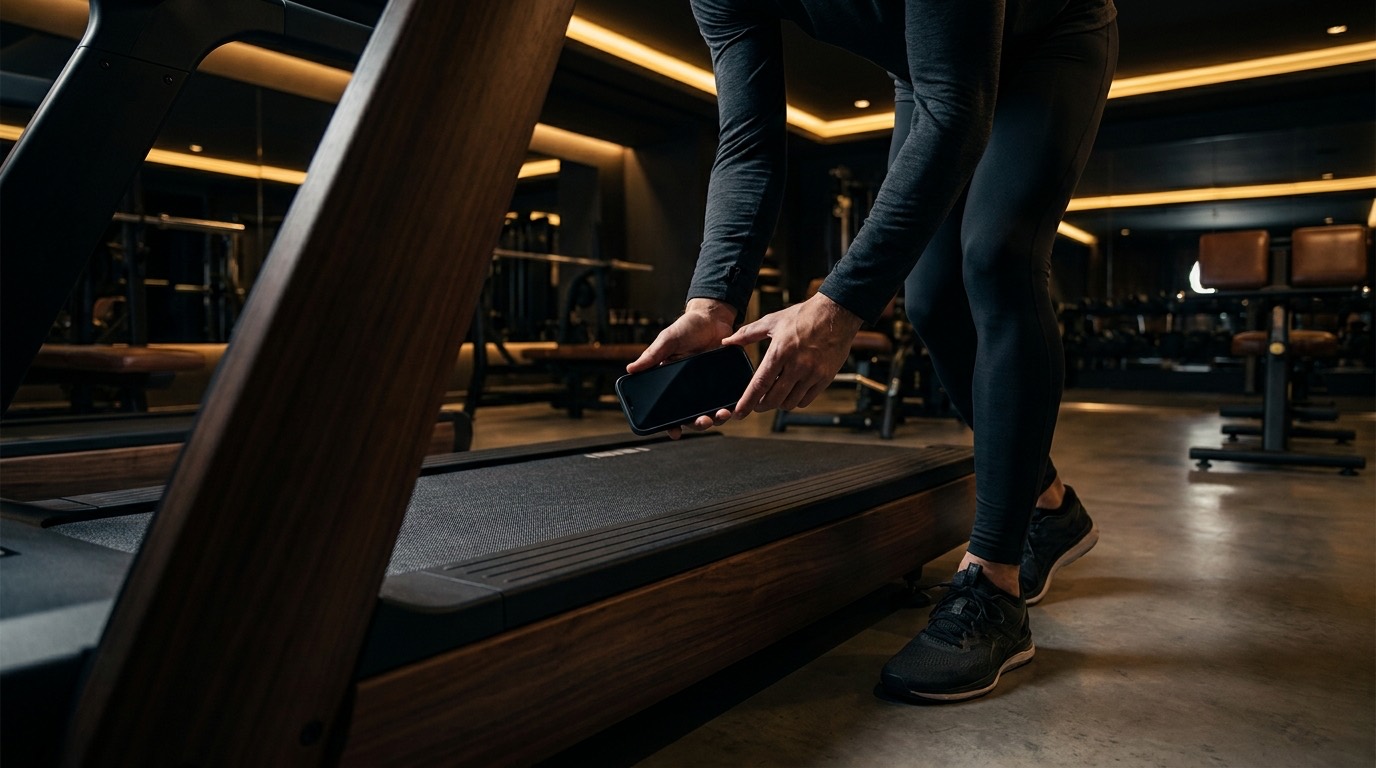
Treadwell reads the belt's real speed through your iPhone Pro's camera and LiDAR sensor. You stand beside the machine and hold the phone over the moving belt. The only thing it looks at is the belt itself, so the display and your stride never enter the math.
On a hotel treadmill it had never seen, with nothing set up for that machine, its reading came within half a percent of my handheld tachometer's. The hotel's own display was never part of that test. When the app cannot get a reading it trusts, it says so instead of inventing one.
Find out what your belt is really doing
Measure any treadmill's true speed in seconds, with your iPhone Pro.
Your watch is still worth wearing
Keep it on. It counts your heart rate, it holds your training history, and it is the best record of your week that you own. Indoor distance is simply the one job it was never built to do, because the information it needs is under your feet and it has no way to reach it.
Once you know the belt's real speed, you know what to make of every number the watch logs indoors. Measure the belt once, and every treadmill mile in your log has a real number behind it.
No iPhone Pro? You can still get there with a tape measure and a stopwatch, by measuring the belt loop and counting how many times a seam, logo or scuff already on it comes round in a minute. The full method is here.
Quick answers
Is an Apple Watch accurate on a treadmill? It is an estimate. Indoors the watch works out distance from your arm movement and a stride length it learned about you outdoors. Nothing in that chain looks at the belt you are standing on.
Does an Apple Watch use GPS on a treadmill? There are no satellites to reach indoors, so the watch turns GPS off and works out speed and distance from its accelerometer instead. The outdoor calibration exists exactly for runs like this, when GPS cannot help.
How do I calibrate my Apple Watch for the treadmill? You cannot calibrate it on the treadmill. Calibration happens outdoors: about 20 minutes of walking or running in a flat, open area with good GPS reception. The watch learns your stride out there, then applies what it learned when you run indoors.
Is a Garmin more accurate than an Apple Watch on a treadmill? Apple Watch and Garmin take different routes to the same kind of guess. Both estimate indoor distance from the accelerometer. A Garmin Forerunner adds a step where you read the distance off the treadmill and type it into the watch, which means your watch is only as right as that display was.
Does pairing my watch to the gym treadmill make it accurate? Pairing makes the two numbers match, because both now come from the machine itself. What lands in your workout summary is the machine's own version of the run, and nothing in the pairing checks whether the machine was correct.
Sources.
- Calibration happens outdoors, in a flat open area with good GPS reception, for about 20 minutes, and the watch keeps learning your stride length at different speeds on those outdoor runs: Apple Support, "Calibrate your Apple Watch for improved Workout and Activity accuracy."
- The watch uses the accelerometer when you run indoors, and Apple's instruction to choose Indoor Run on a treadmill: Apple Support, "Get the most accurate measurements using your Apple Watch."
- Pairing with compatible cardio equipment, and equipment data appearing in the workout summary: Apple Watch User Guide, "Use gym equipment with Apple Watch." The wording comes from an archived edition of the guide.
- GPS is turned off for indoor activities, and speed and distance are then calculated using the accelerometer, plus the tip that holding the handrails reduces accuracy: Garmin Forerunner 165 Series owner's manual, Indoor Activities.
- Being prompted to calibrate the treadmill distance the first time you save a treadmill run, by checking the treadmill display and entering that distance on the watch: Garmin Forerunner 965 owner's manual, Calibrating the Treadmill Distance. Wording is from Garmin's Forerunner manuals; other Garmin lines may differ. Garmin's manual does not state how long that calibration stays in effect.
- Outdoor watch distance error of about 3% to 6%: "Accuracy of Distance Recordings in Eight Positioning-Enabled Sport Watches," JMIR mHealth and uHealth (2020). Eight watches from Apple, Coros, Garmin, Polar and Suunto, mean absolute error 3.2% to 6.1%.
- Eleven wearable trackers tested on a treadmill, nine at the wrist, one on the upper arm and one at the hip, twenty participants, four steady belt speeds, distance error as high as 50%, with the treadmill's own calibrated output used as the reference: Wahl Y, Düking P, Droszez A, Wahl P, Mester J, "Criterion-Validity of Commercially Available Physical Activity Tracker to Estimate Step Count, Covered Distance and Energy Expenditure during Sports Conditions," Frontiers in Physiology 8:725 (2017). None of the devices tested was an Apple Watch, and all are 2017 models, so the result describes that test rather than any watch sold today.
- The 2.3 against 2.0 run is our own test on a gym treadmill, graded against that machine's own measured tachometer table rather than a fresh tachometer reading that day.
- The hotel treadmill result is our own test, checked against a handheld contact tachometer on the day, on a machine we had never measured before. The figure is the accuracy of our own reading against the tachometer, and it is not a statement about that treadmill's display.
- The 5.6 against 5.0 run, with the Apple Watch agreeing with the display, is our own test, checked against that machine's standing tachometer table rather than a fresh tachometer reading that day.
- The 5 miles against 4 is my own run on a machine I use regularly, reported from my own training rather than from a captured test file.
- The 5.20 against 5.00 calibration example is arithmetic on a made-up machine, included to show the direction of the error. Nobody ran it.