Guides · How to tell if your treadmill belt is slipping
How to tell if your treadmill belt is slipping
You have been telling yourself it was your footing. Twice this week the belt caught under a landing and jerked, and twice you grabbed the rail and carried on. Before you report the machine, or blame your legs again, you want to know what a slipping belt actually feels like.
A treadmill belt that pauses, skids or catches under your foot plant and then catches up is slipping, while a healthy belt gives a little under every footstrike and you never feel it. The display will not tell you either way, so the test is your own foot: at a slow walk, holding both rails, plant one foot firmly. A give you have to concentrate to notice is normal, and a belt that hesitates or stops under your foot for longer than a blink and jerks forward when you ease off is slipping.

Every belt dips under your foot. A slip is something else.
Each landing on a treadmill is a small brake. Your foot arrives a touch slower than the belt is moving, so the belt loses a little speed under you, and the motor pulls it back up. A car's suspension does the same over a speed bump. It squashes every time, and the car keeps its pace. That is a sound belt doing what every belt does under a runner.
A slip is a different event. The belt is one long loop, and a roller at the front drags it round. When the loop loses its grip on that roller, your weight stops the belt for a moment and then it jumps to catch up. That is a bike chain skipping a tooth. Nobody misses that one.
The healthy dip has been measured. On four lab treadmills, one of them badly worn, the belt dipped about 4 to 17 percent at the deepest instant of a footstrike, and over the whole stride it stayed within 98 to 103 percent of the set speed. A stride average that close tells you the dip is made up inside the stride, which is why you do not notice it.
Normal footstrike dip versus a slip
The same moment, a foot landing on the belt, on a healthy machine and on one that has lost its grip.
| Normal footstrike dip | A slip | |
|---|---|---|
| What you feel | Nothing. The belt gives and recovers inside one stride. | A pause, a skid or a catch under your foot, then a lurch as the belt catches up. |
| When it happens | On every landing, at any speed, on every treadmill. | Under load, on hard foot plants. |
| What to do | Nothing. This is the machine working. | Confirm it with the foot-plant check, then hand it to whoever services the machine. |
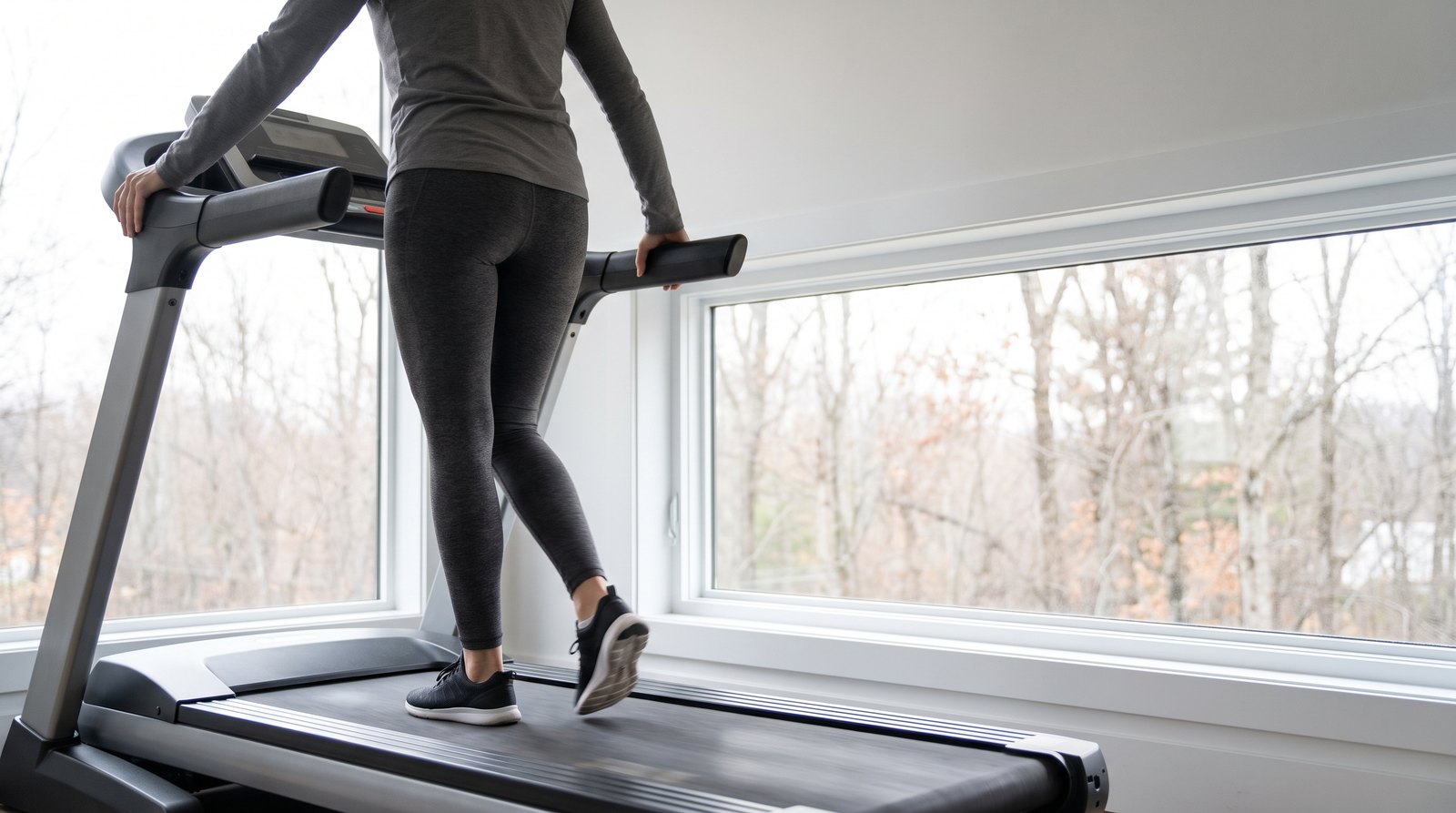
How to tell in one session
Set the belt to a slow walk and hold both rails. Plant one foot firmly, as if you meant to stop the belt. A give you have to concentrate to notice is normal. That is the dip from the top of this page. A belt that hesitates or stops under your foot for longer than a blink and jerks forward when you ease off is slipping. That is the whole test, and it is the same check the people who service treadmills start with. The next step is adjusting the belt, and that part is theirs, not yours.
Now listen. A squeak or a flapping sound from under the hood at the front points at the drive belt, the short belt under the hood that turns the front roller. If the belt holds under a firm plant at a walk but still lets go under your running stride, that still counts as a slip. A running belt that is only slightly loose can pass one walking plant and still let go under a running load. So report both facts and let them decide which belt is at fault. If the drive belt is the one, that is a technician's job, not yours.
Then hand it off. Tell whoever services the machine two things: whether it lets go under a firm plant at a walk or only under a running stride, and whether you heard a squeak or a flap from the front. That is what separates the running belt from the drive belt, and it can save a second visit. Your manual's belt section names who adjusts what on your machine. If the treadmill lives in a gym, report it at the desk and use another one. A belt that pauses under a foot plant is a trip and fall hazard by one maker's own reckoning. They wrote that warning about a badly adjusted belt, and a belt that has loosened on its own puts your feet in the same spot, so do not run on it until it has been looked at.
Two belts can slip, and they feel the same
Most treadmills have two belts, and either one can let go. The running belt is the one under your feet, looped round a roller at each end. The drive belt sits under the hood at the front and carries the motor's pull to the front roller. If the drive belt slips, the front roller pauses, and the running belt pauses with it. From where you stand, a loose drive belt feels much the same as a loose running belt.
The running belt loses its grip for a few reasons. Most often it has stretched with use, like an old fan belt, and a stretched loop rides its rollers loosely. Sometimes the underside of the belt has glazed over and the deck under it has worn smooth, so the two surfaces stop gripping. A deck that has gone dry lets go the same way. Glaze and a worn deck have a second symptom you may have noticed already: the machine can no longer reach the top speed it once did.
Nothing on the display reports it
You might expect the speed readout to flinch when the belt does. It does not, as far as we can find. The number on the screen is the speed the machine was told to run, and nothing on the machine says the belt let go under your foot, so the screen has no verdict to give you.
Every slip is a moment of ground you did not cover at the speed on the screen. Nobody has measured how much: no study we could find puts a figure on a slipping belt, so anyone quoting you a percentage is guessing. The cost you can feel is plainer than any percentage. You spend the rest of the session bracing for the next one, and a run spent bracing is not the run you came to do.
The question a slip check cannot answer
A slip is a fault under load. It shows up when your weight is on the belt and disappears when you step off. There is a second question the display cannot answer either. With nobody on it, is the belt running at the speed it was set to? That fault is silent, and a machine can have either one without the other. A slipping belt can run true with nobody aboard. A belt that never slips can be five percent slow every day and feel perfect. Checking that number is a different job from the one you just did with your foot.
Treadwell measures that base speed. Point an iPhone Pro at the belt with nobody on it and the camera clocks how fast the surface is really moving, so the number that comes back belongs to the belt itself. It is a check on the number, not a slip detector, because a slip needs your weight on the belt and the app reads the belt empty. On a hotel treadmill I had never measured before, its reading matched the handheld tachometer I held to that belt the same day to within half a percent at the two lower of the three speeds I tested. That says nothing about the hotel's display, which I did not check that day.
Check the number under your run
Treadwell measures your treadmill's real belt speed in seconds, so you know the number before you ever plant a foot on it. Requires an iPhone Pro with LiDAR.
Quick answers
How can you tell if a treadmill belt is slipping? A treadmill belt that pauses, skids or catches under your foot plant and then catches up is slipping, while a healthy belt gives a little under every footstrike and you never feel it. The display will not tell you either way, so the test is your own foot: at a slow walk, holding both rails, plant one foot firmly. A give you have to concentrate to notice is normal, and a belt that hesitates or stops under your foot for longer than a blink and jerks forward when you ease off is slipping.
Why does my treadmill belt slip when I run but not when I walk? A slip needs load. Running plants your foot harder than walking does, so a belt that has lost some grip can hold through a walk and let go under a running stride. A loose belt tends to hesitate or stick under a heavy foot plant, which is why the check uses a deliberate firm plant at walking speed. If it holds through that plant and still lets go when you run, tell whoever services it exactly that, because the drive belt under the front hood is one suspect and that one is a technician's job.
Does the treadmill display show a lower speed when the belt slips? Not as far as we can find. The number on screen is the one the machine was told to run, and nothing on the machine reports that the belt let go under your foot, so the readout is not a check. Your own foot plant is.
Is a slipping belt the same as a treadmill that runs slow? No. A slip happens under your weight and you can feel it. A belt whose base speed is off runs steadily and you feel nothing, and the display checks neither.
Sources.
- The stride-average figure of 98 to 103 percent and the per-machine braking-phase dips of about 4 to 17 percent come from Willwacher et al., Scientific Reports 11:2244 (2021), who recorded belt speed on four treadmill types while seven participants walked and ran on them. Two of the four were research treadmills built to measure force, and the paper documents the machine with the deepest dip as one whose belt and bed had been substantially worn. Those figures describe the normal dip under load and say nothing about mechanical slip.
- The Trackmaster TMX428/TMX58 service manual, hosted on the maker's own site, states that "a loose belt tends to hesitate or stick with a heavy foot plant" and warns in a note that improper adjustment could cause the treadmill to hesitate and cause a trip and fall hazard. Its identification check has the user walk, grab the side handrail and apply foot pressure to the running belt. It describes a drive-belt problem by a flapping noise under the hood.
- True Fitness owner's manuals for the Z5.0, TM30 and TM50, M50, Performance 100 and 300 and CS200, hosted on True's own shop site, list "walking belt hesitates or slips when stepping" as a symptom with belt tension and a dry belt as causes. Their body text states that if the belt still slips after the walking belt has been adjusted, the problem could be the drive belt under the motor cover, that a loose drive belt feels similar to a loose walking belt, and that adjusting it is a job for a trained service person.
- Sole owner's manuals for the F63, F65, F80 and F85 (2012 to 2020 editions, hosted by a documents reseller rather than by Sole) carry the same drive-belt language, describe checking tension by walking on the belt to make sure it is not slipping or hesitating with each step, and likewise assign drive-belt work to a trained service person.
- Matrix service manuals for the T7X, T7XE, T7xI and T3X, hosted on the Johnson Fitness content site, state that when a person walks or runs on the belt it should not hesitate or slip, and name stretch from temperature, humidity and use as the cause. The Matrix care and maintenance instructions on the same host describe a hard one-foot stomp in which a belt that stops or hesitates for more than a fraction of a second is too loose.
- Horizon service manuals from 2003 to 2004 and 2006, hosted on Johnson Fitness sites, say that a slipping sensation while running means the belt has, in most cases, stretched from use. Their erratic-speed table lists running-belt tension and drive-belt tension as separate causes, and the older manual adds a dry deck and belt.
- The Bowflex T7 and T18 owner's manual lists "hesitation or walking belt slips when in use" with belt tension as the cause. The Bowflex BXT series service manual's flowchart tests slip at low speed with a foot and, when the belt does not slip, sends the technician to the drive belt under the motor cover.
- Life Fitness technical manuals for the 97Ti, 95Ti, 93T, 97Te and 95T, hosted by a parts reseller rather than by Life Fitness, list "striding belt slips during footfall" and "maximum speed is reduced" as two symptoms of one cause, a deck laminate worn through or a glazed belt underside. The same tables tie a squeaking noise to the drive belt. Their belt-tension check has the user walk at 2 mph, grasp the handrails and try to stall the belt, with a slip as the tell. Neither of those two documents uses the word hesitate.
- That nothing on the machine reports a slip is our own negative finding. We searched the manuals of every maker cited on this page, plus Precor's, for any description of what the display does during a slip and found none, so this page does not claim the readout holds, and does not claim it drops.
- That nobody has measured mechanical slip is also our own search. We found no peer-reviewed study and no standards document that measures belt-on-roller slip on a treadmill. A 2019 study named it as probable and measured only the control-lag dip, and the slip clauses in the treadmill safety standards, as far as their published summaries show, concern foot traction on the surface rather than belt grip on the roller.
- The hotel treadmill result is my own test on June 30, 2026, on a machine I had never measured before, graded against a handheld tachometer I read on that belt the same day. The half a percent covers the two lower of the three speed settings tested that day, and it describes how closely the app's reading matched the tachometer. The hotel machine's own display was not assessed in that test. At the fastest setting, on a glossy belt, the app refused one attempt and showed a wrong, slow reading on the other, so the half a percent does not cover that speed.