Guides · Do all the treadmills in a class run the same speed?
Do all the treadmills in a class run the same speed?
The instructor calls out 6.5 and the whole room reaches for the arrows. Ninety seconds later you are breathing harder than the person on the machine beside you, who is holding the same number without much trouble.
They almost certainly do not, and nothing in the room can tell you by how much. Each machine converts the number you press into belt motion using its own sensing hardware, its own stored settings and its own service history. The called speed is the request every machine received, not proof they answered it the same way.
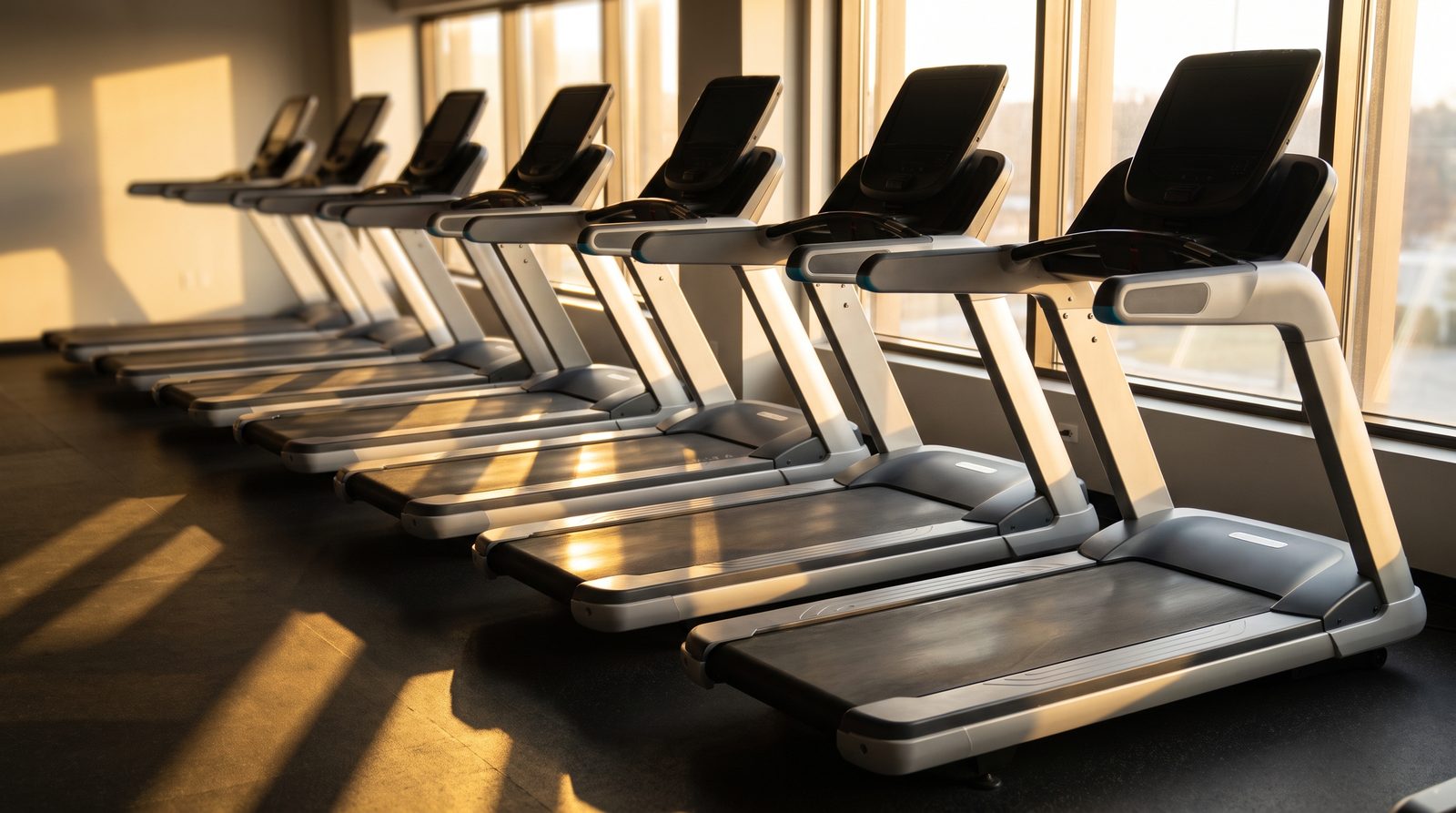
One number, twenty different answers to it
When you press 6.5, you are not telling the belt how fast to move. You are handing the machine a target. Working out how to hit it is the machine's own job, and that is where the machines part company.
They do not even agree on how to watch themselves. Some count how fast a part underneath is turning. Some never look at the belt at all and work the speed out from the power going to the motor. Whatever they count, they turn it into a display number using figures stored in memory. Those figures differ from one model to the next.
Think of twenty people told to walk at a brisk pace. They all heard the same instruction and they are all trying. You would still not bet on any two of them matching. The instruction was shared. The interpretation was not.
Every machine in the room also has its own history: the miles it has carried, how long since anyone opened it, and whether a part was replaced and which settings got entered afterwards.
Nobody in the room checks the number
You would assume somebody checks. A studio sells those numbers, so verifying them looks like basic housekeeping.
We read one maker's full service manual for a commercial machine. That includes a preventive maintenance schedule running weekly, monthly, quarterly, twice yearly and yearly across every part of the machine. Not one item at any interval checks the displayed speed against anything. The only calibration procedure in the entire manual is for the touchscreen.
Another maker publishes its treadmill maintenance schedule openly. Monthly is cleaning and safety. Once a year, it says to check that the speed sensor is working. That asks whether the sensor is firing. Whether the number it produces is true is a different question.
What a documented service schedule covers
Drawn from two manufacturers' own published maintenance programs for commercial treadmills.
Scheduled and written down
- Cleaning and safety checks
- Belt tension and belt tracking
- Drive belt tension
- Roller and deck inspection
- That the speed sensor is working
Never scheduled, at any interval
- Whether the speed on the display is the speed of the belt
Sorted from the two service documents listed at the foot of this page. A machine can pass every item on the left for years while the number on its display drifts, because no item on the left is looking at that number.
So a machine can be genuinely well maintained and still report a speed nobody has ever verified. Well maintained and accurate are two different claims, and only one of them is on the schedule.
How far apart can two machines be?
Two published figures give the honest shape of it, and neither one describes the machine under your feet.
The one speed tolerance we could find from any maker in writing is plus or minus 5%, and it belongs to a home machine rather than a studio one. Being built for a studio does not tighten it. How sturdily a machine is built and how accurately it displays speed are two separate grades. A studio machine can carry the first without the second.
Laboratory work measured belt speed on four types of treadmill and found it running between 98 and 103% of the speed it had been commanded.
What a called 6.5 could actually be
The two published ranges, converted to the pace you would be running.
A manufacturer's own published tolerance, plus or minus 5%
Measured in the laboratory across four treadmill types, 98 to 103%
A called 6.5 mph is a 9:14 mile if the belt is honest. The upper band is one maker's published tolerance for a home machine, not a rating for studio equipment. The lower band comes from four treadmill types measured in a laboratory, one of them documented as heavily worn. It describes how far belt speed sat from the commanded speed, not how far two machines in one room sit from each other.
The study everybody would want does not exist
The obvious experiment is to set twenty identical running treadmills in one room to the same speed and measure all of them. Nobody has published that test on gym or studio machines, as far as we can find.
The spread in your studio has never been published, and anyone who quotes you a figure for it is guessing.
What we have measured ourselves
On a treadmill I measure regularly, a run finished with the display reading 2.3 miles when the belt had carried 2.0. On a different machine I use, the display read 5 miles for a run that was really 4, so I definitely under-ran my marathon training. Put those two side by side in a class and the runners on them get the same number and very different workouts.
What it costs you in the room
The real cost arrives after class. A class speed feels like a benchmark, so it travels. You tell yourself you hold 6.5 comfortably now, and you plan a race around it. What you actually hold is whatever the belt in position 14 was doing.
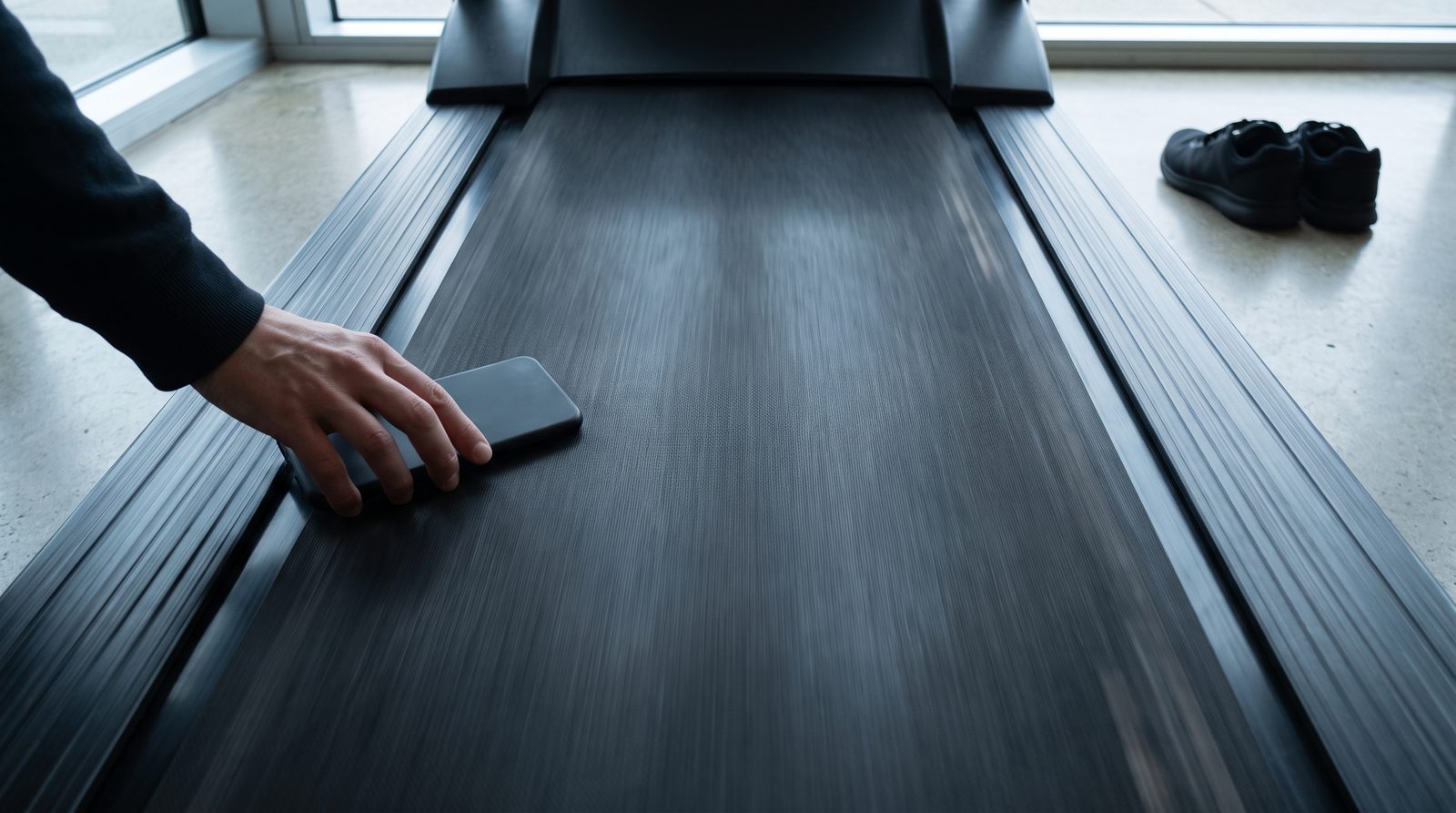
How to find out what your machine is doing
You can work it out with a stopwatch. Find a scuff already on the belt, measure the loop, then time a set number of passes. It costs nothing and takes a slow ten minutes, and a studio class is the worst place to try it.
Get to class early, start the belt at the speed the instructor tends to call, and let an iPhone Pro watch it for a few seconds. Treadwell reads the belt itself, not the display, so the answer owes nothing to what the machine believes about itself. If your studio lets you book a tread, measure the one you book. If not, measure the one you land on and note the number beside its position. At the speed the class lives at, that number becomes a pace you can trust.
Find out what your machine really gives you
Treadwell measures your treadmill's real belt speed in seconds, so a called speed becomes a pace you can actually use. Requires an iPhone Pro with LiDAR.
Quick answers
Do all the treadmills in a class run the same speed? They almost certainly do not, and nothing in the room can tell you by how much. Each machine converts the number you press into belt motion using its own sensing hardware, its own stored settings and its own service history. The called speed is the request every machine received, not proof they answered it the same way.
Why do two treadmills at the same speed feel different? Some of it is the machine underneath you, including deck give and belt friction. Some of it is that the belts are not actually running the same speed. Feel cannot separate the two, which is why a runner who is sure they are working harder at the same number may well be right and has no way to prove it from the display.
Does a gym check whether its treadmills show the right speed? The documented schedules do not ask. We read one maker's full service manual for a commercial machine and found no item at any interval that checks displayed speed against a reference. Another maker's published schedule checks that the speed sensor is working once a year, which asks whether it is firing rather than whether the number is right.
How far apart can two treadmills set to the same speed be? One maker publishes a speed tolerance of plus or minus 5% on a home machine, which at a called 6.5 mph spans roughly 8:47 to 9:43 per mile. Laboratory work across four treadmill types measured belt speeds between 98 and 103% of the commanded speed. Neither figure describes the specific machine under your feet.
Sources.
- A full preventive maintenance schedule running weekly through yearly across every subsystem, containing no item that verifies displayed or belt speed, and carrying touchscreen input calibration as its only calibration procedure: Life Fitness 95T Elevation Series treadmill service manual (M051-00K65-A003). We read the whole document rather than a summary of it.
- That a controller can work the motor's speed out from the electrical currents driving it so that a speed sensor is not required: the same 95T Elevation service manual. This describes that machine's design, not treadmills in general.
- A published maintenance schedule whose only speed-related item is an annual check that the speed sensor is functioning: Precor, Cardio Equipment Care, Maintenance Schedule for Treadmills (CS-1897, 2022). A function check asks whether the sensor works, which the document does not describe as an accuracy check.
- A published speed tolerance of plus or minus 5% across the machine's speed range: Technogym MyRun technical specifications. MyRun is a compact home machine rather than group-fitness equipment, so this figure is not a rating for studio treadmills. It was the only published speed tolerance we could find from any maker.
- Stored per-model values converting roller rotation into displayed speed, differing between models in one maker's own range, with that maker's warning that improper values can create inaccurate speeds: Horizon Fitness Elite Series service manual (2005). It is a service setting and never something an owner adjusts.
- Belt speeds between 98 and 103% of the target speed across four treadmill types: Willwacher et al., Scientific Reports 11:2244 (2021). Two of the four were laboratory instrumented machines rather than ordinary gym treadmills, one of the four is documented as heavily worn, and the study measured departure from the commanded speed rather than differences between machines standing in one room.
- Usage classes, which include a studio class, and display accuracy classes defined as separate classifications, so a machine built for studio use is not thereby a high-accuracy machine: ISO 20957-1:2024, clause 4. The numeric tolerance behind each accuracy class sits in a further part of the standard that is not publicly readable, so no percentage is quoted from it here.
- We could not find any published study measuring a set of nominally identical running treadmills in a gym or studio setting against each other. The closest work we found compared two same-model units chosen for their differences, on a treadmill built for wheelchair use. The absence is stated as an absence, not as evidence that the spread is small.
- Our 2.3-mile display against a belt that had carried 2.0 is a test of ours, run on a machine we return to often. Its grade comes from that treadmill's standing tachometer table, not from a tachometer reading taken the same day.
- The 5-mile display against a true 4 comes from my own training on a different machine from the one above, one I run on often. That session was never captured as a test file and its date went unrecorded, so this page claims no grading method for it. The consequence, that I under-ran my marathon training, is my own account of that block.
- Pace conversions are arithmetic on the speeds shown, rounded to the nearest second.