Guides · Belt speed under load
Does a treadmill belt slow down when you run on it?
You land hard midway through a tempo and the belt gives, just for a beat, before it is back at pace. You have felt that a hundred times and never known whether the machine lost speed or your legs did.
Yes. The belt loses speed on every footfall and the motor pulls it back before your next stride, so on a healthy machine the average across the stride stays within a few percent of the number you set.
Your foot is a brake
When your foot lands out in front of you, it is not yet moving backward as fast as the belt is. For the first part of the step it is dragging against the surface instead of riding it. You are braking. That happens two or three times a second for the whole run, and the machine has to absorb every one of them.
The motor absorbs them easily, because it is far stronger than you are pushing. It holds the belt turning at a set rate and simply leans in harder when something loads it. Your foot wins for a fraction of a second, then the motor takes the speed back before your other foot arrives.
Cruise control does the same thing on a rolling road. You hit a rise, the car sags a mile an hour, the engine leans in, and you are back at speed before you notice. The dip was completely real. The difference is that your car is watching its own wheels, so the speedometer would show you the sag. Every treadmill manual we have read is silent about that top surface, the strip actually carrying your weight. The number on the screen holds perfectly still through every one of those dips, because nothing down there is reporting back.
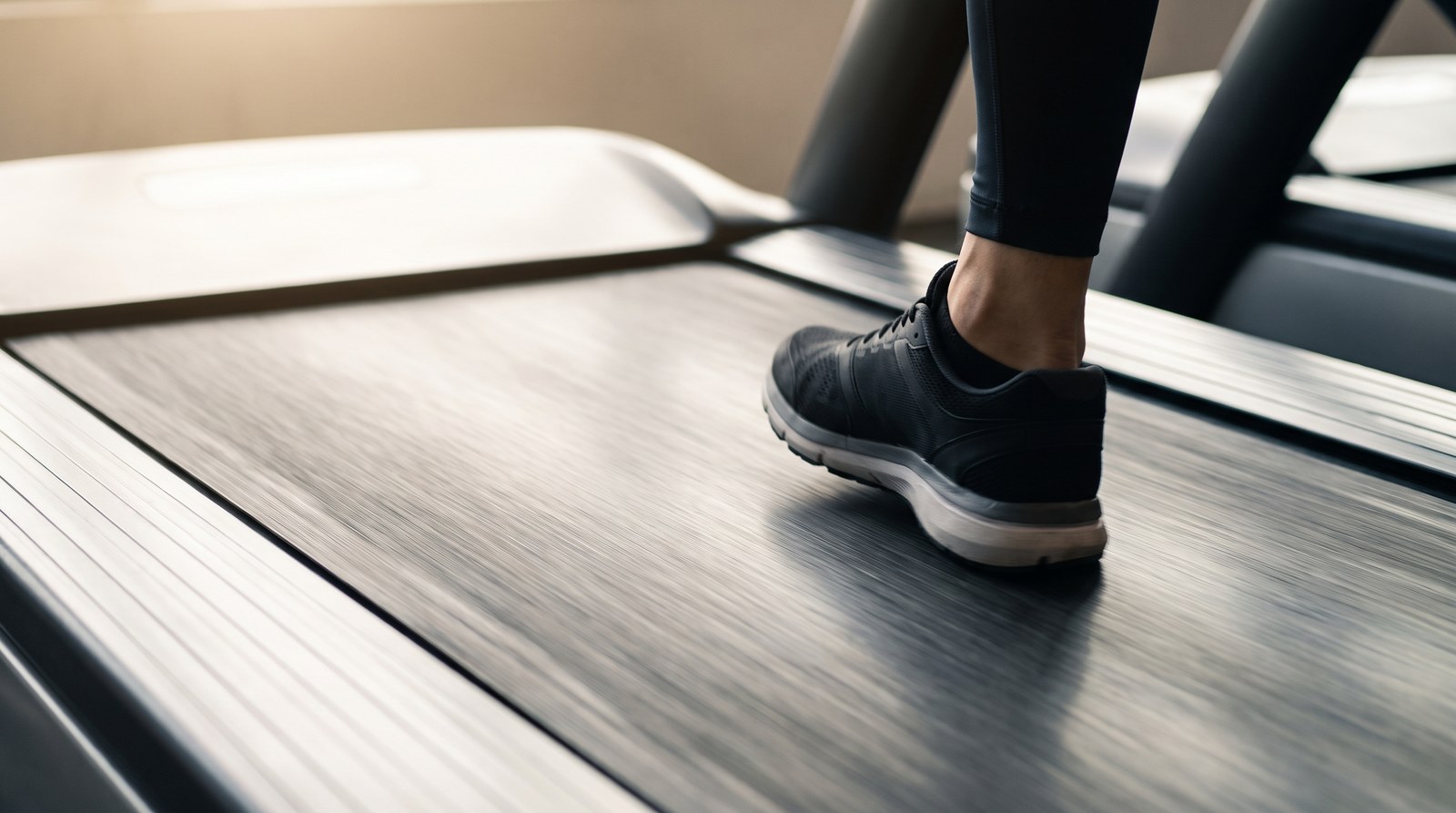
How deep the dip actually goes
Researchers have measured this directly. A study that instrumented four treadmills found the belt dropping somewhere between about 4 and 17 percent below the target speed during the braking part of a footfall. The deepest of those came off a worn machine. Read on its own that 17 percent sounds ruinous.
It is not, and the same study says why. Across the full stride, averaged over the dip and the recovery together, the belt speed on those machines sat within a few percent of the target while people were running on them. The motor gives back within one stride almost everything your foot took.
One footfall, on a machine set to 6.0 miles per hour
The dip is deep and short. The stride average is what your distance is built from.
The two dip depths are the 4.2 and 16.6 percent figures from the study applied to a 6.0 setting. The stride average shown is 99 percent of target, toward the low end of the range the study reported. Bar lengths are proportional to speed, measured from zero.
So if your pace is further out than that, the dip under your feet is not where it went. That matters, because the dip is the explanation runners reach for first. It is the one you can feel, and feeling it makes it convincing. A belt whose speed is wrong all the way through is the far bigger problem, and that one you cannot feel at all.
When the dip stops recovering
Sometimes the dip is not physics. If the belt keeps giving under you instead of snapping back, that is wear. A deck worn smooth or a belt underside gone glassy lets the belt skate under your foot, and the same wear is what puts a machine's top speed out of reach. Speed that wanders up and down on its own is a separate fault, and that one comes from belt tension.
That gives you three tells, and you can check all of them without opening anything.
- The belt skates under your foot. The slip arrives with your weight, not as a dip you had time to see coming.
- The top end has gone. The machine will not hold the speed it used to hold, or will not reach it at all. That travels with the slipping, because the same worn surfaces cause both.
- The speed wanders on its own. The belt drifts up and down while the number on the screen sits still. That points somewhere else, at the tension rather than the surfaces.
Your part ends at spotting it. A running belt sits under real tension with a lot of torque behind it, and getting that wrong damages the deck or the motor. If you own the machine, its manual covers what is yours to adjust. If it lives in a gym, the fault belongs to whoever services it, and reporting it is useful to them because these causes get worse and cost more the longer they run.
The error you cannot feel
A slipping belt and a slow belt fail in opposite directions. A machine that slips announces itself, and now you know its three tells. Nothing announces the machine that is quietly five percent slow, and that is the one that reshapes a training block. Run a ten mile week on it. You banked nine and a half, and not one session felt wrong while you did it.
The dip nudges your stride average. A slow belt moves every mile you run.
Your watch will not close the gap either, because indoors it is estimating your stride rather than reading the ground. That fight has a guide of its own.
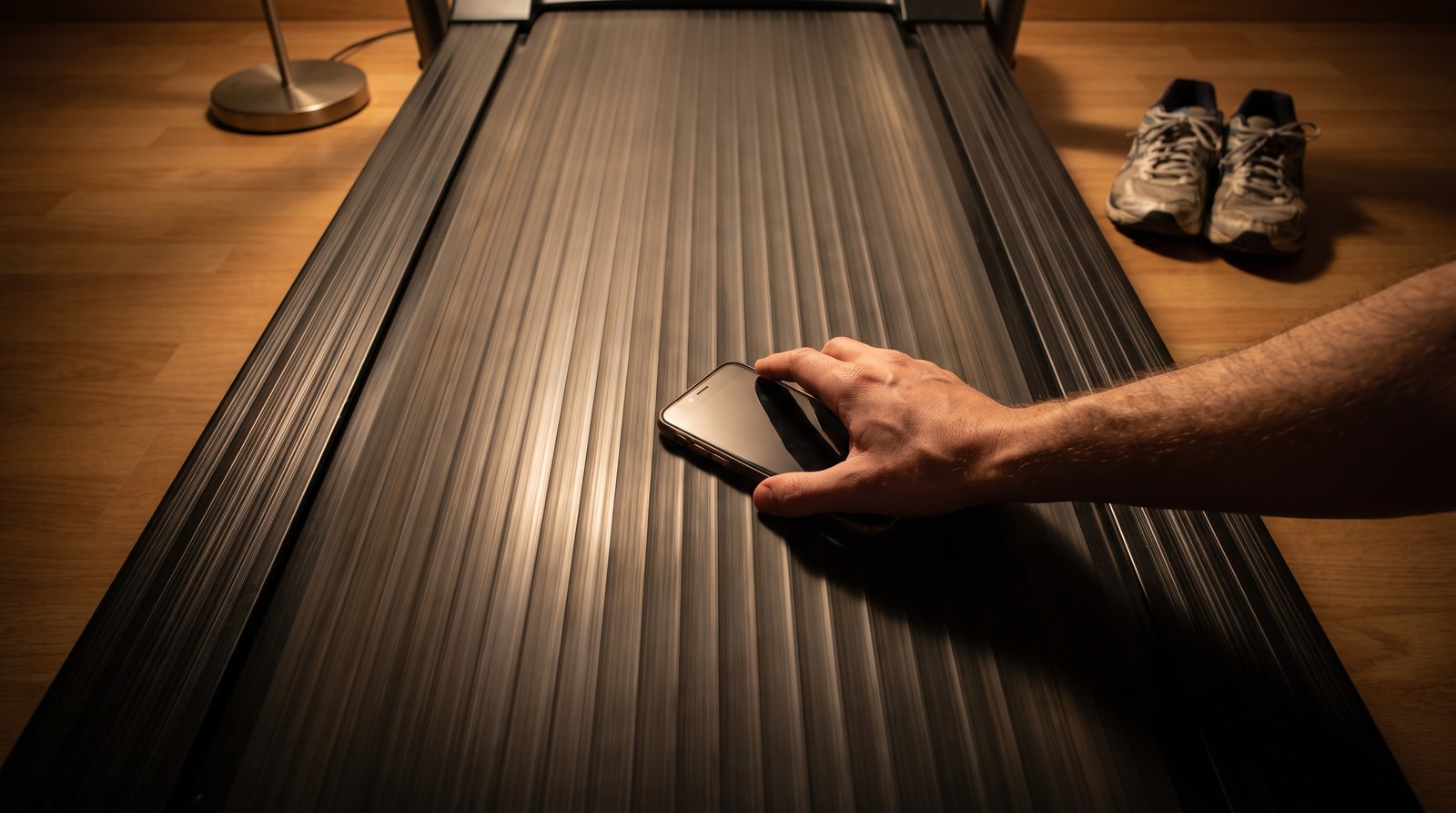
Treadwell answers the question this whole page circles, which is what the belt is actually doing. Its camera and LiDAR sensor measure the moving surface itself, from an iPhone Pro held above it for a few seconds, and hand back the pace and the distance that surface earned you. Your stride never enters the calculation and neither does your watch. When the read is not clean, the app says so rather than inventing a number.
Treadwell reads the belt with nobody standing on it. With you on it the belt dips and recovers around that number, and in the study that measured it the stride average landed within a few percent of the setting, some a little above and some a little below. The reading itself we have checked. Ours held to within half a percent of a handheld tachometer on a hotel machine it had never been calibrated for.
Measure the belt, not the number on it
The belt's real speed in a few seconds, without stepping on it. Treadwell needs an iPhone Pro.
Quick answers
Does a treadmill belt slow down when you run on it? Yes, briefly, every time a foot lands. Your foot arrives moving slower than the belt and drags on it, and the motor pulls the belt back up to speed before your next stride. On a healthy machine the average speed across a full stride stays close to the number you set.
How much does a treadmill belt slow down under a runner? A laboratory study that measured four treadmills found the belt dipping between about 4 and 17 percent below the target speed during the braking part of each footfall, with the deepest dip on a worn machine. Across the whole stride the average speed on those machines still sat within a few percent of the target.
Why does my treadmill belt feel like it slips when I run? A dip that does not recover is wear rather than physics. A belt that skates under your foot, on a machine that no longer reaches its top speed, points to a worn deck or a glazed belt underside. Speed that wanders up and down on its own is a separate fault and points to belt tension. Either way, that is work for the machine's manual or a technician, not for you.
Does the belt dipping under my feet make my treadmill distance wrong? Hardly at all on a healthy machine. The dip lasts a fraction of a second and the motor returns the speed within the same stride, so it barely moves the stride average your distance is built from. The error worth chasing is a belt that runs slow the whole way through, because that one compounds over every mile and never announces itself.
Sources.
- The dip depths and the stride averages come from Willwacher et al., Scientific Reports 11:2244 (2021), which measured belt speed directly on four treadmills. Braking-phase speed ran 4.2 to 16.6 percent below target and average belt speed ran 98 to 103 percent of target. Those four machines were measured in a laboratory in known condition, and two of them were research treadmills built for force measurement rather than ordinary gym machines. The deepest dip came from a worn unit. Do not read the range as a survey of gym equipment.
- That a motor holds its commanded speed rather than sagging under drag is manufacturer documentation, not our inference. The Precor Experience Series service manual explains that its drive controls speed by frequency, which is also why it states that design needs no speed sensor. We scope that to those bases rather than to the brand.
- A striding belt that slips during footfall, and a machine whose maximum speed is reduced, are two separate symptom entries in Life Fitness service documentation that share one cause: the deck laminate worn through, or the underside of the striding belt glazed over. The same wording appears in two of its documents, the 95T service manual and the 97Ti, 95Ti, 93T and 97Te technical manual. Horizon's troubleshooting documents a different symptom, erratic speed, with its own separate causes in the running belt tension and the drive belt tension. These are two manufacturers' two documented pictures rather than one shared list, and the page keeps them apart for that reason.
- That these faults are known and progressive rather than freak failures comes from the manufacturers' own documentation. The Life Fitness T5 owner's manual treats belt stretch and slipping under normal use as expected maintenance, and the Precor Experience Series service manual logs advanced wear as a named fault whose remedy is replacing the belt and deck. We do not publish the adjustment procedures that follow those passages.
- The manuals we hold place every sensor they document on a roller or a motor shaft, and none of them describes anything watching the belt's upper surface. That absence is what we are reporting, and no manufacturer makes a claim either way.
- The half a percent above is our own reading's accuracy, not the machine's, and it is the conservative way of stating it. The measured figures were tighter: on a hotel treadmill the app had never been calibrated for, three readings across two speeds all sat within 0.4 percent of a same-day handheld tachometer.
- The five percent belt and the ten mile week are an illustrative example. They are arithmetic, not a machine we measured.
- The bar figure applies the study's two published dip percentages, and a stride average toward the low end of its published range, to a 6.0 mile per hour setting. It draws the shape of a single footfall, and no real machine was measured to make it.