Guides · Marathon training on a treadmill only
Marathon training on a treadmill only this winter? Check the belt first
Boston is Monday, April 19, 2027. Count back 18 weeks and week one lands in mid-December. If dark evenings and bad footing keep you indoors, the whole spring gets built on one treadmill.
Yes, you can do your marathon training on a treadmill only, even all winter. The whole block then runs on one belt. The display shows the speed you set, and as far as I can find, nothing on the machine checks it against that belt. Check that belt before week one.
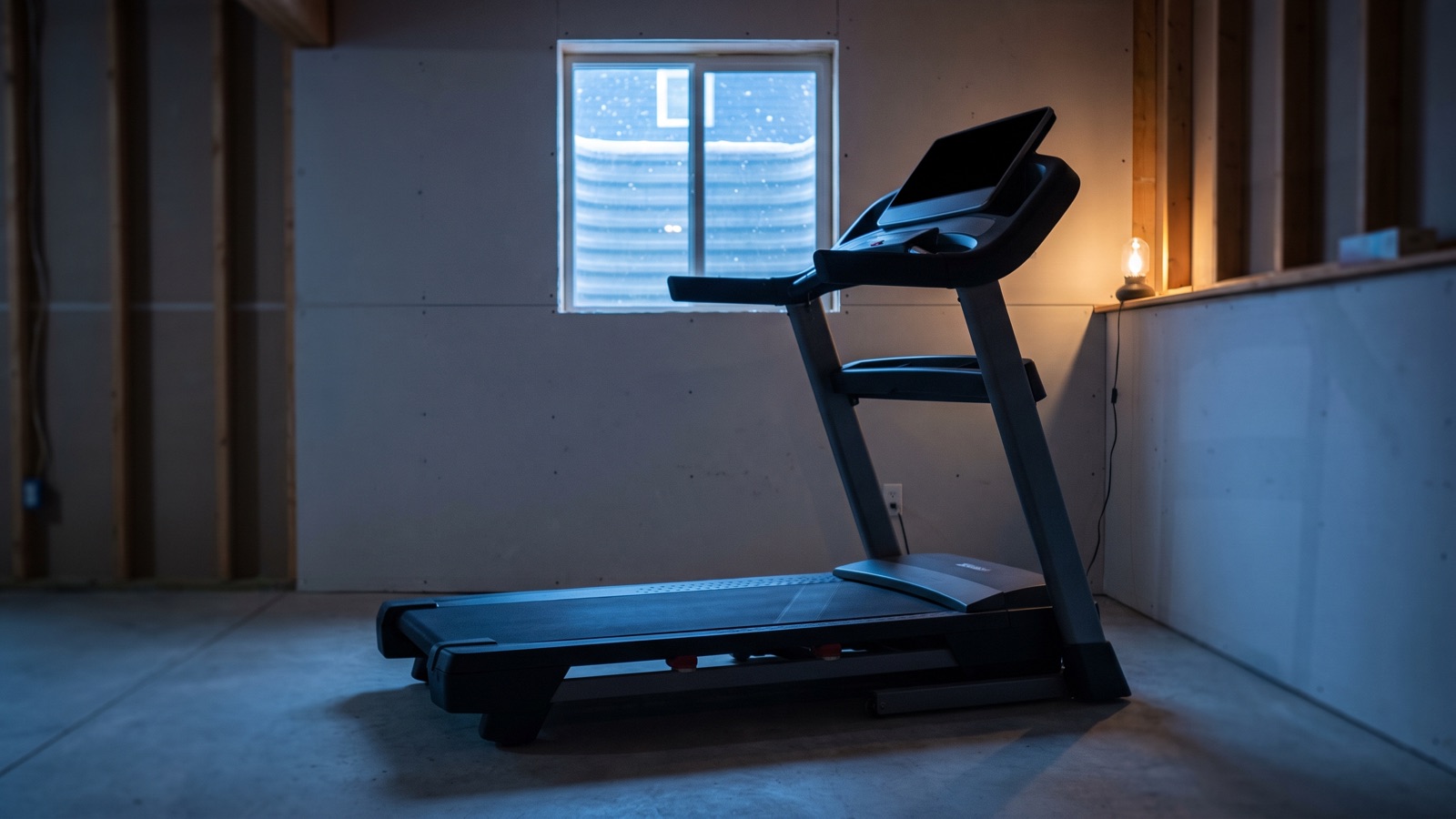
A treadmill-only block runs on one machine
A treadmill-only block puts every kind of run on the same belt. Your easy days, your long runs and your marathon pace sessions all happen at speeds that one machine says it is holding. The goal you pick in the spring comes from that machine too, because you pick it from those sessions.
The effort side of indoor training is already settled. In a study of trained male runners, a 1 percent incline made up for the air they were not pushing through. The guides on marathon pace on a treadmill and treadmill pace vs road pace cover that, along with the speed to set for each goal. Neither one can tell you what this winter's belt is doing, and a treadmill-only block leans on that belt for four months.
Why the block can never catch its own belt
Every run in a treadmill-only block gets graded by the same display. The display shows the speed you set. As far as I can find, no part of the treadmill ever holds that number up against the moving belt under you.
Think of a home barbell stamped 45 pounds. You can lift it three times a week all winter and never learn what it really weighs, because every lift gets counted against the stamp. Your numbers climb, and the progress looks clean. The first time those numbers meet a weight you know for certain is the day that counts.
Race morning is the first time your training meets a distance nobody chose on a dial. Big races like Boston and London run on officially measured courses, so the 26.2 miles are fixed before you get there. Whatever the belt did all winter, the course is where it shows.
What one belt's error does to a whole block
One belt's error moves every kind of run in the block by the same share, so none of them looks wrong next to the others. Take a runner whose plan calls for easy runs at 6.0, long runs at 6.5 and marathon pace at 7.2.
One week of a winter block, if the belt is true, 2 percent slow, or 2 percent fast
Each row keeps one setting, and only the belt changes from column to column. The numbers are illustrative arithmetic, not a reading from a machine I measured.
| Run | Setting (mph) | Display says | Real pace, belt 2% slow | Real pace, belt 2% fast |
|---|---|---|---|---|
| Easy | 6.0 | 10:00 | 10:12 | 9:48 |
| Long run | 6.5 | 9:14 | 9:25 | 9:03 |
| Marathon pace | 7.2 | 8:20 | 8:30 | 8:10 |
Paces are minutes per mile. The gap between easy and marathon pace is 1:40 on the display, 1:42 on the slow belt and 1:38 on the fast one.
Read across any row and the pace moves. Read down any column and the gaps between the three runs barely change. Your easy days still feel easy next to your marathon pace days, and the week looks just the way the plan wrote it. Nothing inside the block has a reason to look off.
On the slow belt, every marathon pace session was really 8:30, and the goal you choose in March still rests on the 8:20 the display showed you.
A gap of 2 percent sits inside what a lab study found on four treadmills, where belts averaged anywhere from 98 to 103 percent of their set speed. For the distance side, read what a small error costs over a long run. The one on treadmill time trials shows how a race goal gets built from a pace.
When to check the belt in a winter block
Check the belt in week one, before your first long run, so the whole log starts from a known speed. Run that check at your marathon pace setting, since that is the number your goal rests on. Then check again in the week you settle on a goal pace, because one check in December cannot speak for a belt you use until April.
Any time the block moves to another treadmill, whether that is a new gym, a holiday with family or a hotel on a work trip, check that belt too. A new belt brings its own error, and the guide on treadmill 800m repeats explains why what you learned on one machine does not carry over.
Start the block on a belt you have measured
Treadwell gives you that check without trusting the display at all. Set your marathon pace speed with nobody on the belt, and the app measures how fast that belt is really moving through an iPhone Pro's camera and LiDAR sensor. Do it in week one on the treadmill you will live on until April, and every session after that starts from a pace you actually know.
Know your belt before week one
Find out what your treadmill's belt really runs at your marathon pace setting, before the block starts. Treadwell needs an iPhone Pro with LiDAR.
 Scan with your iPhone Pro to get the app
Tested: in our tachometer tests the app read within about 2 percent of true belt speed.
Quick answers
Can you do marathon training on a treadmill only? Yes, you can do your marathon training on a treadmill only, even all winter. The whole block then runs on one belt. The display shows the speed you set, and as far as I can find, nothing on the machine checks it against that belt. Check that belt before week one.
Do I need to check the treadmill again partway through the block? Yes, once more in the week you choose your goal pace. A single check tells you what the belt did on that day. A block runs about four months, and a goal picked near the end deserves a reading from near the end.
What if I split my marathon block between two treadmills? Treat them as two separate machines. Each belt carries its own error, so a session on one does not compare cleanly with a session on the other. Check both, and note in your log which machine each run was on.
Sources.
- Race dates come from the organisers. The Boston Athletic Association's 2027 registration news gives Monday, April 19, 2027. London Marathon Events gives 24 and 25 April 2027. The 18 weeks is an example plan length, counted back from the Boston date.
- Measured courses: World Athletics Label Road Races Regulations (Book C, C1.6, approved by Council 21 July 2026, effective 3 August 2026), clause 10.2, requires every label race course to hold an international measurement certificate valid through race day. The World Athletics label calendar lists both the Boston Marathon and the London Marathon for 2026.
- The 1 percent incline figure comes from Jones AM and Doust JH (Journal of Sports Sciences 14(4):321-327, 1996), a study of trained male runners.
- What the display reports is my reading of the treadmill service manuals I could reach. Their speed sensing sits at the motor or a roller, or there is none at all, and none of them reads the running surface of the belt. That covers those manuals, not every treadmill sold.
- Belt speeds of 98 to 103 percent of the setting come from Willwacher et al. (Scientific Reports 11:2244, 2021), a study of seven people on four lab treadmills, two of them built for force research.
- The three settings and the 2 percent gaps in the table are illustrative arithmetic chosen to sit inside that range, not readings from a machine I measured.