Guides · Treadmill pace vs road pace
Treadmill pace vs road pace: why the same effort feels different
You run 9:00 pace on the road and it feels like work. You set the belt to the same 9:00 and your legs ask what the problem is. Some days it flips, and the belt feels brutal at a speed you cruise outside. Two separate things cause that, and a pace conversion only handles one of them.

Quick answers
Is treadmill pace the same as road pace? No. At the same speed, running indoors costs you less energy than running outdoors, because there is no air to push through. A 1996 study in the Journal of Sports Sciences found that a 1% treadmill grade made the energy cost of the two match for paces between about 5:22 and 9:11 per mile.
Should I run at 1% incline on a treadmill? If you run faster than about 9:11 per mile, 1% is a fair way to match flat road effort. Slower than that, air resistance barely matters, so a flat belt is fine. The rule came from trained male runners at 5-minute efforts, so treat it as a good default rather than a law.
Why does the treadmill feel harder if it takes less energy? Cooling is a large part of it. Running outdoors you generate your own wind, and a 2024 wind tunnel study of 14 participants found that this self-generated cooling does not carry over to an indoor treadmill. You make the same heat on the belt with less moving air to take it away.
Does a treadmill pace conversion make my numbers accurate? No. A conversion adjusts for effort. It cannot check the belt. If the belt is moving slower than the display claims, the converted pace carries that error straight through.
How do I find my real treadmill pace? Measure the belt itself. The display reports the speed the motor was told to hold, not the speed the belt is really moving, so the only honest number comes from measuring the belt directly.
What the air is doing to you outside
Every step you take outdoors pushes a small wall of air out of the way. You never notice it on a calm day, but your body pays for it the whole run. On a treadmill that cost disappears. The air in the room is standing still, so there is nothing to push.
Researchers put a number on it in 1996. Nine trained male runners ran six different speeds, from about 9:11 per mile down to about 5:22 per mile, on a treadmill at several inclines and on a level road outdoors. A 1% treadmill grade made the energy cost of the belt match the energy cost of the road across that whole range.
That is where the 1% rule comes from, and it holds up. It applies to a specific band of paces, though, so find yours.
What to set, by the pace you actually run
Belt speed, the pace it works out to, and whether the 1% rule was tested there.
| Belt speed | Pace per mile | Set the incline to |
|---|---|---|
| 5.0 mph | 12:00 | Flat is fine, you move too little air to matter |
| 6.0 mph | 10:00 | Flat is fine |
| 7.0 mph | 8:34 | 1% |
| 8.0 mph | 7:30 | 1% |
| 10.0 mph | 6:00 | 1% |
| 12.0 mph | 5:00 | 1% is reasonable, though it is faster than the study measured |
The tested band was 5:22 to 9:11 per mile, using trained male runners over efforts of about 5 minutes. Every pace in this table assumes the belt speed is real, which is the second half of this article.
Why it still feels harder some days
Less energy on paper does not mean easier in the moment. Running outdoors, you generate your own wind, and that moving air cools you. A 2024 wind tunnel study of 14 participants found that this self-generated cooling is a real benefit of running outdoors, and that it does not carry over to an indoor treadmill. You are producing the same heat on the belt with less air to carry it away.
The belt also holds you to one exact speed. Outdoors your pace drifts constantly. You surge past a light, you ease off up a rise, you let a downhill give some back. A treadmill removes every one of those small dips, so holding 9:00 on a belt means holding it evenly for the entire run, which is a different job from averaging 9:00 on the road.
The same speed, two different runs
Why the belt can cost less energy and still feel worse.
Easier indoors
- No air to push through
- No hills unless you add them
- No wind, no rough footing, no stops
Harder indoors
- No self-generated wind, so less cooling
- One exact speed held for the whole run, with no natural drift
- No changing terrain, weather or scenery
A 1% incline answers the left column. Nothing on the right column is fixed by a number.
The conversion everyone uses, and what it assumes
Pace conversion charts all work the same way. You give them a treadmill speed and an incline, and they hand back a road-equivalent pace. They are useful, and the math behind them is sound.
Every one of them assumes the speed you typed in is true.
That assumption is the weak link. The number on your treadmill is a command sent to the motor rather than a reading taken off the belt. Your machine may not be watching the belt at all. Precor's own service documentation states that its motor control design means there is no need for a speed sensor.
A well-maintained machine follows that command closely. A 2021 study in Scientific Reports measured four treadmills and found average belt speeds running between 98% and 103% of the set speed. Even a machine in that good range hands you a pace that is a little off, and nothing on the display tells you which way. Those four treadmills were also the good case, in known condition and measured by researchers in a lab.
What a small error does to your converted pace
A runner sets 6.0 mph for a tempo mile on a machine running 2% slow, which published testing puts in the good range.
This is an illustrative example, not a logged test. The plan called for a 10:00 tempo mile, so that workout never happened at the pace it was written for, on a machine nobody would call broken.
Converting that 10:00 to a road-equivalent pace does not help. The conversion is careful arithmetic performed on a number that was wrong before it started. Machines further out than 2% exist, and we have measured some of them.
What we found when we measured
We check treadmills with a handheld contact tachometer, a tool that reads the belt's true surface speed directly instead of asking the machine what it thinks. Where a machine already has a tachometer speed table we built for it, we check against that.
On one machine, the display claimed 2.3 miles for a run that was really 2.0, which is 15% of that run credited to a runner who never covered it. The next day, the same machine read 5.6 miles against a real 5.0, and an Apple Watch on the runner's wrist agreed with the display rather than catching it. Indoors a watch has no GPS to check against, so agreement between the two proves nothing.
Some machines are honest. The 2021 study found its four treadmills inside a few percent of their set speeds. Nobody audits gym equipment, so how common that is across every gym is not a number anyone can give you. The problem is that an honest machine and a machine 15% out show you the same confident number, so there is no bias you can learn and subtract. The treadmill you use tomorrow is a fresh question.
How to compare the two honestly
Four options, from the least effort to the most useful.
- Match your effort and let the number go. Run by feel or heart rate and stop converting anything. This is free and it works. It also leaves you with no pace data to train against.
- Add 1% and accept the rest. A sound habit at faster paces. It settles the air resistance question and leaves the belt question untouched.
- Count belt revolutions. Measure the belt's loop length, pick a mark already on it, and count laps for 60 seconds. Length times revolutions gives you true speed. It works, and you are counting belt laps with a stopwatch instead of running. The full method is here.
- Measure it with your phone. A few seconds, on any machine, including one at a gym you have never used.
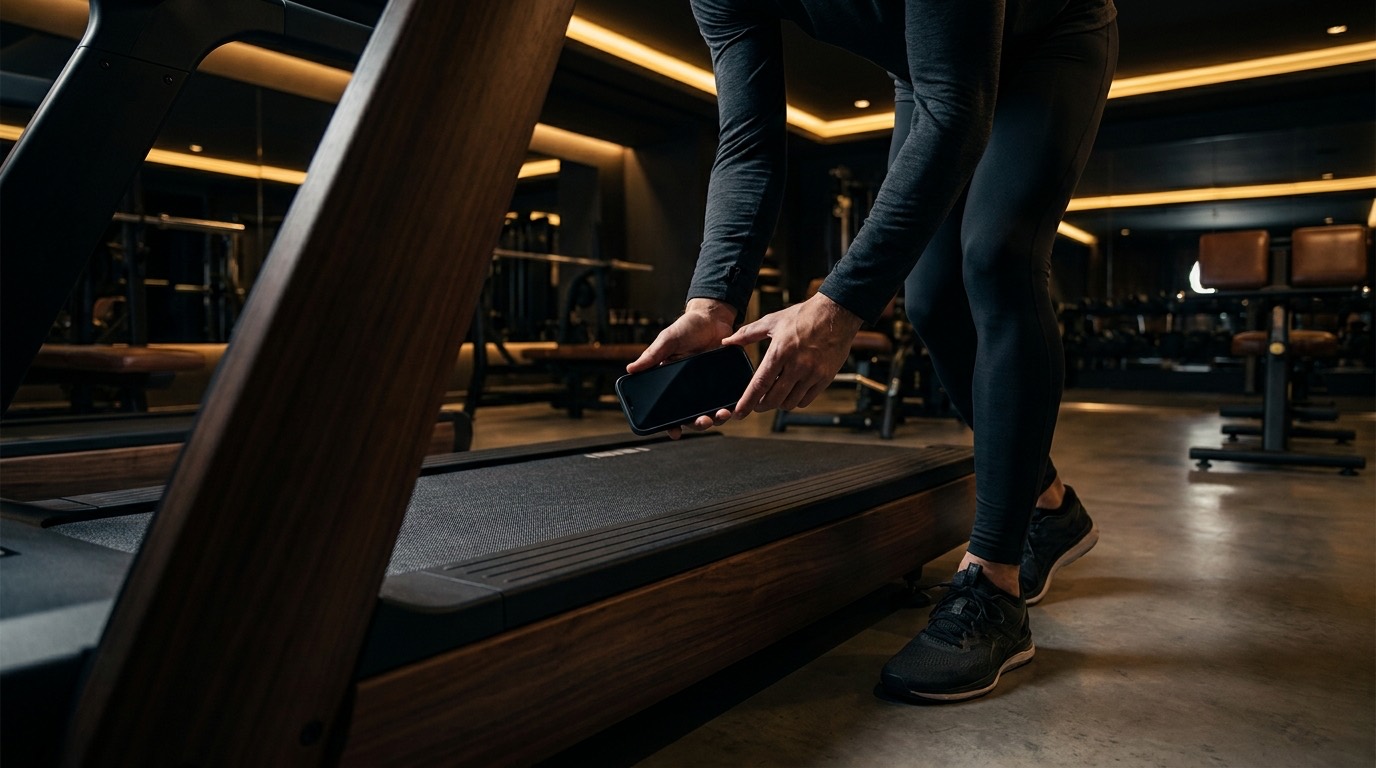
Treadwell reads the belt's real speed through your iPhone's camera and LiDAR sensor. You hold the phone over the moving belt from beside the machine and it measures the belt directly. It does not read the display, and it does not watch your stride. We took it to a hotel treadmill it had never seen, with no calibration for that machine, and its reading landed within half a percent of a handheld tachometer. If it cannot get a reading it trusts, it tells you so rather than showing you a number it made up. It needs an iPhone Pro, because those carry the LiDAR sensor it measures with.
Know what your indoor paces actually mean
Measure any treadmill's true speed in seconds, with just your iPhone.
Set the incline, then check the number
Put the belt at 1% if you are running faster than about 9:11 per mile. That squares the effort against the road, and it is the part of this that a rule of thumb can fix.
Then find out what your belt is really doing, because effort was only half the gap. Once the speed is real, your indoor paces finally mean the same thing as your outdoor ones, and a mile in your log is a mile either way.
Sources.
- The 1% grade finding and its tested speed range: Jones AM and Doust JH, "A 1% treadmill grade most accurately reflects the energetic cost of outdoor running," Journal of Sports Sciences 14(4):321-327 (1996). Nine trained male runners at speeds from 2.92 to 5.0 metres per second.
- Self-generated wind cooling you outdoors, and that benefit not carrying over to an indoor treadmill: Yamashita N, Ly CL, Smallcombe JW, Hodder S and Havenith G, "Air speed and direction affect metabolic and thermoregulatory responses during walking and running in a temperate environment," Journal of Applied Physiology 137(3):554-568 (2024). Wind tunnel study, 14 participants.
- Belt speed against set speed: Willwacher et al., Scientific Reports 11:2244 (2021). Four treadmills, average belt speeds 98% to 103% of target.
- No speed sensor in the motor control design: Precor treadmill base service manual.
- The 2.3 against 2.0 run and the hotel treadmill result are our own tests, checked against a handheld contact tachometer on the day.
- The 5.6 against 5.0 run is our own test, checked against that machine's standing tachometer table rather than a fresh tachometer reading that day.
- The hotel treadmill figure is the accuracy of our own reading against the tachometer on a machine we had never measured before. It is not a statement about that treadmill's display.
- The 6.0 against 5.88 worked example walks through the arithmetic. Nobody ran that mile on a belt to log it.