Guides · Marathon pace on a treadmill
Marathon pace on a treadmill: what to set, and the trap in the number
Tuesday is marathon pace day and you need the number to press for 8:35 miles. That part is arithmetic, and the table below has it for every common goal. Whether the belt then runs 8:35 is the part nothing on the machine can tell you.
Divide your goal time by the marathon distance of 26.2188 miles to get your pace per mile, then set the speed that matches it. A 3:45 marathon is 8:35 miles, which is 7.0 mph, and a 4:00 marathon is 9:09 miles, which is 6.6 mph. Add a 1 percent incline if your goal pace is faster than about 9:11 per mile, the range the incline rule was tested in. That speed is a setting, and nothing I have found on any treadmill checks it against the belt, so the pace you rehearse for months may not be the pace you race.
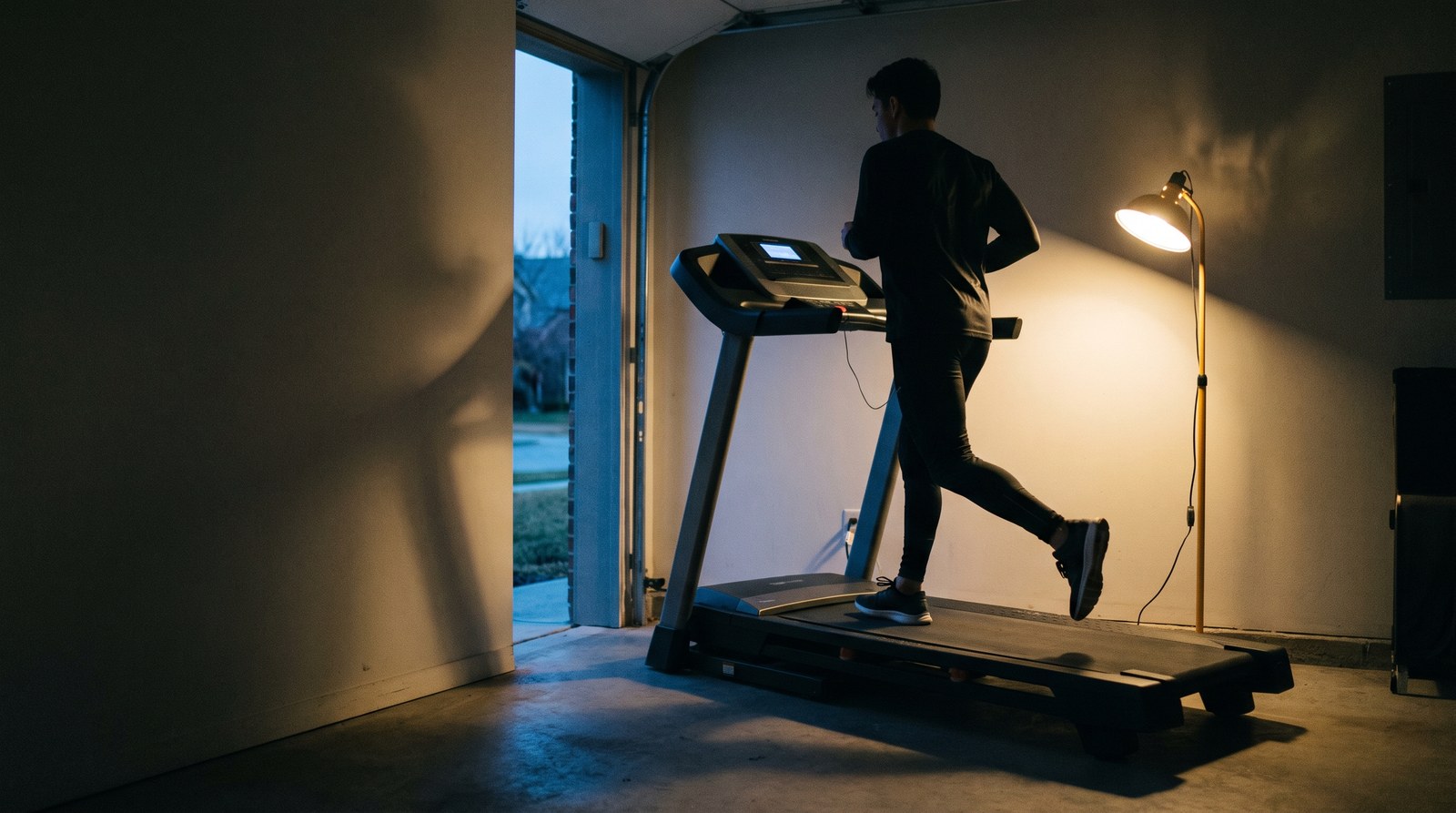
What to set
The table divides each goal time by the exact marathon distance, 26.2188 miles, because the round 26.2 tips a 4:00 goal from 9:09 to 9:10.
Marathon goal to treadmill speed
Speeds rounded to the nearest tenth. The last column shows where the 1 percent rule was actually tested.
| Goal time | Pace per mile | Speed (mph) | Speed (km/h) | Incline evidence |
|---|---|---|---|---|
| 2:45 | 6:18 | 9.5 | 15.3 | Tested |
| 3:00 | 6:52 | 8.7 | 14.1 | Tested |
| 3:15 | 7:26 | 8.1 | 13.0 | Tested |
| 3:30 | 8:01 | 7.5 | 12.1 | Tested |
| 3:45 | 8:35 | 7.0 | 11.3 | Tested |
| 4:00 | 9:09 | 6.6 | 10.5 | Tested |
| 4:15 | 9:44 | 6.2 | 9.9 | Not tested |
| 4:30 | 10:18 | 5.8 | 9.4 | Not tested |
| 5:00 | 11:27 | 5.2 | 8.4 | Not tested |
"Tested" means the pace sits inside the 5:22 to 9:11 per mile range the incline study covered. "Not tested" means the study never looked at that pace, so the 1 percent there is a convention.
A belt gives you no headwind, so any speed on it takes slightly less effort than the same speed on the road. In the study behind the 1 percent rule, nine trained male runners held paces between about 5:22 and 9:11 per mile, and a 1 percent grade brought their energy cost on the belt level with the road. Those paces cover every marathon goal from about 2:21 to four hours. Paces slower than 9:11 have not been tested, so the 1 percent there is a habit rather than a result. The treadmill pace vs road pace guide covers the effort side in full.
The incline fixes the effort. It takes the speed on trust, and 1 percent added to a 7.0 that really runs 6.8 only corrects the wrong number.
The trap in the number
The 7.0 on the display is the setting you chose, shown back to you, not a measurement of the belt. The machine drives the motor at a stored value it has filed under 7.0, and on every machine I have been able to look into, nothing checks the moving belt against that number. If the stored value is off, the display still says 7.0, every time you press it.
A singer who rehearses for months with a piano tuned a little flat learns every note a little flat, and finds out on the night, when the orchestra is in tune. A treadmill with a speed error is that piano. A stored number nobody touches has no reason to change from one session to the next, so a belt error does not average out. I checked that on one machine I train on. I put a tachometer on its belt at three speeds, then again nine days later, and none of the three had moved more than 0.6 percent. One machine is an example rather than a rule. On that one, the error repeated.
If your belt runs 3 percent slow, every 8:35 rehearsal happened at 8:50, and race morning at a real 8:35 is fifteen seconds a mile faster than anything your legs have practiced. That is arithmetic on a made-up belt, not a reading I took, and a real belt can run fast instead. The slow case happens, though. One of the machines I run on said 5 miles when I had run 4, so I definitely under-ran my marathon training. Your watch cannot referee this either, since indoors it has no GPS and guesses pace from your arm swing, which the watch vs treadmill guide covers.

Know the pace you are rehearsing
The fix is to find out what the belt actually does at your marathon speed, on the machine you rehearse on. Hold an iPhone Pro with Treadwell open beside the moving belt, and its camera and LiDAR sensor clock the surface itself, so the answer comes from the belt and the display has no say in it. It needs a Pro model because only those carry the LiDAR sensor. If your 7.0 is really 6.8, you set 7.2, check the new setting the same way, and train at the pace you actually meant.
Know it before race day
Find out what your treadmill's belt really does at your goal speed, in seconds, on the machine your block runs on. Treadwell needs an iPhone Pro with LiDAR.
Quick answers
What speed is marathon pace on a treadmill? Divide your goal time by the marathon distance of 26.2188 miles to get your pace per mile, then set the speed that matches it. A 3:45 marathon is 8:35 miles, which is 7.0 mph, and a 4:00 marathon is 9:09 miles, which is 6.6 mph. Add a 1 percent incline if your goal pace is faster than about 9:11 per mile, the range the incline rule was tested in. That speed is a setting, and nothing I have found on any treadmill checks it against the belt, so the pace you rehearse for months may not be the pace you race.
Can you train for a marathon on a treadmill? Yes. An indoor block needs two things beyond the numbers you press. A 1 percent incline covers the effort difference at goal paces from about 2:21 to four hours, and a check of the belt's real speed covers the pace, because nothing on the machine confirms that the number you set is the speed the belt runs.
Should I lower the speed when I add the 1 percent incline? No. In the study behind the rule, the runners held the same speeds with the grade added, and the 1 percent alone brought the effort level with the road. Keep the speed that matches your goal pace and add the incline on top of it.
Sources.
- The incline study is Jones and Doust, "A 1% treadmill grade most accurately reflects the energetic cost of outdoor running," Journal of Sports Sciences, volume 14, 1996, pages 321 to 327. It measured nine trained male runners at six speeds between roughly 5:22 and 9:11 per mile, each effort about five minutes long, on grades from 0 to 3 percent and on a flat road outside. The 1 percent grade is the one that matched the road. Paces slower than 9:11 per mile were not part of the study.
- The GPS-off, accelerometer-paced indoor run comes from the Garmin Forerunner owner's manuals for the 165, 255, 265, 955, 965 and 970. The 165 manual's Indoor Activities page says GPS is switched off and speed and distance come from the accelerometer, and all six include a Calibrating the Treadmill Distance step where you type in the distance the treadmill showed. I read those six manuals and no others.
- Apple Support article 105002, Work out with Apple Watch, which says the watch tracks movement from arm motion and its accelerometer, with GPS playing no part indoors.
- What the machine does and does not check comes from three sets of service manuals: Horizon Fitness (the 2003 to 2004 Series T20, T30 and T40, plus the RST5.6 and RCT7.6), Matrix (T3x-03 and T7xE-03) and Precor's Experience Series (TRM 885.v2, 835.v2 and 811.v2). The two Horizon generations read a sensor on the front roller pulley or an optical sensor at the motor, the Matrix manuals say the sensor wire from the motor is not used and should not be plugged in, and the Precor AC drive has no speed sensor at all. My conclusion that none of them measures the belt surface you run on is my own reading of those manuals, and it reaches no further than the manuals I could get hold of.
- The twice-checked machine is one I train on. I put a handheld tachometer on its belt at three speed settings on 28 June 2026 and did the same again on 7 July 2026, and none of the three moved more than 0.6 percent between the two dates. That is the whole of the evidence: a single machine, three settings, nine days apart.
- The 5 miles against 4 happened to me on one of the machines I run on, and what it did to my marathon block is my own account. I did not write down which machine it was or the date, so that is all I can say about it.
- The pace table is arithmetic: goal time divided by the exact marathon distance of 26.2188 miles, speeds rounded to the nearest tenth. The 3 percent example is worked arithmetic on a 7.0 setting and not something I measured on a real machine.