Guides · Why every machine feels different
Hotel and gym treadmills: why every machine feels different
You have a number you trust, and you set it without thinking. Then you travel, set that same number on the treadmill in a hotel fitness room, and the run comes out wrong. It feels quick and easy, or your legs are asking why this is so hard.
No two treadmills give you the same run at the same number, because the display shows what the machine is aiming for, not what the belt is doing. The only way to know what a strange belt is really doing is to measure it.
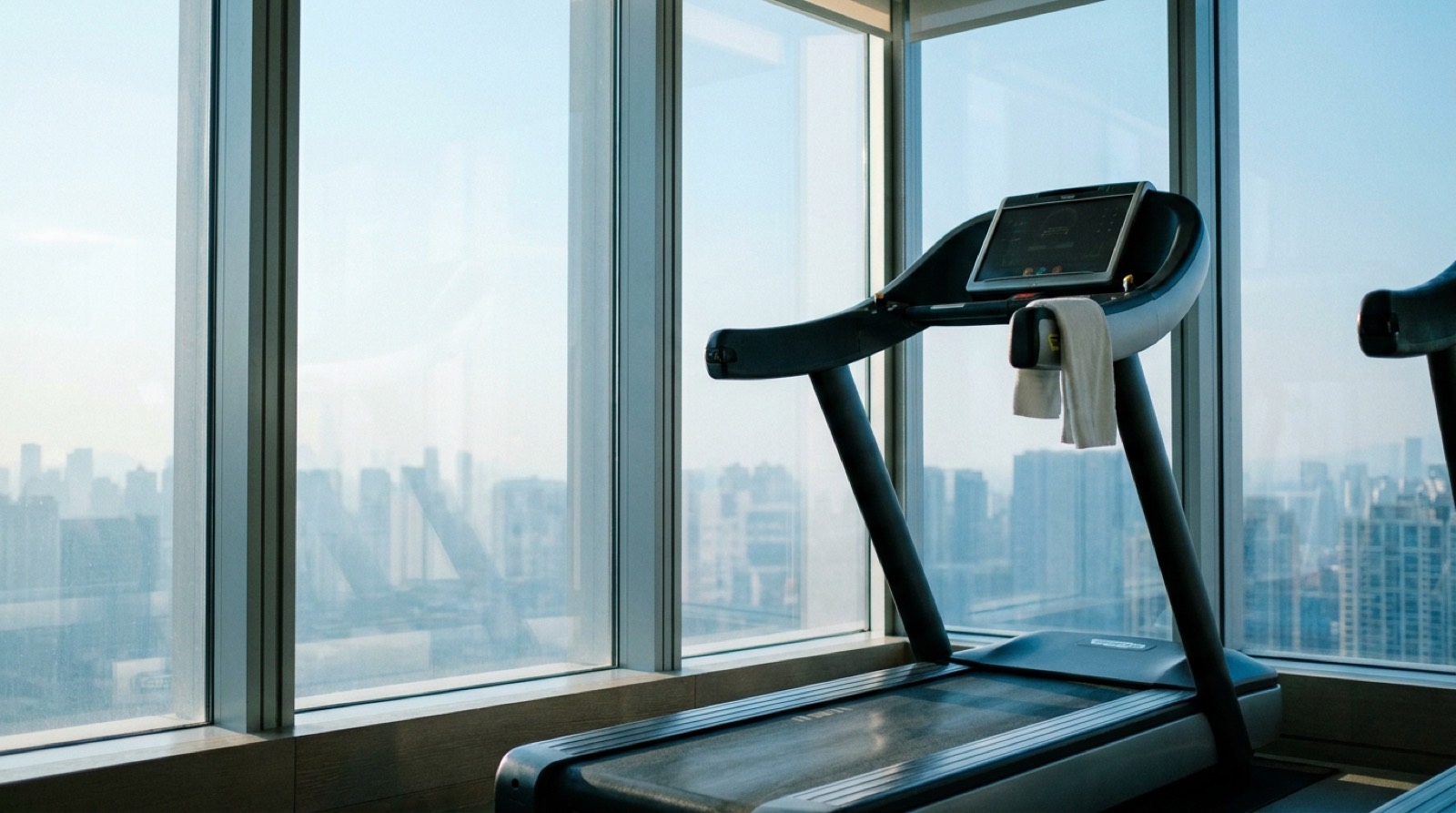
The number on the display is an instruction
When you press 6.5, you are not asking the treadmill what the belt is doing. You are telling the motor what to aim for. The display shows you your own request handed back.
Whether anything checks the belt after that is a design choice. Some machines count a spinning part under the deck. Some check nothing at all and trust the motor to hold what it was told. Both kinds show you the number with the same confidence, and nothing on the outside tells you which one you are standing on. How the number actually gets made is its own story.
Four things that change from machine to machine
Speed is the one that wrecks your training log. The rest is why the run felt strange before you ever looked at your watch.
| What changes | What it does to your run | Can you tell? |
|---|---|---|
| The belt's real speed | Every pace and every mile in your log shifts, in whichever direction this machine happens to be off. | No |
| The deck under you | A softer deck costs you slightly less energy at the same speed. The effect is small and it does not keep growing with more cushioning. | You feel it, you cannot measure it |
| Wear in the belt and deck | A worn belt can slip or hesitate as your foot lands, and the machine can struggle to reach the speed you set. | Sometimes, once it is bad |
| The room | Outdoors you make your own wind, and that cooling does not carry over indoors. A small room with still air makes the same run feel harder. | Yes |
Three of those four you can live with. You adapt to a firmer deck by the second mile. A hot room makes you slow down, which is a decision you get to make with full information.
The speed is the one you never find out about. It is also the only one that follows you home in your training log.
What a small difference costs you
Machines do not have to be broken to disagree. A 2021 study in Scientific Reports measured four treadmills and found their average belt speeds ran between 98% and 103% of the set speed. Call that the good range, because it was measured in a lab on machines in known condition.
Now put two of those good machines in two different gyms and run the same workout on both.
The same 7.0, on two machines nobody would call broken
One belt runs 2% under the set speed, the other 3% over. Both sit inside the range published testing found.
This is an illustrative example rather than a logged test. It is arithmetic on the published 98% to 103% range. The two paces are rounded to the nearest second for reading, while the gap is worked out from the belt speeds themselves.
Twenty-five seconds a mile is the difference between an easy run and a tempo run, and you set the identical number on both machines.
That is the honest version of the problem. Treadmills are not all wrong. Each one is off by its own amount, so there is no bias you can learn and subtract. The machine you use tomorrow is a fresh question.
What I found on real machines
I measure belts with a handheld contact tachometer, which reads the belt's true surface speed instead of asking the machine what it thinks.
On one gym treadmill, the display claimed 2.3 miles for a run that was really 2.0. The next day, the same machine read 5.6 miles against a true 5.0, and an Apple Watch agreed with the display instead of catching it. Indoors a watch has no GPS to check against, so the two agreeing proves nothing.
On one of the machines I run on regularly, the display said 5 miles when I had really run 4. I definitely under-ran my marathon training.
Those are three runs on two machines, each off by its own amount, and every gap sat far outside the lab's good range. That spread is the whole point of this article.
What we are not claiming. We have not measured enough machines to tell you what a typical treadmill does, and nobody else has published that number either. What we can tell you is that the range between machines is wide, and that a machine 15% out looks exactly like an honest one from where you are standing.
The hotel treadmill is a stranger
Your own gym at least gives you consistency. Use the same machine every week and your paces mean something relative to each other, even if the number itself is off.
A hotel takes that away. The machine is a stranger, with no baseline and no second treadmill to compare against. Whether anyone has maintained the one in front of you is not a question you can answer from the handrails.
The machine is also not yours to adjust. The covers stay on, and service belongs to trained technicians. Working on a machine you do not own can hurt you, and it can damage a machine the hotel has to answer for. If a belt slips under your foot or will not hold the speed you set, tell the staff what it did and use a different one.
Knowing the real number is a different matter. That one is entirely yours, and it takes seconds.
How to know, on a machine you have never used
You have three options, and only one of them is both quick and gives you a number.
- Run by feel and let the number go. This costs nothing and it genuinely works. It also leaves you with nothing to write in a log.
- Count belt revolutions. Measure the belt loop, pick a mark already on it, and count laps for a minute. It gives you a real answer. It also means standing beside a hotel treadmill with a tape measure instead of running. The full belt revolution method is here.
- Measure it with your phone. This takes a few seconds before you start, on a machine you have never touched.
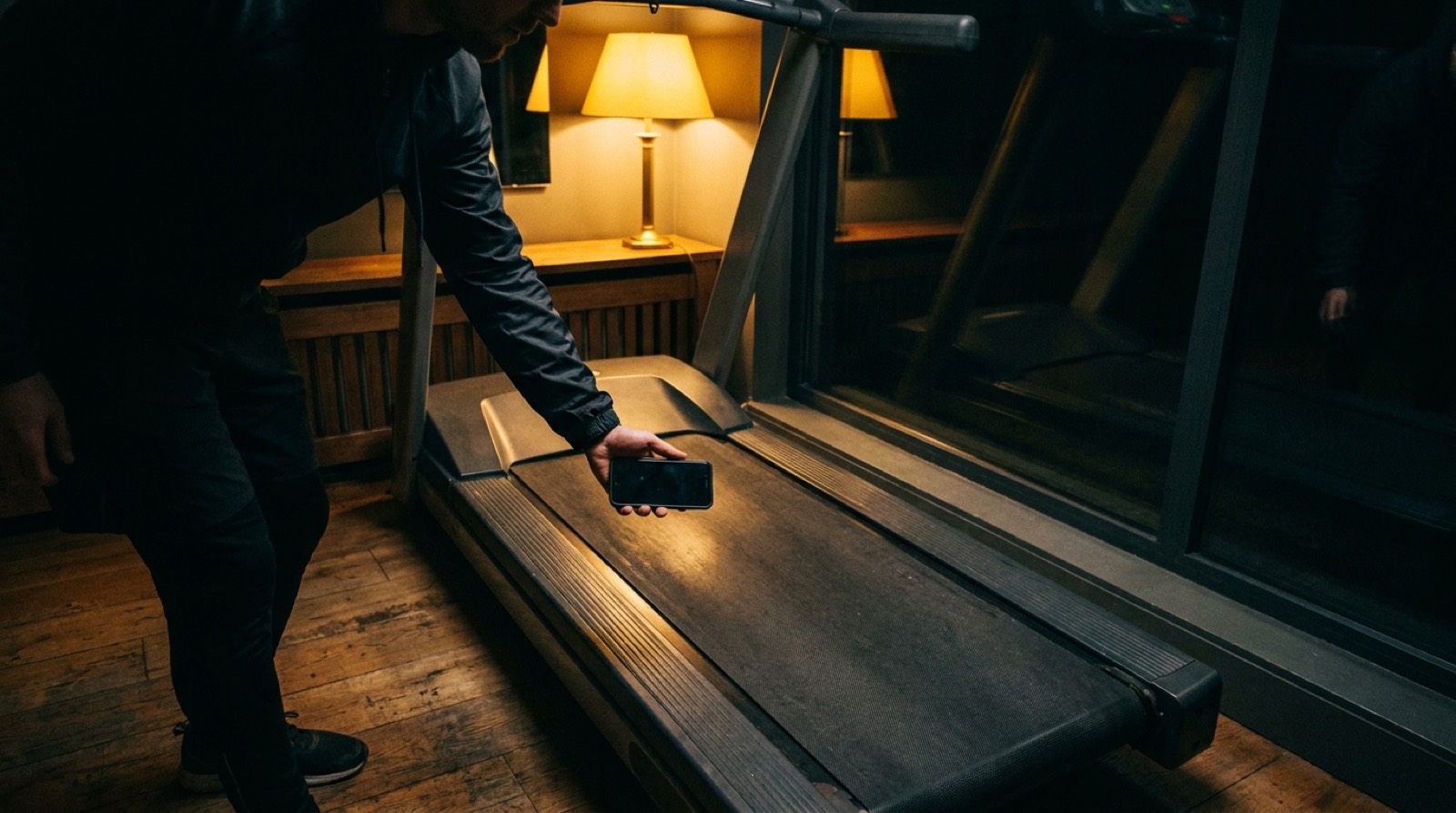
Treadwell reads the belt's real speed through your iPhone Pro's camera and LiDAR sensor. You stand beside the machine and hold the phone over the moving belt, and it measures the belt directly. Because it measures the belt itself, it does not matter whose treadmill this is or whether anyone ever calibrated it. On a hotel treadmill it had never seen, with no setup for that machine, the app's reading came within half a percent of my handheld tachometer's. The hotel's own display was never part of that test. If the app cannot get a reading it trusts, it says so instead of inventing a number.
Know what the strange machine is doing
Measure any treadmill's true speed in seconds, with your iPhone Pro.
Take the number with you, not the machine
You are never going to control which treadmill you get. A hotel, a gym on holiday, the one free machine at peak hour: every one of them hands you a stranger and a display you cannot check.
What you can carry is a way to check it. Measure the belt for a few seconds and you know exactly what a mile on that machine is worth.
Quick answers
Why do treadmills feel different from each other? The speed on the display is a command sent to the motor, not a reading taken off the belt. Two machines set to the same number can be moving at genuinely different speeds. The deck under your feet changes too, along with the wear in the belt and the air in the room.
Are hotel treadmills accurate? You have no way to tell by looking at one. A hotel gives you one treadmill for a few days, with no history and no second machine to compare it against. The only way to know is to measure the belt yourself.
Does a treadmill measure its own belt speed? Some machines do and some do not. Some treadmills count a spinning part under the deck, and some are designed to run with no check at all, trusting the motor to hold the speed it was told. Nothing you can see from the handrails tells you which kind you are standing on.
Why does the same speed feel harder on one treadmill than another? The biggest reason is that the belt may not be running at the speed you set. The deck matters too, and a 2014 study measured a small energy difference between a cushioned running surface and a rigid one. Heat and still air in a small room add the rest.
How can I check a treadmill I have never used before? Measure the belt instead of trusting the display. You can count belt revolutions against a stopwatch, or measure the belt directly with the Treadwell app on an iPhone Pro in a few seconds, on a machine it has never seen.
Sources.
- Machines designed to run with no speed check at all, trusting the motor control design: Precor TRM800 base service manual. Service restricted to trained providers: the same manual. This is a statement about that machine rather than about Precor as a brand.
- Machines that count a spinning part under the deck (a magnet or disc on the roller or motor): Horizon Fitness and Matrix service documentation, detailed in the sibling guide on how treadmills measure speed.
- Do not remove the covers, service by an authorized technician only: Matrix T7XE-03 service manual.
- Belt speeds of 98% to 103% of target across four treadmills: Willwacher et al., Scientific Reports 11:2244 (2021).
- Cushioning and energy cost: Tung KD, Franz JR and Kram R, "A test of the metabolic cost of cushioning hypothesis during unshod and shod running," Medicine & Science in Sports & Exercise 46(2):324-329 (2014). Twelve runners, 10 mm of foam over a rigid belt, about 1.6% less energy, with no significant further benefit at 20 mm.
- Still indoor air and cooling: Yamashita N, Ly CL, Smallcombe JW, Hodder S and Havenith G, Journal of Applied Physiology 137(3):554-568 (2024). Wind tunnel study, 14 participants.
- The hotel treadmill result is our own test, checked against a handheld contact tachometer on the day.
- The 2.3 against 2.0 run and the 5.6 against 5.0 run are our own tests, each graded against that machine's standing tachometer table rather than a fresh tachometer reading that day.
- The 5 miles against 4 is my own run on a machine I use regularly, reported from my own training rather than from a captured test file.
- The hotel treadmill figure is the accuracy of our own reading against the tachometer, on a machine we had never measured before. It is not a statement about that treadmill's display.
- The 7.0 mph comparison is a worked example. It applies the published 98% to 103% range to one speed. Nobody ran those two miles to log them.