Guides · Display versus your pace
Why your treadmill's display and your pace disagree
You set the belt to 6.0 and settle in for what should be a ten minute mile. Your watch calls it 11:04, the display still reads 6.0, and you have no way to tell which of them is closer.
Three things can open a gap between the display and your real pace. The machine may be set in kilometres while you read it as miles, whatever you are comparing against may be estimating rather than measuring, or the belt may not be running at the number on the screen. Only the last one is the machine being wrong. The machine's own pace readout cannot settle any of them, because it is worked out from that same speed number.
The pace on the display is the speed number in different clothes
Some machines show a pace field alongside the speed, and it looks like a second measurement. Pace is the speed number flipped over, sixty minutes divided by the speed, worked out from the number the display is already showing you. Set 6.0 and the pace field says 10:00 because 60 divided by 6 is 10. Nothing watched you cover a mile. On some machines the pace field is a setting the owner can switch off entirely, which tells you how much of it is presentation.
Think of a currency converter. You type in a hundred dollars and it shows you ninety two euros. The two numbers will always agree, because the second one is made from the first. Neither of them has looked in your wallet. Your treadmill's speed and pace fields are that same pair, so they cannot disagree, and their agreement is not evidence.
The three things that actually put a gap there
- Check the unit first. A machine set in kilometres per hour shows 6.0 for what is really a sixteen minute mile, while you read it as a ten minute one. That one mistake moves the number by about sixty percent. Ruling it out takes seconds. See which unit you are on.
- Ask what your comparison is measuring. A watch indoors has no satellite signal, so it estimates your pace from the swing of your arm against a stride length it learned outdoors. When your watch and the display disagree, you are holding an estimate of your body against a setting on a machine, and a watch gap on its own proves nothing about the belt. We took that argument apart in its own guide.
- Then suspect the belt. No treadmill we have looked into watches the top of its own belt, which is the only surface your foot lands on. The number you press is a target you hand the motor. The screen keeps showing that request whatever the belt does with it, because nothing reports back from the surface under your feet.
What a small gap costs you
A published study of treadmill speed accuracy found errors of roughly two to three percent on the machines it tested. Errors that size do not feel like anything. They still change the workout you think you are doing.
The pace you think you are running, against the pace a slightly slow belt gives you
These are illustrative bands, not measurements of any particular machine.
| Display shows | Pace you assume | If the belt runs 2% slow | If it runs 5% slow |
|---|---|---|---|
| 6.0 | 10:00 /mi | 10:12 /mi | 10:32 /mi |
| 7.0 | 8:34 /mi | 8:45 /mi | 9:01 /mi |
| 8.0 | 7:30 /mi | 7:39 /mi | 7:54 /mi |
| 9.0 | 6:40 /mi | 6:48 /mi | 7:01 /mi |
| 10.0 | 6:00 /mi | 6:07 /mi | 6:19 /mi |
Paces are 60 divided by miles per hour, rounded to the nearest second.
Gaps get much wider than that. One gym treadmill I logged counted about fifteen percent more distance than I actually ran. Its pace field was about thirteen percent optimistic at the same moment, and no number on that machine would have shown me either. On a machine running like that, a ten mile day in your plan hands you about 8.7 miles and calls it ten. The wider accuracy case sits in its own guide.
Now hold your own gap against those numbers. A gap near sixty percent is the unit until you have ruled it out, because that is the size the mile to kilometre switch makes. A few percent is the size the published belt errors reach, and our own logged tests have gone well past that. A gap in the middle, like the eleven percent hiding in that 11:04, could be the watch, the belt, or both at once. Nothing on the machine and nothing on your wrist will tell you which.
Working out which one it is
Rule out the unit and you have removed the only cause you can settle on your own. After that the watch and the display are left facing each other, and neither one can check the other. That is where everyone stops. Adding a foot pod or a new watch buys you another guess about your body. A gym is not going to let you open a machine, and it should not, so measuring the gap has to happen from outside.
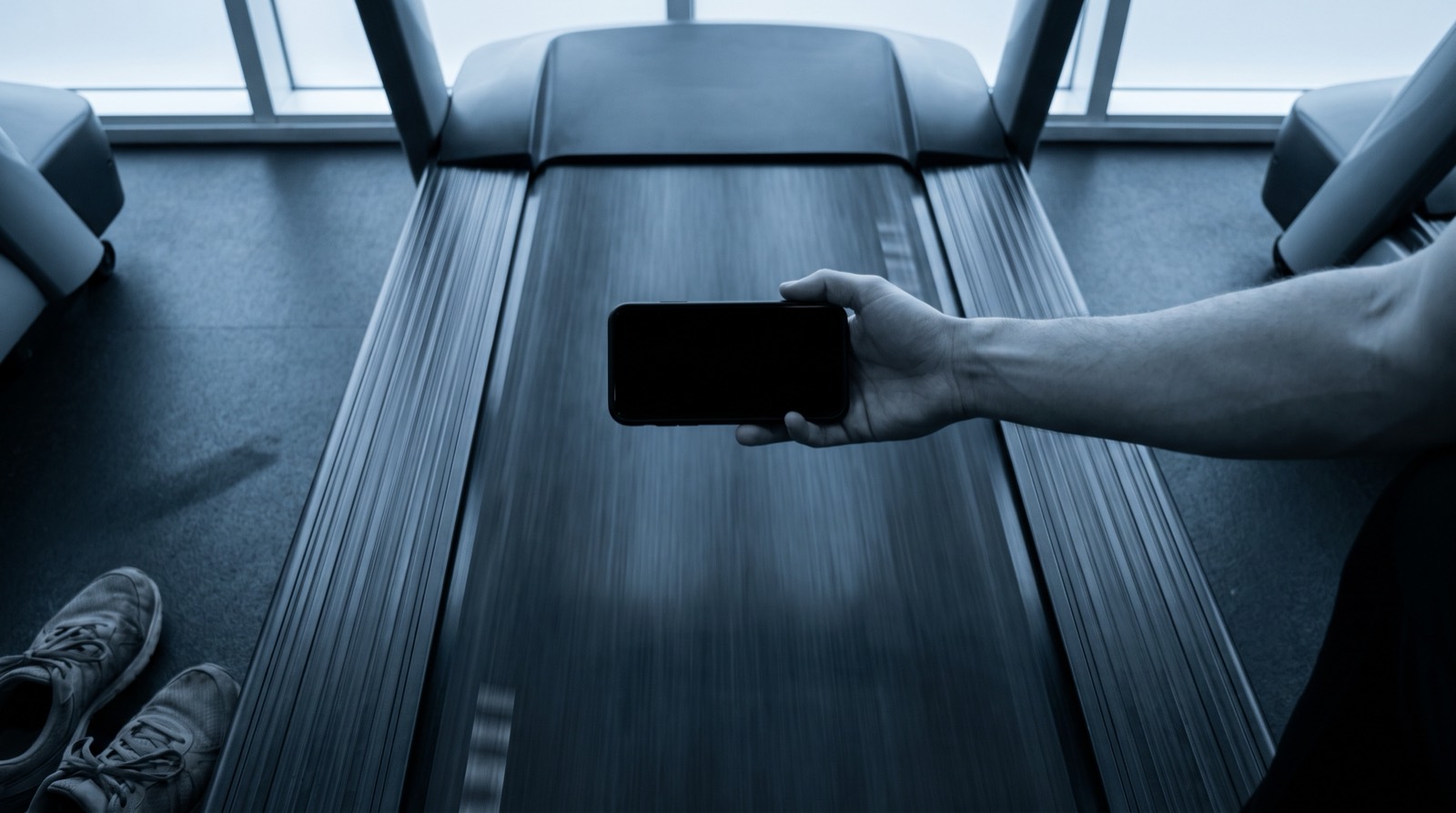
Treadwell settles it from beside the machine. You hold your iPhone Pro over the belt for a few seconds and its camera and LiDAR sensor read the belt's real speed. The app turns that into your pace with the same arithmetic the display was doing, only now the number going in was measured. Nothing about your stride, your watch or the screen goes into it, and when the reading is not one the app trusts, it says so instead of guessing.
Get the pace the display cannot give you
Your treadmill's true belt speed, and the pace that goes with it. Treadwell needs an iPhone Pro.
Quick answers
Why does my treadmill's pace not match my actual pace? Three things can put a gap there: the display may be set in kilometres while you read it as miles, whatever you are comparing against may be estimating rather than measuring, or the belt may not be running at the number on the screen. You can settle the first one on the machine, and nothing on the machine will settle the other two.
Is the pace shown on a treadmill accurate? It is exactly as accurate as the speed shown beside it, because a treadmill's pace readout is that speed number inverted rather than a separate reading. A belt running slow makes the pace field optimistic in the very same moment, and the two can never catch each other out.
Does the pace field on a treadmill measure anything? It measures nothing on its own. It is arithmetic performed on the speed the machine is already displaying, which is why some machines let the owner switch the pace field off without losing any information.
How do I find the pace I am really running on a treadmill? You have to measure the belt, because every other number on offer comes from the machine's own setting or from an estimate of your body. Measuring the belt's speed and converting it gives you a pace that inherits nobody else's assumption.
Sources.
- A treadmill's pace readout is derived from its speed reading. The SportsArt T635A specification states it as a formula, one divided by speed. Vision Fitness describes its pace field as the time needed to travel one mile or kilometre at the current speed, and its T9200 series carries a second average pace field worked the same way from average speed.
- A pace display is a feature a machine can switch on or off, which is another sign of how much of it is presentation. The Life Fitness F1 settings menu turns the pace display on and off, and on the 97Ti and 95Ti it sits behind a manager setting.
- The strongest manufacturer statement that nothing measures the belt comes from the Precor TRM800 base service manual, which says its motor control design needs no speed sensor.
- Every motorized manual we read is silent about the belt's top running surface. We are reporting that silence, not quoting a claim.
- The two to three percent figure comes from Willwacher et al., Scientific Reports 11:2244 (2021), which measured treadmill speed accuracy directly. The two and five percent columns in the table are illustrative bands chosen to bracket that finding. They are arithmetic applied to the displayed speed.
- The fifteen percent figure is our own logged test on a gym treadmill, where the display read 2.3 miles for a run that was really 2.0. It was graded against that machine's standing tachometer table. There was no same-day handheld reading. The pace figure is thirteen percent rather than fifteen because pace is the reciprocal of speed, so one error reads as a different percentage in each direction.
- Pace conversions on this page are arithmetic: 60 divided by miles per hour gives minutes per mile.