Guides · Treadmill runs and VO2 max
Does treadmill running affect your VO2 max estimate?
You ran five hard treadmill runs this week, and your watch's VO2 max did not move. You start to wonder if the treadmill is to blame.
On an Apple Watch, no. Apple says indoor workouts do not count toward Cardio Fitness, its VO2 max estimate, so a treadmill that reads fast or slow cannot move it. The Garmin manuals I read ask for an outdoor run. A treadmill that reads off can still throw off the pace you choose.
Apple Watch counts only outdoor walks, runs and hikes
Apple calls its VO2 max estimate Cardio Fitness. Only three workouts feed it: an Outdoor Walk, an Outdoor Run and a Hike. Indoor workouts do not count, including ones on gym equipment.
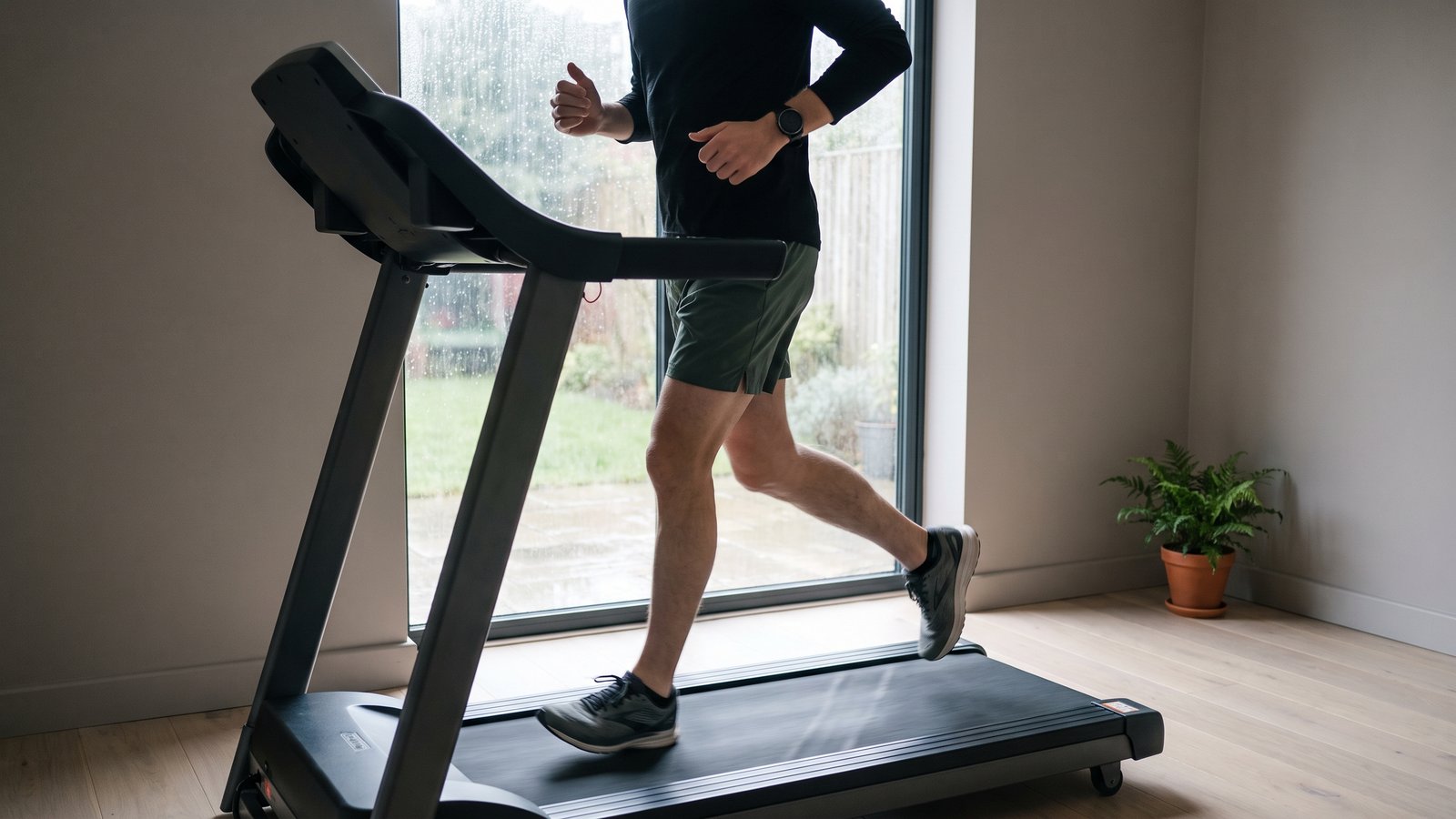
A treadmill run is an indoor workout, so it never enters the estimate.
A teacher who grades only the tests taken in class never sees your homework, even though the homework built the skill. On an Apple Watch, your treadmill runs are the homework. If you want the estimate to move, it has to see some outdoor walks, runs or hikes.
The Garmin manuals ask for an outdoor run
I read two Garmin owner's manuals. Both tell you to run outdoors to get a VO2 max estimate, and one says you must run outside with GPS. Neither one mentions treadmill runs, so check the manual for your own watch.

COROS says indoor runs can now affect its metrics
COROS said in its May 2026 update that indoor runs can now affect its Running Fitness metrics. The announcement is brief, so I cannot tell you how much a treadmill that reads off would move them. If you run with a COROS, the question stays open.
Where your treadmill still matters
You probably pick your treadmill pace from what you can hold outside. The treadmill then has to deliver that pace. The display shows the number the machine was asked for, and the treadmill gives you no way to check the belt against it. A lab study of four treadmills, one of them substantially worn, found average belt speeds of about 98 to 103 percent of the target.
The same setting, three belts
Made up for illustration, using a setting that equals 8:57 per mile.
The slow belt and the fast one sit about 27 seconds per mile apart, and the display reads 8:57 on both.
A slow belt makes the run easier than you planned. A fast belt makes it too hard, and you may doubt the fitness your watch measured outside. On an Apple Watch, the fitness estimate stays the same either way, because it only grades your outdoor workouts.
Treadwell closes that gap. Hold your iPhone Pro over the moving belt and Treadwell measures how fast the belt really goes. Then you can set the treadmill to the pace you planned. Your watch's indoor distance is a separate question, and what your Apple Watch really does on a treadmill covers where it comes from. If the same pace feels harder indoors, why your heart rate runs higher on a treadmill explains why.
Run the pace you planned
Read your treadmill's true belt speed before your next run. You need an iPhone Pro, because Treadwell reads the belt with its camera and LiDAR sensor.
 Scan with your iPhone Pro to get the app
Tested: in our tachometer tests the app read within about 2 percent of true belt speed.
Quick answers
Does treadmill running affect your VO2 max estimate? On an Apple Watch, no. Apple says indoor workouts do not count toward Cardio Fitness, its VO2 max estimate, so a treadmill that reads fast or slow cannot move it. The Garmin manuals I read ask for an outdoor run. A treadmill that reads off can still throw off the pace you choose.
Why did my VO2 max not change after a week of hard treadmill runs? On an Apple Watch, indoor workouts do not count toward the estimate. It comes only from outdoor walks, runs and hikes. Your treadmill week still counts for your training. The estimate leaves it out.
Do Garmin watches use treadmill runs for VO2 max? The two Garmin manuals I read ask for an outdoor run, and one says you must run outside with GPS. Neither one mentions treadmill runs. Look up VO2 max estimates in your own watch's manual to be sure.
Can a treadmill that runs slow make my workouts feel wrong? Yes. If you pick a pace from your outdoor fitness and the belt runs slow, you run slower than you planned and the run feels easier than it should. A fast belt makes it feel too hard. Knowing the belt's real speed settles it.
Sources.
- Apple Watch: Apple Support article 108790, "Workouts that count toward Cardio Fitness," which lists Outdoor Walk, Outdoor Run and Hiking, and says indoor workouts, including ones that require gym equipment, do not count.
- Garmin: Forerunner 265 Series Owner's Manual and fenix 9 Series Owner's Manual, "About VO2 Max. Estimates." Both ask for an outdoor run reaching at least 70% of maximum heart rate, saved after at least 10 minutes; the Forerunner 265 manual says you must run outside with GPS. Other Garmin models were not checked.
- COROS: "May 2026 Feature Update," which says indoor runs can now impact Running Fitness metrics.
- Belt speed range: Willwacher S. et al., Scientific Reports 11:2244 (2021). Four lab treadmills, one of them substantially worn, with average belt speed about 98 to 103 percent of target.
- Invented to explain the idea: the five treadmill runs in the opening, the teacher and the homework, the 8:57 per mile setting and the 2 percent slow and 3 percent fast belts. The paces in the table are plain arithmetic from those made-up numbers.