Guides · Cooper test on a treadmill
The Cooper test on a treadmill, and the distance it rests on
You want a VO2 max number without a lab, so you hold 7.2 on the treadmill as hard as you can for 12 minutes and bank the 1.44 miles it should cover. A calculator turns that into a score and a label, and you plan to beat both in eight weeks. The score rests on one number you never checked.
Yes, you can run the Cooper test on a treadmill. Run as far as you can in 12 minutes and put the distance into the Cooper formula. The catch is that distance. If the belt runs 3 percent slow, the score a calculator gives you comes out about 4 percent too high.
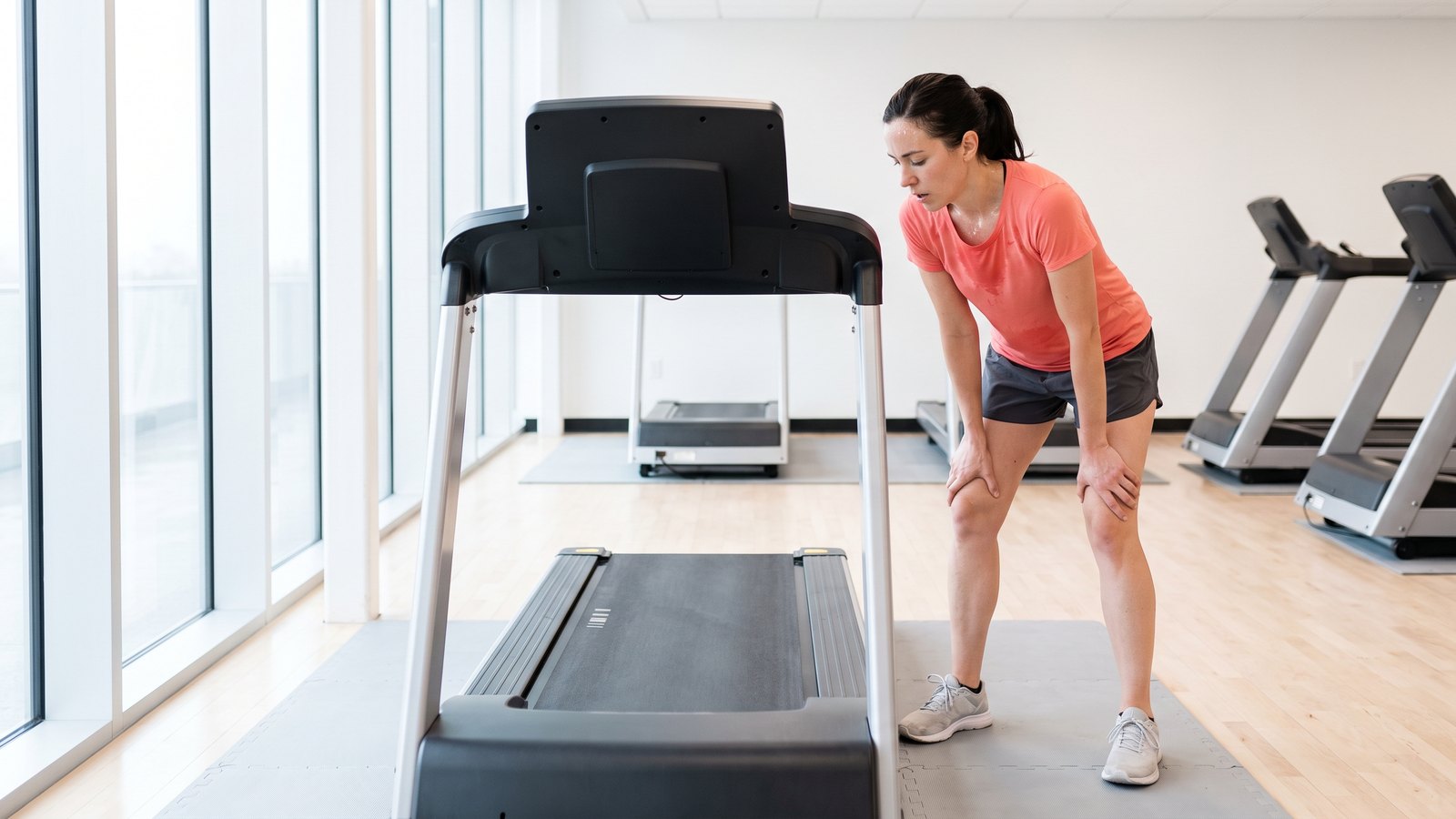
How the Cooper test moves onto a treadmill
Kenneth Cooper built the test in 1968 from 115 Air Force men. He compared how far each man ran in 12 minutes with a lab test of his oxygen use, and the two lined up closely.
The test was made for flat ground that has been measured, like a 400 meter track. The Cooper Institute allows a treadmill when weather or the lack of a track keeps you off one. The exception is a test used for hiring, which has to be done the same way each time.
On a belt you pick the pace instead of feeling for it. Warm up first. Start at a speed you think you can hold for the full 12 minutes, and raise it near the end if you have more left. Note the distance the moment the clock reaches 12:00. If you want to add a slight grade, the 1 percent incline rule covers when that holds.
The formula takes a fixed chunk off first
Cooper's formula does not use your whole distance. It first takes 504.9 meters off, then divides what is left by 44.73. The answer is your estimate in milliliters of oxygen per kilogram per minute.
That first step matters on a treadmill. Any error in your distance lands on the part left after the cut. That part is smaller than your total, so the same error is a bigger share of it.
Think of a gas tank with a reserve. Only the fuel above the reserve line is range you can use. If the gauge reads a little high, the whole error comes out of the usable part. Your real range is then short by a bigger share than the gauge was off. Your Cooper score works the same way. It moves about 1.2 to 1.35 times as much as the belt is off, depending on how far you ran.

What 12 minutes at one speed works out to
Worked arithmetic for five steady speeds. The calculator's column holds only if the belt runs the speed shown. The last column is an example belt running 3 percent slow, a little past the slow end of what one lab study found.
| Speed held 12 minutes (pace per mile) | Distance at that speed | Calculator's estimate | Estimate if the belt runs 3 percent slow (true score) |
|---|---|---|---|
| 6.0 mph (10:00) | 1.20 mi (1,931 m) | 31.9 | 30.6 |
| 6.6 mph (9:05) | 1.32 mi (2,124 m) | 36.2 | 34.8 |
| 7.2 mph (8:20) | 1.44 mi (2,317 m) | 40.5 | 39.0 |
| 7.8 mph (7:42) | 1.56 mi (2,511 m) | 44.8 | 43.2 |
| 8.4 mph (7:09) | 1.68 mi (2,704 m) | 49.2 | 47.3 |
Estimates are in milliliters of oxygen per kilogram per minute, from Cooper's formula, rounded to one decimal.
What a few percent does to your score
Your display shows the speed the belt was set to hold. A 2021 lab study put walkers and runners on four treadmills, one of them worn, and belt speed averaged about 98 to 103 percent of the setting. Take the 7.2 row and put it on two example belts: one 3 percent slow, just past that slow end, and one 2 percent fast.
- On a belt 3 percent slow, 12 minutes at 7.2 carries you about 1.40 miles. The calculator, fed 1.44, says 40.5. Your true score is 39.0.
- On a belt 2 percent fast, the calculator still says 40.5. Your true score is 41.6.
The label the calculator hands you, and the progress you read at the retest, can both belong to the belt. Retest on a different machine, and the change you call fitness may be the gap between two belts.
Before you bank the score
Compare a treadmill Cooper score only with another one from the same machine, at a belt speed you checked both times. The test was built and validated on measured ground, so keep a track score and a treadmill score apart. The treadmill gives you no way to confirm the belt carried you the distance you are about to enter. Indoors an Apple Watch works out distance from its own motion sensor, which is why your watch's distance cannot referee the 12 minutes. If the belt turns out to be off, adjusting it is a job for the manual or a technician.
Check the speed your 12 minutes ride on
Twelve minutes at one setting is the whole test, so the setting is the thing to check. Run the empty belt at your test speed and point an iPhone camera at it from the floor beside the machine. Treadwell reports how fast that belt really moves at that setting. With you on it the belt dips at each footfall, and the guide to belt speed under load covers what that does to the average. The empty reading tells you whether the speed you set is the speed the belt runs, and that is the number your 12 minutes were built on.
Check the setting before the clock starts
Read the belt at your test speed before the 12 minutes count, so the distance you feed the formula rests on a speed you checked. The reading uses the LiDAR sensor, so you need an iPhone Pro, the 12 Pro or any later one.
 Scan with your iPhone Pro to get the app
Tested: in our tachometer tests the app read within about 2 percent of true belt speed.
Quick answers
Can you do the Cooper test on a treadmill? Yes, you can run the Cooper test on a treadmill. Run as far as you can in 12 minutes and put the distance into the Cooper formula. The catch is that distance. If the belt runs 3 percent slow, the score a calculator gives you comes out about 4 percent too high.
What speed should I run a 12 minute run test on a treadmill? The test asks for the farthest you can go, so run the fastest speed you can hold for all 12 minutes. If you are not sure, start a little easy and speed up near the end. A speed of 7.2 mph held the whole way works out to 1.44 miles and an estimate of 40.5. That score holds only if the belt runs the speed shown.
Is the Cooper test an accurate VO2 max estimate? In Cooper's 1968 study of 115 Air Force men, the 12 minute distance lined up closely with a lab test of oxygen use. A 2011 study of young adults found it tended to read low for less fit people and high for fitter ones. A 2026 study of 73 college team-sport athletes found it read 6 points low on average, with a wide spread from person to person. None of these studies tells you what your belt adds on top.
Sources.
- The original test: Cooper KH, "A means of assessing maximal oxygen intake. Correlation between field and treadmill testing," JAMA 203(3):201-4, 1968. In 115 US Air Force men, 12 minute field-test distance correlated 0.897 with treadmill-measured maximal oxygen intake.
- The formula, VO2 max = (meters run in 12 minutes minus 504.9) divided by 44.73, as quoted in Soares EM, Silva R, et al., "Cooper's 12 Minute Run Systematically Underestimates VO2 max in Collegiate Team Sport Athletes: Validity and Classification Accuracy," International Journal of Exercise Science 19(2):2012, 2026, and in Campos LCB, et al., International Journal of Exercise Science 10(4):560-567, 2017, which credits Cooper's 1968 paper.
- Where to run it: The Cooper Institute, "50 Years of the Cooper 12-Minute Run," 2018. It calls for a flat, accurately measured surface such as a 400 meter track, allows a treadmill when weather or access rules out a track, and when the test is used for hiring, asks that it be given the same way every time (a track both times or a treadmill both times).
- Belt speed against target: Willwacher S, et al., Scientific Reports 11:2244, 2021. Across four treadmills (two research-grade, two commercial-style), one of them substantially worn, with participants walking and running, mean belt speed fell within about 98 to 103 percent of the set speed.
- Accuracy of the estimate: Penry JT, Wilcox AR, Yun J, Journal of Strength and Conditioning Research 25(3):597-605, 2011, found the 12 minute run underestimated lower and overestimated higher lab values. Soares et al., 2026, found a mean underestimate of 6.0 mL/kg/min in 73 college team-sport athletes, with limits of agreement from minus 19.8 to plus 7.9.
- Indoor distance on the wrist: Apple Support article 105002 says an Apple Watch uses its accelerometer for an indoor run.
- Every number in the table and the two example belts is worked arithmetic, not a logged test: distance is speed times 12 minutes, and each score comes from the formula above. The gas tank is an analogy.