Guides · World Treadmill Championship 5K
World Treadmill Championship: is a treadmill 5K accurate?
It is a designated Qualification Day at your gym. You set your speed, the belt ramps up, and 25:00 later the screen says 5 km. Your time lands on a world leaderboard next to runners in gyms around the world. So how sure can you be that you ran a true 5K?
A treadmill 5K is exactly as accurate as the belt under it. The RUN X rules have World Athletics officials check the treadmills the day before the Final. The rules say the maker calibrates all treadmills, but they describe no check on qualifying days, and by entering you accept the calibration.

What the RUN X rules check, and when
For a time to count, you run at an official RUN X Center, on an eligible connected treadmill, with a RUN X Specialist watching and your own RUN X ID logged in. The incline stays at 0 percent for every attempt. You pick your starting speed and can change it whenever you want.
During qualifying you get at most one attempt a day, and your fastest valid time is the one that counts. The top 25 percent in your country, sex and age group move on to Regionals. There you get a single attempt, and every one is "deemed certified." RUN X's own race page adds that each run is verified on the maker's treadmills, meeting World Athletics standards.
The rules also deal with the machines themselves. They say the treadmill maker calibrates all treadmills, and that World Athletics officials check them the day before the Final. By entering, you accept that calibration and give up the right to protest it.
So the rules describe an officials' check for the Final. They do not describe one on qualifying days or at Regionals. In our reading, 'certified' means the run happened on an approved, connected, supervised machine. The rules do not say what, if anything, was measured about the belt.
One list, many sand pits
Picture a long jump contest held in many sand pits at the same time. Each pit has its own measuring tape, and all the tapes came off the same factory line. Every jump goes onto one list. On the day before the final, the officials walk out to the final's pit and check it themselves.
That setup gives the final extra attention, because officials looked at that one pit the day before. The list that decides who reaches the final rests on many pits, and the rules describe no officials' check on those days. A tape from a good factory can still read a hair long or a hair short, so any pit may bring its own small error onto the shared list.
On a treadmill, the 5 km on the screen is the distance the machine reports, and the rules say every machine is calibrated. Each one still keeps that count with its own parts and its own history, which is why machines given the same number do not all run it the same way. A road 5K gets its distance measured before anyone lines up, as our virtual race guide explains. On the belt, the machine under you settles the distance while you run.
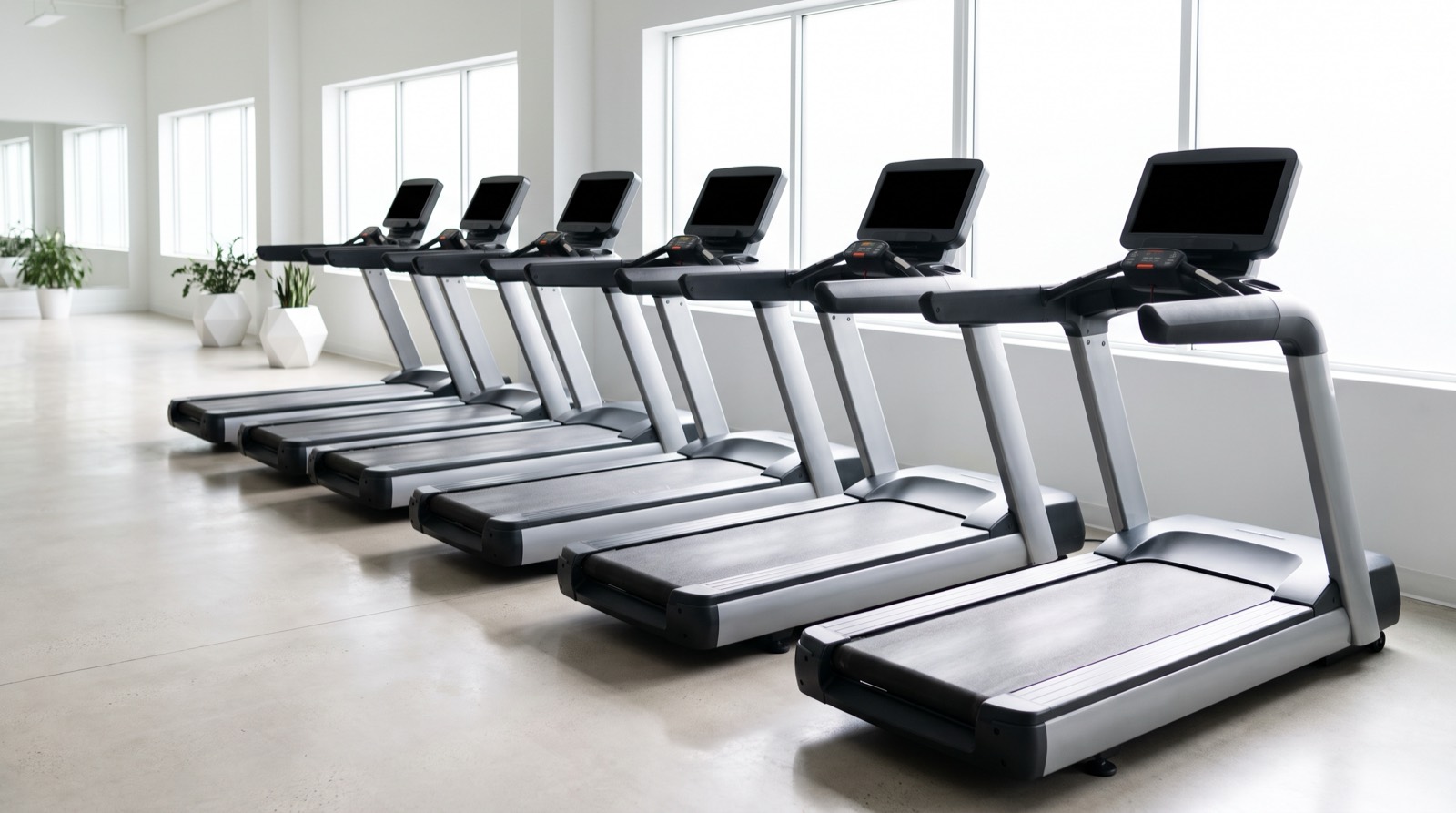
What 1 percent does to a 25-minute treadmill 5K
Take a runner whose screen reads 5.00 km at 25:00. That works out to about 8:03 a mile, or close to 7.5 mph.
| Example belt | Ground the belt really covered | Your time for a true 5K at that effort |
|---|---|---|
| Matches the screen | 5.00 km | 25:00 |
| Runs 1 percent slow | 4.95 km | about 25:15 |
| Runs 1 percent fast | 5.05 km | about 24:45 |
For scale, a lab study of four treadmills, none of them RUN X machines, found belts that averaged as slow as about 98 percent and as fast as about 103 percent of their setting.
Each 1 percent of belt error moves this 5K by about 15 seconds. Two runners with the same 25:00 on the screen could be about 30 seconds apart in real fitness. In a busy age group, the top 25 percent cut line may fall inside a gap that size. With a belt 1 percent from its setting, a miss could belong to the belt, and so could a pass.
Check the belt before your attempt
Before your next Qualification Day, is the belt you train on giving you the pace you plan to start at? What is the belt you will race on doing at that speed? Since you control the speed, knowing the real number helps you read your result for what it is. It will not change the result itself, and getting faster is a different job, covered in building a faster treadmill 5K.
During an attempt, nobody but the runner may touch the machine, so any check belongs on an ordinary day at a steady setting. You have three ways to get the number.
- A handheld tachometer reads speed straight off the moving belt. It gives the most accurate number here, though it costs money.
- A free method needs a stopwatch and the length of the belt. The treadmill accuracy check lays it out.
- Treadwell, an app for iPhone Pro models, is the third. You keep the phone steady over the running belt while its camera and LiDAR work out the belt's speed.
Pick a steady setting under 8.5 mph (slower than about 7:04 a mile), such as an easy jog or the example runner's 7.5 mph race speed. A belt that is off at an easy setting tells you about that setting only.
Know your belt before Qualification Day
Measure the belt you train on, and your next 5K starts from a pace you have measured. The app works only on an iPhone Pro, since that model has the LiDAR sensor it measures distance with.
 Scan with your iPhone Pro to get the app
Quick answers
Is a treadmill 5K accurate? A treadmill 5K is exactly as accurate as the belt under it. The RUN X rules have World Athletics officials check the treadmills the day before the Final. The rules say the maker calibrates all treadmills, but they describe no check on qualifying days, and by entering you accept the calibration.
How are RUN X times certified? The rules say a time counts only at an official RUN X Center, on an eligible connected treadmill, supervised by a RUN X Specialist, with the runner logged in under their own ID. At Regionals, every attempt is deemed a certified run. In our reading, that vouches for the place, the machine and the supervision, and the rules do not say whether anything about the belt was measured.
Are RUN X treadmills calibrated? The rules say the treadmill maker calibrates all treadmills, and that World Athletics officials check them the day before the Final. The rules describe no such check on qualifying days. Every entrant accepts the calibration and gives up the right to protest it.
Does a treadmill 5K count as a real 5K? For RUN X it does, by the event's own rules. As a road time it is a different measurement. A road course is measured before the race, while a treadmill counts the distance as you run it.
Sources.
- RUN X, Competition Rules for the World Treadmill Championships 2026/27, runx.org/en-US/rules/ (read November 1, 2026). Rule 2: where and how a time counts. Rules 3a and 3b: at most one attempt a day in qualifying, fastest valid time, top 25 percent advance, Regional attempts deemed certified. Rule 7: runner sets and changes speed, incline fixed at 0 percent. Rule 8: nobody else touches the machine during an attempt. Rule 12: the treadmill maker calibrates all treadmills, World Athletics officials check them the day before the Final, and entrants accept the calibration.
- RUN X, "The race," runx.org/en-US/the-race/ (read November 1, 2026). Runs from certified facilities give a verified time, over the official 5K distance, and every run is verified on the maker's treadmills, meeting World Athletics standards.
- World Athletics press release, October 22, 2026, "RUN X World Treadmill Championship set to begin," worldathletics.org. Results are certified through treadmills connected to the supplier's digital system, with an online leaderboard.
- Willwacher S. and coauthors (2021), Scientific Reports 11, paper 2244. Across four lab treadmills used by runners and walkers, the average belt speed sat near 98 percent at the low end and near 103 percent at the high end of what was commanded, under loaded running and walking.
- My own notes: the 25:00 runner and the three example belts are made up for the arithmetic, which I worked by hand. The line marked "our reading" is our interpretation of the rules, not their words. No RUN X machine was measured for this page.