Guides · Treadmill mile times
Are treadmill mile times accurate?
You push the pace for one hard mile, and the distance finally ticks over to 1.00. The clock shows a time faster than you have ever run, and before you tell anyone, you want to know if it counts.
A treadmill mile time is only as accurate as the belt speed behind it. The elapsed time is the easy part. The distance is the question, because the mile is the machine's own count. If your belt runs 3 percent slow, a 7:00 display mile was really about 7:13 pace, and you can find out which way yours leans.
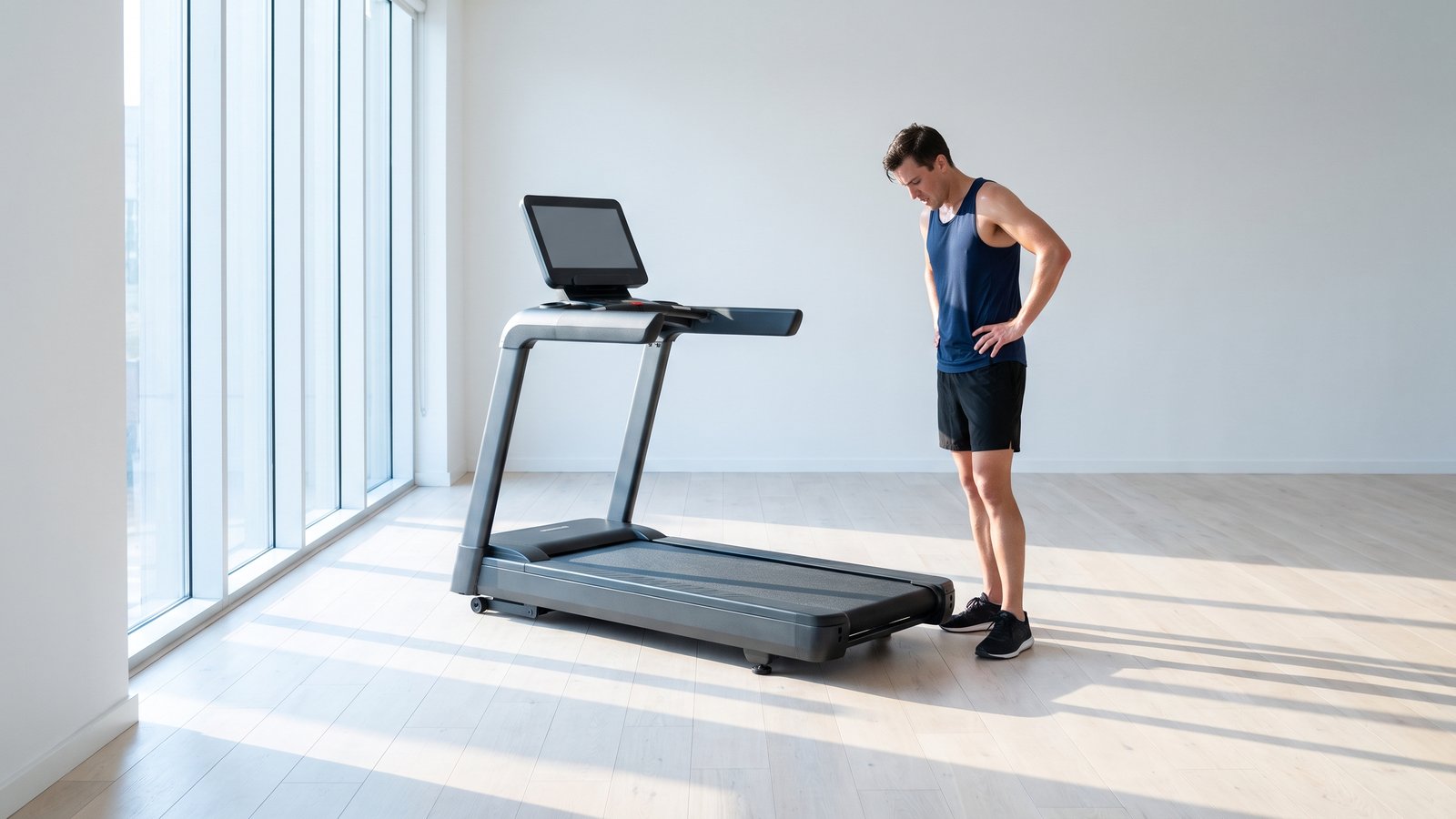
The clock is not the worry. The mile is the question.
The part to doubt is the finish line. The mile you just ran is the machine's own count, and I have not found a manual that says the machine checks that count against the ground the belt actually covered.
A road mile PR means something because, before the race, someone rolls a measuring wheel along the course, so everyone knows the finish line sits where it should. A treadmill mile is a course nobody wheeled unless you check it. The finish line lands wherever the machine's count says it does, and if that count runs ahead of the ground the belt really covered, it lands short.
The guide on what the distance number on your treadmill means explains why a clean 1.00 can still be off.
Why one mile shows the error in seconds
A belt that is off by a few percent sounds harmless. Over a week of easy runs, it mostly is. A timed mile is different, because you judge a mile in seconds. A steady error in the belt turns straight into seconds on the clock, and a single hard mile is exactly where you care about each one.
You might hope the error evens out as you run. If the belt is off by a steady amount, the error never evens out, and one mile gives you no other runs to balance it against. In one lab study of four treadmills, average belt speed ran within about 3 percent of the setting, and one of the four was substantially worn.
What a small belt error does to one mile
These belts are made up for illustration. Each one runs the stated percent off the speed on the display. The pace arithmetic is real.
| If the belt runs | Display says 7:00 | Display says 9:00 |
|---|---|---|
| 1 percent slow | 7:04 | 9:05 |
| 3 percent slow | 7:13 | 9:17 |
| 5 percent slow | 7:22 | 9:28 |
| 3 percent fast | 6:48 | 8:44 |
Each cell is your real pace per mile. A slow belt makes your time look faster than you ran, and a fast belt hides a better run than you think.
At 3 percent slow, that 7:00 you celebrated was about 7:13 of real running. Thirteen seconds is a real gap in a mile PR.

What that looked like on one machine I measured
I have caught a belt doing this on a gym treadmill I train on. At the end of one run, the display read 5.6 miles and so did my watch, yet the belt had only carried me 5.0. That was one run on one machine, graded against its standing tachometer table. If that same gap held at a harder pace, a display mile at 8:00 would have been about 8:58 of real running. A mile time set on a belt like that would not hold up on a track.
Before you compare it with a track mile
Two separate things stand between a treadmill mile and a track mile. One is effort. With no air to push through, a flat belt is a little easier at the same true speed, and the guide on whether treadmill running translates to the road covers that side. The other is the number itself, which is this page. A small incline closes most of the effort gap for many runners, but no incline fixes a belt that is running at the wrong speed.
If you plan to use your mile to predict a race, the guide on treadmill time trials and race times shows how a wrong pace carries into the prediction.
Know the belt before you race the clock
The only way to trust a treadmill mile is to know how fast the belt really moves. Once you have that speed, the math is simple. Divide 60 by the true speed in miles per hour, and you get your real minutes per mile.
Treadwell measures that speed for you. It reads the moving belt itself through your iPhone's camera and LiDAR, not the number on the display. Check the machine you plan to test on before the effort, and you will know the pace the belt really gave you.
Time a mile you can trust
Find out how fast the belt really moves, then run the mile. Treadwell needs an iPhone Pro, because it relies on the Pro's LiDAR sensor.
 Scan with your iPhone Pro to get the app
Tested: in our tachometer tests the app read within about 2 percent of true belt speed.
Quick answers
Are treadmill mile times accurate? A treadmill mile time is only as accurate as the belt speed behind it. The elapsed time is the easy part. The distance is the question, because the mile is the machine's own count. If your belt runs 3 percent slow, a 7:00 display mile was really about 7:13 pace, and you can find out which way yours leans.
Is a mile on a treadmill really a mile? Only if the machine's count matches the ground the belt covers. If the count runs ahead of the belt, you get a short mile, and if it runs behind, you get a long one. I have not found a manual that says how a given machine counts distance. The guide on treadmill miles and outdoor miles covers the distance side in full.
Is a treadmill mile easier than a track mile? At the same true speed, a flat belt is a little easier, because you have no air to push through. Many runners set a 1 percent incline to close most of that gap. That effort gap is separate from whether the belt's speed is right, and both can move your time.
Can I work out my real mile time on a treadmill? Yes, once you know the belt's true speed. Divide 60 by the true speed in miles per hour and you get your real minutes per mile. A belt truly moving at 8.0 mph is a 7:30 mile, whatever the display says.
Sources.
- How close a belt runs to its setting: Willwacher, S. et al. (2021), Scientific Reports 11:2244, pmc.ncbi.nlm.nih.gov/articles/PMC7838258/. Four lab treadmills, one substantially worn, with seven participants who walked and ran. Average belt speed was about 98 to 103 percent of target.
- Our own test, the 5.6 and 5.0 miles: one run on one gym treadmill, with an Apple Watch that echoed the display. The 5.0 is Treadwell's reading, graded against that treadmill's standing tachometer table, a chart of real belt speed at each setting that I recorded earlier with a handheld tachometer, not a tachometer reading from that day. Applying the run's gap to an 8:00 display mile is our own scaling, not a mile anyone timed.
- Made up for illustration: the belts that run 1, 3 and 5 percent slow or 3 percent fast, the 7:00 and 9:00 display miles, the 8.0 mph belt, and the measuring wheel. The pace arithmetic is ours.