Guides · Brisk walk speed on a treadmill
Brisk walk speed on a treadmill: count your steps, not the number
You set 3.5 because a chart called it brisk. Some mornings it feels easy enough to sing to, and you wonder if it still counts.
Public health guidance puts a brisk walk at about 2.5 to 4 mph, a 15 to 24 minute mile. That speed is a rough guide, not the definition. Brisk means you can talk but not sing, and research offers about 100 steps a minute as a rule of thumb for that effort.
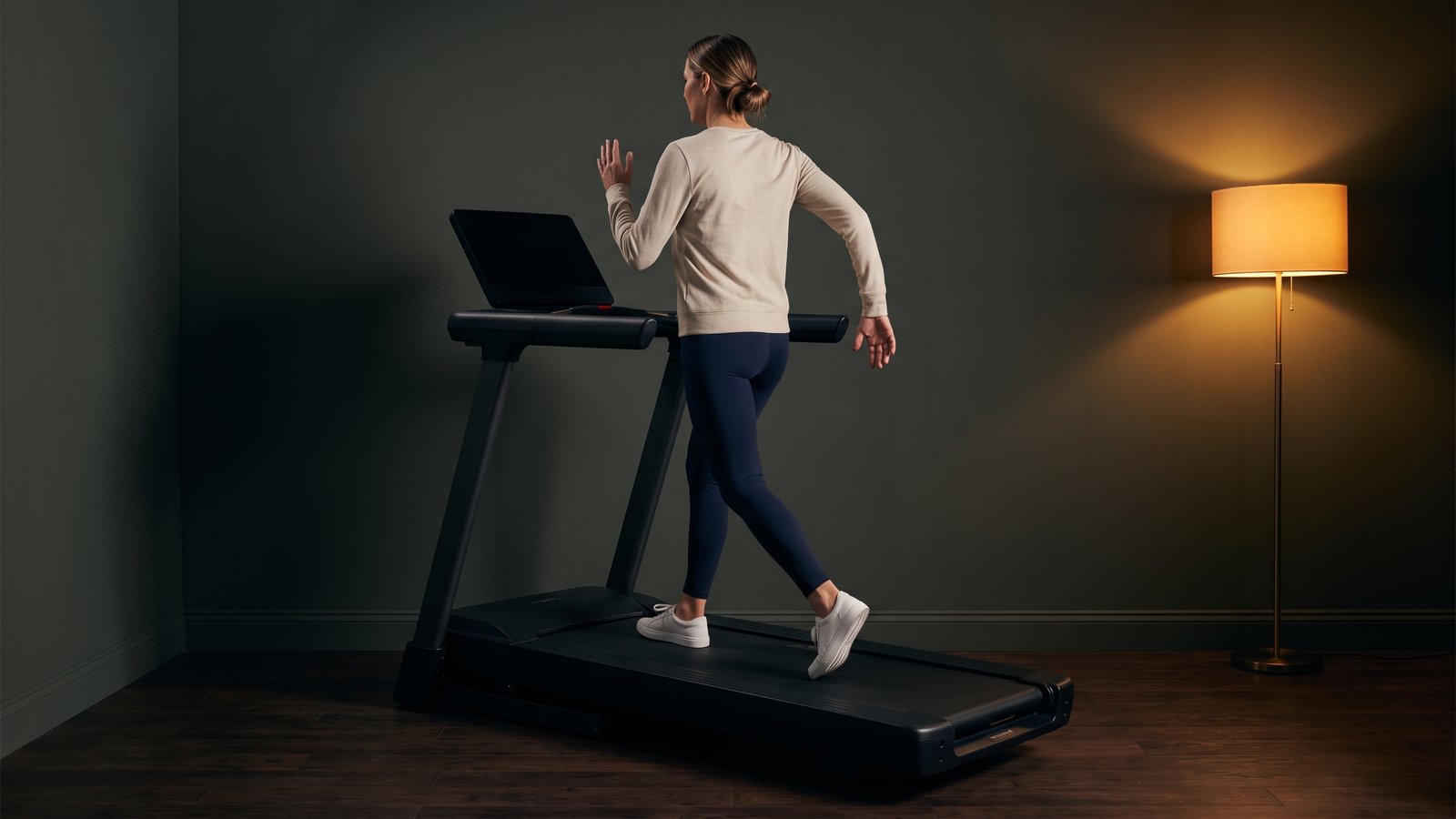
Brisk is an effort, and the speed is an example
Brisk is a level of effort, the one health guidance calls moderate, not a speed. On a scale where sitting is 0 and your hardest effort is 10, it sits at 5 or 6: you can talk, but you cannot sing. The 2.5 to 4 mph you see quoted is only an example of where that effort tends to land. It cannot be the definition, because the same speed is a different job for different bodies. An older or less fit walker can be working hard at a speed where a fitter one sings through it.
A box of penne says 9 to 11 minutes, and you still bite a piece first. The 2.5 to 4 mph is the box time. Your breathing and step rate are the bite.
One set speed, a wide spread of effort
In one lab study, 76 adults aged 21 to 40 walked a flat treadmill at set speeds. At a set 3.0 mph, cadence ran from 101 to 127 steps a minute, and effort ran from just under the moderate line to well into the moderate range. At a set 2.5, it stretched from light walking into moderate work. A copied speed can leave you strolling, or working harder than you meant.
The 15-second check
Mid-walk, count every step for 15 seconds and multiply by 4. Your step rate tends to rise with your effort, so the count is a reading taken from your own body, with no machine in between. Twenty-five steps is 100 a minute, the line researchers use as a rule of thumb for moderate effort in adults. A study of walkers aged 61 to 85 found the same line. If you counted under 25 and could still sing, nudge the speed or incline up and count again. Treat 100 as a rule of thumb, because its authors say a single cutoff is only a rough guide for any one person, and let your breathing decide.
Brisk walkers on a path
In one study, 212 older adults who said they walk briskly for exercise were timed over a half-mile path. The men averaged about 3.55 mph, a 16:54 mile, and the women about 3.44 mph, a 17:27 mile. Those speeds came from timing a known distance, a check your display's setting does not make.
What your step count cannot tell you
Your steps and your breath tell you whether the walk is brisk. Neither tells you your speed or your miles. Those come from the number you set, which the 12-3-30 speed guide shows is a setting, not a measurement.
Picture a morning your step count and talk test both say brisk, and the display says 3.5. Say the belt really runs 2 percent slow, about 3.43 mph. This belt is an example nobody measured. I picked 2 percent because one lab's four treadmills, one of them badly worn, landed from 98 to 103 percent of their settings. Your effort was brisk either way, because your legs did the work at that cadence. Your log is what is wrong: it writes 17:09 miles you walked at 17:30, and over a year of 45-minute walks, five a week, it credits you about 14 miles you never covered. The gap shows up the day you compare your indoor pace with an outdoor walk, or this year's log with last year's.
Your watch rides on your wrist, so it cannot check the belt. How accurate a watch is on a treadmill covers what it counts.
Give your brisk setting a real pace
Treadwell turns your brisk setting into a measured pace. Start the belt at that setting, then step off so it runs empty. Standing beside the machine, hold an iPhone Pro still above the moving belt, and the app reads the belt's true speed. Any fix to the machine belongs to your manual or a technician.
See what your brisk walk really is
Read the belt at the speed that passes your talk test, and log the pace it really runs. You need an iPhone Pro, since the app works from its LiDAR sensor and camera.
 Scan with your iPhone Pro to get the app
Tested: in our tachometer tests the app read within about 2 percent of true belt speed.
Quick answers
What is a brisk walk speed on a treadmill? Public health guidance puts a brisk walk at about 2.5 to 4 mph, a 15 to 24 minute mile. That speed is a rough guide, not the definition. Brisk means you can talk but not sing, and research offers about 100 steps a minute as a rule of thumb for that effort.
Is 3 mph a brisk walk? For many adults it is, and England's health service describes a brisk walk as about 3 mph, which is a 20 minute mile. Whether 3.0 is brisk for you comes down to your breathing and your steps, so run the talk test and a 15-second count before you trust it.
How many steps per minute is a brisk walk? About 100 steps a minute is the research rule of thumb for moderate effort in adults, which is 25 steps in 15 seconds. In one lab study of adults aged 21 to 40, vigorous effort began near 130 steps a minute.
Should I add incline to make my walk brisk? Incline is a good lever if walking any faster feels awkward, because a steeper grade asks more of you at the same speed. Raise it a little at a time, and stop when you can still talk but cannot sing.
Sources.
- Brisk as effort: US Department of Health and Human Services, Physical Activity Guidelines for Americans, 2nd edition (2018). Moderate intensity is 3.0 to less than 6.0 METs, with "walking briskly (2.5 to 4 mph)" as an example (PDF page 20); Table 4-1 words it as "Walking briskly (2.5 miles per hour or faster)." Relative effort of 5 or 6 on a 0 to 10 scale, the talk-but-not-sing rule of thumb, and the note that older or less fit adults may feel moderate activity as vigorous while fitter adults may sing through it are on PDF page 60.
- CDC, "Measuring Physical Activity Intensity": 5 or 6 on a 0 to 10 scale, talk but not sing, and "Walking briskly (2.5 miles per hour or faster)."
- NHS, "Walking for health": a brisk walk is about 3 miles an hour, and you can talk but cannot sing. None of these three public health sources gives a steps-per-minute figure.
- The 100 steps a minute line: Tudor-Locke C and co-authors, "How fast is fast enough?", British Journal of Sports Medicine 52(12):776-788 (2018), PMID 29858465, a review of 38 studies that calls 100 steps a minute a consistent heuristic for moderate intensity in adults despite differences between individuals.
- The spread at one set speed: Tudor-Locke C and co-authors, CADENCE-Adults, International Journal of Behavioral Nutrition and Physical Activity 16:8 (2019), PMID 30654810. Seventy-six adults aged 21 to 40 (74 reached 3.0) walked at 0 percent grade in 0.5 mph steps with hand-tallied cadence. Table 2: at a set 3.0 mph, cadence 101 to 127 steps a minute and energy use 2.6 to 5.0 METs; at a set 2.5 mph, 2.3 to 4.0 METs. Moderate begins at 3 METs. The speeds are as set on the lab treadmill, and the paper reports no separate check of belt speed. The authors set heuristics at 100 and 130 steps a minute and say any single threshold has limited precision for one person.
- Older walkers: Tudor-Locke C and co-authors, CADENCE-Adults aged 61 to 85, International Journal of Behavioral Nutrition and Physical Activity 18:129 (2021), PMID 34556146: 100 steps a minute was associated with 3 METs.
- Timed brisk walkers: Parise C, Sternfeld B, Samuels S, Tager IB, Journal of the American Geriatrics Society 52:411-416 (2004), PMID 14962157. 212 older adults who said they walk briskly for exercise were timed over half a mile on a walking path; men averaged 5.72 km/h and women 5.54 km/h; 98 percent of men and 97 percent of women walked at a speed equal to 3 METs or more. The mph and paces are my conversions.
- Belt speed against setting: Willwacher S and colleagues, Scientific Reports 11:2244 (2021). The team tested four treadmills, one whose belt and bed were substantially worn, with walkers and runners across about 2 to 10 mph on board. Each machine's mean belt speed fell within roughly 98 to 103 percent of its target.
- Incline at one speed: Hofmann C and co-authors (2014), in the International Journal of Exercise Science, volume 7, starting on page 339. Thirteen healthy adults walking hands free at the same speed used less energy at a 5 percent grade than at 10 percent.
- The 15-second count is my arithmetic on the 100 steps a minute heuristic, not a method from any of these papers.
- The 3.5 walker and the belt running 2 percent slow are made up, like the opening scene and the pasta box. Nobody measured them. The yearly figure assumes 45 minutes a walk, 5 walks a week and 52 weeks: 3.5 against 3.43 mph is 0.0525 miles a walk, 0.2625 a week and 13.65 a year, which I rounded to 14.