Guides · Jogging speed on a treadmill
Jogging speed on a treadmill: start where walking ends
A beginner chart put jogging at 3.5, so that is where you set the belt. Your feet land somewhere between a walk and a run, and you start to wonder if you are doing it wrong.
In treadmill studies of young adults, the switch from walking to jogging averaged about 4.2 to 4.6 mph, a 13:00 to 14:20 mile. Near that speed, a jog starts to feel easier than a walk. In one study, runners and non-runners switched at almost the same speed. Find yours by raising the belt slowly until the jog feels easier.
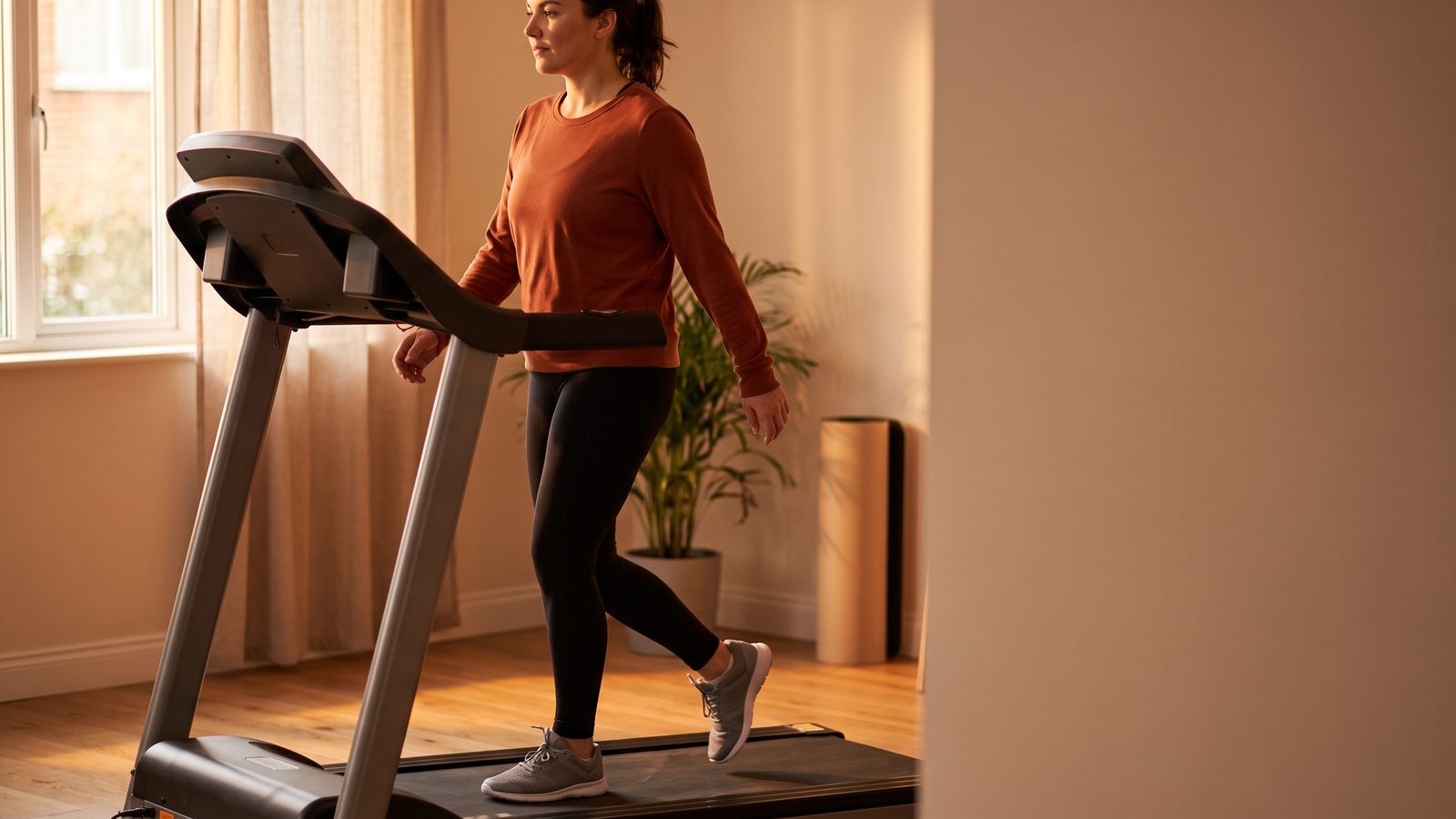
Your body has a switch point
In these studies, the switch was the speed where people on a treadmill traded walking for running. Where the abstracts describe the method, the belt crept up or down until they did. The papers call it running, and this guide calls a slow first run a jog. On average, the switch came at about 4.2 mph in one study and about 4.5 to 4.6 mph in two others.
Average switch speeds in three treadmill studies
Each study timed the switch its own way. Paces are converted from the rounded speeds shown.
| Group | Switch (mph) | Pace per mile |
|---|---|---|
| 18 men, belt speed recorded | 4.2 | 14:17 |
| Young men who did not run (one study of 19 men) | 4.5 | 13:20 |
| Young men who ran (same 19-man study) | 4.6 | 13:03 |
| 20 young adults, 10 women and 10 men | 4.6 | 13:03 |
In the study of 18 men, switch speeds across that study's trials ran from about 2.9 to 5.7 mph, and men with longer legs tended to switch faster. Your 3.5 shuffle sits below the average switch in all three studies, which in this guide's reading is why a jog there may feel awkward. If your own switch is near the low end of that range, 3.5 may feel fine.
Right at the switch, people rated walking as clearly harder than jogging, even though the jog burned more energy. So the feeling you are waiting for is real.
Runners and non-runners switched at nearly the same speed
An automatic gearbox shifts up at a set road speed, whether the tank is full or nearly empty. In the one study that compared runners and non-runners, the switch behaved like that gearbox: the runners were the more trained group, the fuller tank, and their switch landed in nearly the same place. Your own switch sits in a range rather than on one number.
That study tested 19 young men, and for them, being a runner made no clear difference to where the switch fell. What the switch means for you is that your first jogs can be shorter, not slower. Jog at your switch for as long as it holds, walk when it does not, and let the jogging minutes grow as you get fitter. The couch to 5K guide covers a plan that builds those minutes.
Find your own switch with a slow ramp
Start at a walk that feels easy. Raise the belt by 0.1 mph each minute. Small steps keep you from jumping past the moment. When a jog begins to feel easier than the walk, start jogging. The setting on the display at that moment is where your jog begins today. If you start at 3.8 and switch at 4.3, the test takes five minutes.
The number you wrote down is a setting
One of the lab studies recorded the belt's actual speed. The number on your display is the setting you chose, and you have not checked it against the belt. Researchers who checked four lab treadmills, one substantially worn, found each belt's average speed landed somewhere from 98 to 103 percent of what was dialed in. Say your switch shows 4.5, a 13:20 mile, on a belt that runs 2 percent slow, which sits inside that range. Your jog really started at 4.41, a 13:36 mile. You log 13:20 as your first jogging pace, and every faster week after it gets judged against a pace you never ran. If you wear a watch on the belt, see what your watch is really doing indoors. The guide to reading treadmill distance explains where the miles from these first jogs come from.
Set the belt to the speed where your jog began. Hold your iPhone Pro steady above the running belt for a few seconds. Treadwell then reads the speed the belt is really turning at that setting, and that gives you a first pace worth logging.
Find the real speed where your jog begins
Measure the belt at your switch setting before you log that first pace. Treadwell needs an iPhone Pro, because it uses the LiDAR sensor.
 Scan with your iPhone Pro to get the app
Tested: in our tachometer tests the app read within about 2 percent of true belt speed.
Quick answers
What is a good jogging speed on a treadmill for beginners? In treadmill studies of young adults, the switch from walking to jogging averaged about 4.2 to 4.6 mph, a 13:00 to 14:20 mile. Near that speed, a jog starts to feel easier than a walk. In one study, runners and non-runners switched at almost the same speed. Find yours by raising the belt slowly until the jog feels easier.
Is 4 mph a jog or a walk? It can be either. In these studies of young adults, 4.0 sat below all three average switch speeds, so the slow ramp above is how you learn which side you are on.
What is the difference between jogging and running? The US physical activity guidelines list jogging or running together as one example of vigorous activity. They give no speed that separates the two.
Do people switch to a jog at a different speed on a treadmill? One study found the switch came at a somewhat lower speed on a treadmill than over ground, even when the speed rose at a matched rate. The gap was smaller than earlier work had assumed. The number your ramp gives you is a treadmill number.
Sources.
- Walking felt harder than running at the switch: Hreljac A., Med Sci Sports Exerc 25(10):1158-62 (1993), PMID 8231761. Twenty young adults, 10 women and 10 men, on a treadmill. Preferred switch 2.06 m/s (4.61 mph). Rated effort at that speed was 13.5 walking and 10.0 running, while the energy-saving switch sat higher, at 2.24 m/s.
- Runners and non-runners: Rotstein A. et al., Med Sci Sports Exerc 37(11):1864-70 (2005), PMID 16286854. Nineteen young men started at 5 km/h, the speed rose 0.2 km/h each minute, and each began running at the speed he felt was easier. The reported switch was the mean of the walk-to-run and run-to-walk transitions. Switch 7.23 km/h (4.49 mph) for non-runners and 7.42 km/h (4.61 mph) for runners, not a significant difference. Running at the switch felt easier but cost more energy than walking.
- Range and leg length: Thorstensson A. and Roberthson H., Acta Physiol Scand 131(2):211-4 (1987), PMID 3673618. Eighteen men on a motor-driven treadmill with the belt speed recorded. Mean transition speed 1.88 m/s (4.21 mph) across speeding up and slowing down, range 1.30 to 2.55 m/s across the study's trials (about 2.9 to 5.7 mph), with a tendency toward faster switches with longer legs.
- Treadmill versus ground: Van Caekenberghe I. et al., Gait Posture 31(4):420-8 (2010), PMID 20219374. The switch came at a lower speed on the treadmill than overground at a matched speed-up, by less than earlier work assumed. That study used its own speed-up rate and a different calculation method, so its speeds are not comparable with the averages in the table.
- Jogging and running: the federal Physical Activity Guidelines for Americans (HHS, second edition, 2018). Vigorous examples include "jogging, running," and Table 4-1 lists "Jogging or running," with no speed attached.
- Belt speed: Willwacher S. and colleagues, Sci Rep 11:2244 (2021). On average the four lab treadmills they tested, one substantially worn, kept between 98 and 103 percent of their dialed speed. It describes those four machines, not gyms in general.
- My own notes: the paces are my arithmetic, converted from the rounded speeds shown. Of the abstracts checked, only Rotstein's describes telling people to switch when running felt easier. "Shorter, not slower" is my reading of the switch research, not a result any of these studies tested. The 0.1 mph per minute ramp is my home version of the Rotstein method, which raised speed by 0.2 km/h (about 0.12 mph) each minute. The 3.8 to 4.3 ramp and the 4.5 switch on a belt 2 percent slow are illustrations, not belts I measured.