Guides · Fitbit treadmill distance
Fitbit treadmill distance wrong? Which number to trust
You step off after 33 minutes at a steady pace. The treadmill says 3.52 miles, your Fitbit says 3.24, and for months you have been logging something in between. Which one is wrong, and is it even the Fitbit?
When your Fitbit counts steps, it works out distance as your steps times a stored stride length, set from your height and sex unless you changed it. The treadmill reports its own figure, and nothing in the machine watches the belt, so when the two disagree only checking the belt tells you which to trust.
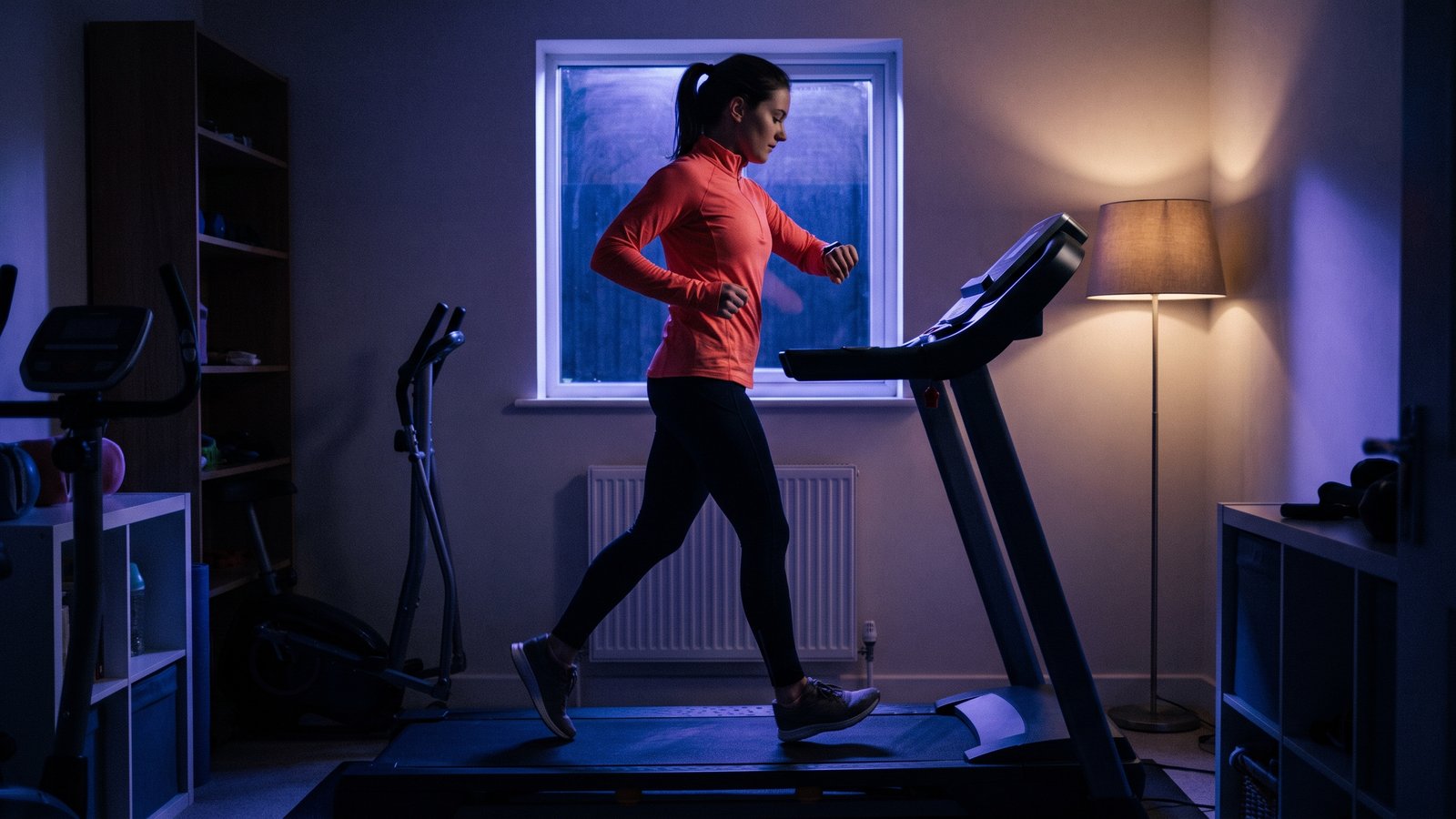
Your Fitbit is counting steps and multiplying
Fitbit's method for distance from steps is one line of arithmetic: steps times stride length. The stride starts as a number worked out from your height and sex, and the app keeps one for walking and one for running.
Your arm has to swing back and forth for a step to count, so a hand resting on the rail shrinks the count before any multiplying starts. The guide to treadmill steps covers how steps and treadmill distance relate.
Picture working out the length of a fence by counting its posts. Say you walk the line, count every post without missing one, and multiply by a gap of eight feet. The length is only as good as that eight feet, so on a fence whose posts were set six feet apart, the count is still right and the total comes out a third too long. Your steps are the posts. Your stride is the gap.

One stride for every speed you dial
Your real stride is a different length at every speed. In a lab study of male recreational runners on a treadmill, stride length grew by 28 percent between about 8:31 and 6:31 a mile, while steps per minute rose only 4 percent. On average, when you speed up, almost all of the extra speed comes from a longer stride.
In that arithmetic, one stored running stride matches only one of those speeds. Say yours was set from a comfortable GPS run. On a tempo day your real stride is longer than the stored one, so the Fitbit comes up short. On a recovery jog your stride is shorter, so it comes up long. Say every step was counted. The multiplier fits neither day.
Fitbit's help page gives two ways to update the stride. One is a GPS run outdoors at a comfortable pace for 10 minutes or more. The other is a measured distance such as a track. Either way, the stride you save is the one you had at whatever pace you were moving that day.
The treadmill's number is a setting
Your display shows whatever speed you requested from the machine, and its miles are the machine's own report of your run. Nothing in the machine watches the belt's surface to check either figure. When a lab tested four treadmills in known condition, each belt held, on average, somewhere from 98 to 103 percent of its set speed. A belt at the fast end carries you farther than the display says, and a slow one carries you less. Your stride setting plays no part in that gap. The guide to checking whether your treadmill is accurate covers how to tell which kind of belt you are on.
Two gaps, two causes
Go back to the opening run: 33 minutes at a displayed 6.4 mph, or 9:22 a mile, at 168 steps a minute. That is 5,544 steps.
One run, read three ways
Made-up arithmetic for a made-up runner on a made-up belt. The stride, cadence and belt errors are invented to show the two causes, and both belt rows sit inside the range the lab found.
| Reading | Distance | Pace per mile |
|---|---|---|
| What the treadmill displayed | 3.52 miles | 9:22 |
| What the Fitbit logged, stored stride 37 inches | 3.24 miles | 10:11 |
| What you ran if the belt was 3 percent fast | 3.63 miles | 9:06 |
| What you ran if the belt was 2 percent slow | 3.45 miles | 9:34 |
A stored stride of 37 inches is about three inches short of this runner's real stride at 9:22, which is why the Fitbit row is low.
The Fitbit's 3.24 is low because of the stride, and that gap can shrink on a slower day. The display's 3.52 could be high or low, and nothing on the deck tells you which. If this belt ran fast, you covered 3.63 miles and logged 3.24. That is more than a third of a mile per session that the Fitbit row leaves out, and over four sessions a week it adds up to more than a mile and a half. Splitting the difference between the two numbers leaves both errors in place.
Why matching the stride to the treadmill does not fix it
One tempting fix is to edit your stride until the Fitbit agrees with the display. That copies the display onto your wrist, belt error included. Say this belt is 3 percent fast. Your edited stride now carries that 3 percent into every other treadmill you run on. Set the stride from a GPS run or a measured track so the Fitbit's number is about your legs. Then the part of the gap from your stride is smaller, and what is left is mostly a question for the belt. If the belt is off, that correction belongs to your manual or a technician.
Find out what your usual treadmill really runs
Start with the machine you log the most miles on. Stand on the floor beside it, set it to the speed of your everyday run, and let the belt turn with no one on it. Treadwell reads the belt's speed from where you stand. The app runs only on an iPhone Pro, since each reading uses the phone's LiDAR sensor. Once you know that number, you have something to compare the display against. Whatever gap is left on your wrist is then no longer about the belt.
Check the belt behind your Fitbit miles
Read your treadmill's belt speed at the pace you run most. You need an iPhone Pro, because the reading uses its LiDAR.
 Scan with your iPhone Pro to get the app
Tested: in our tachometer tests the app read within about 2 percent of true belt speed.
Quick answers
Why is my Fitbit treadmill distance wrong? When your Fitbit counts steps, it works out distance as your steps times a stored stride length, set from your height and sex unless you changed it. The treadmill reports its own figure, and nothing in the machine watches the belt, so when the two disagree only checking the belt tells you which to trust.
How accurate is Fitbit treadmill distance? It depends mostly on how close your stored stride is to your real stride at the speed you ran, and on whether every step was counted. Fitbit's help page gives two ways to update the stride, a GPS run or a measured distance such as a track. The treadmill's own figure can carry a separate error, and only a check of the belt shows it.
Should I change my stride length to match the treadmill? Doing that makes the two numbers agree, and it leaves your Fitbit carrying whatever error that treadmill has. Set the stride with a GPS run or a measured track instead, then check the belt to settle the treadmill's half.
Sources.
- Fitbit's distance formula and stride default: Google Health Help Center, "How does my Fitbit device calculate my daily activity?" (support.google.com/fitbit/answer/14237111). It gives steps times stride length as the distance formula, says stride length is determined by height and sex, says GPS data replaces steps when an activity is tracked with GPS, and says the arm must swing back and forth for steps to count.
- Updating the stride: the same Google help page says to track a run with GPS at a comfortable pace for 10 minutes or more, or to measure the stride over a known distance such as a track, and that the app holds a Walking and a Running stride length. Its measuring steps are on that page.
- Walking and running strides from height: Google Health Help Center, "How accurate are Fitbit devices?" (support.google.com/fitbit/answer/14236920), which suggests measuring and adjusting both values if your legs are longer or shorter than average.
- Stride and speed: Cavanagh and Kram, "Stride length in distance running: velocity, body dimensions, and added mass effects," Medicine and Science in Sports and Exercise, 1989, volume 21, pages 467 to 479. Male recreational distance runners on a level treadmill between 3.15 and 4.12 meters per second (about 8:31 to 6:31 a mile) raised stride length 28 percent while stride frequency rose 4 percent.
- Belt speed range: a 2021 study by Steffen Willwacher and co-authors, published as article 2244 in volume 11 of Scientific Reports. On four lab treadmills whose condition was known, one of them heavily worn, mean belt speed landed from about 98 up to 103 percent of the target. The study covers those lab machines only, so it says nothing about how common an off belt is in gyms.
- The run, the 37 inch stride, the 168 cadence, both belt errors, the table and the fence are my own illustrations, worked out with my own arithmetic. None of them is a measured run.