Guides · Recovery run treadmill pace
Recovery run treadmill pace: it is a ceiling, not a target
Your plan calls today easy, so you type its recovery number, 5.3, and the display shows an 11:19 mile. Twenty minutes in you are breathing harder than a recovery day should ask: is the plan too fast for you, or is 5.3 not 5.3 on this belt?
A recovery run pace on a treadmill is a ceiling, not a target. Stay on the easy side of the line, read by your breathing on that machine. The number you typed is a setting, so the pace you carry in or log is only as true as the belt.
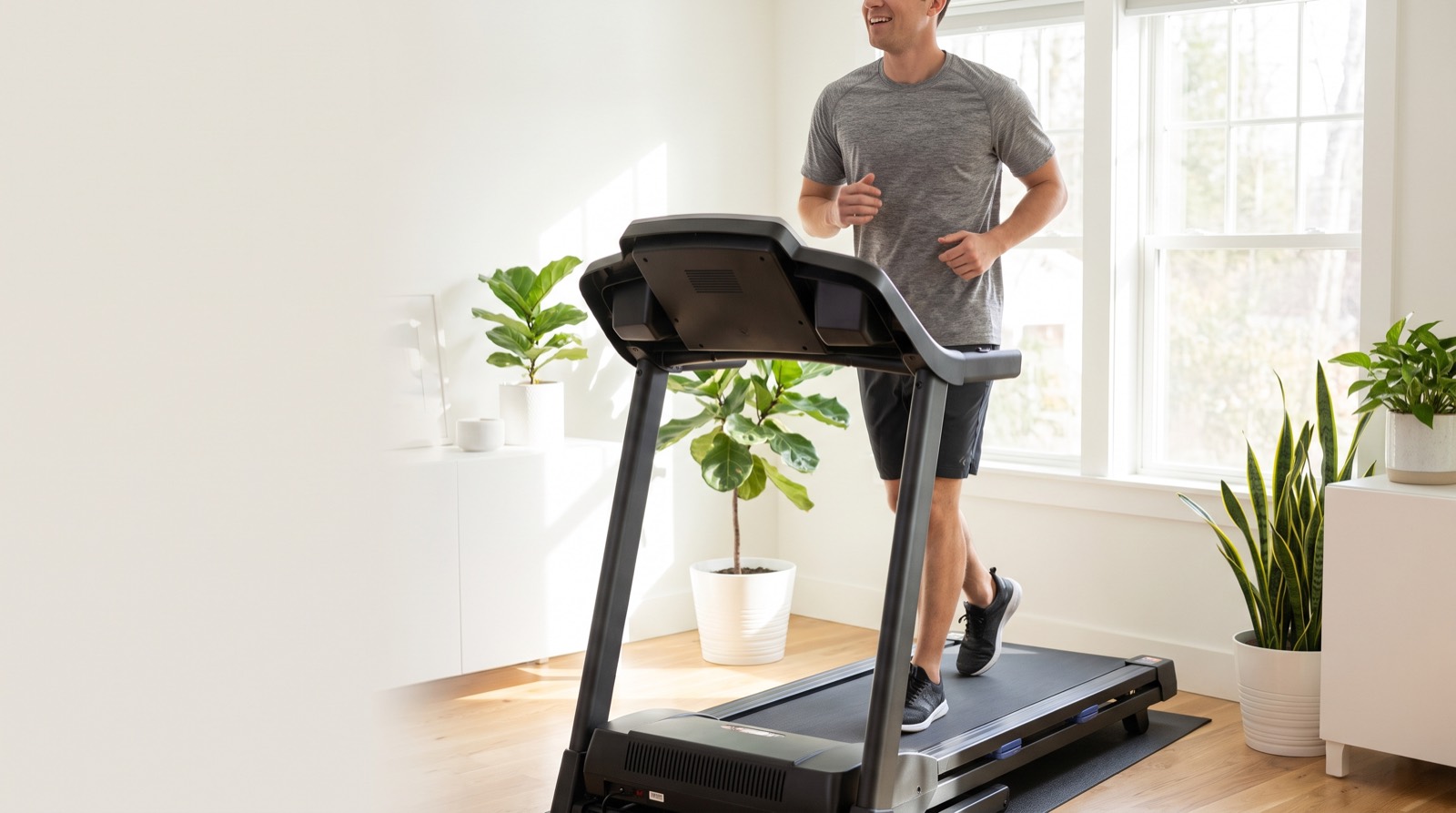
The belt keeps you where you put it
On a road, an easy run sets its own speed. A hill or tired legs slow you, and on a recovery day you let them. A belt keeps the number you typed every minute, whether your legs agree or not. That helps on an easy day and hurts if the number is wrong, because the number you type is the whole decision.
That number is an instruction to the motor, not a reading of the belt. In a lab study of four treadmills in known condition, one of them worn, belt speed averaged about 98 to 103 percent of the setting during walking and running. Your treadmill offers no way to see which side of that range it sits on.
Picture the 20 mph sign outside a school on a quiet street. It is a ceiling. Fifteen is fine, twenty-two is the problem, and no driver tries to hit twenty on the nose. A recovery pace is that sign, and the treadmill is a car that drives itself at whatever you punch into a keypad whose numbers can be a little off. Your own limit has no number painted on it, so the talk test is how you read it.
Where the ceiling comes from, and how to read yours
Your effort has a first threshold, the point where talking starts to get difficult. In one five-month experiment, two groups of runners did a similar share of hard work. The group that spent more of its training time below that threshold, and less in the zone just above it, improved its race time by more. The study measured time below the threshold, not recovery runs as such.
This run lives below the line. Any rule of thumb is only a guess at where your line sits.
Your voice is the check, because talking takes breath. In a study that included a treadmill test, the point where talking first became difficult landed right at that threshold. In another, runs held where talking stayed comfortable gave an effort the authors called compatible with recovery sessions in athletes. If talking gets difficult at your recovery setting, you are at the line or over it, so bring the belt down. To work from heart rate instead, see finding a zone 2 speed on a treadmill.
The number you carry, and the number you log
Your breathing protects today's run. The belt's error gets in through two numbers. One is the pace you carried in from a plan, a chart, last week's log or another treadmill. The other is the pace you write down afterward, the one next week's easy days get set from. Say you typed 5.3, an 11:19 mile.
Four belts, one line in the log
Four invented belts, none measured, all inside the 98 to 103 percent a 2021 lab study recorded. You typed 5.3 on each, and your plan says 11:19.
| Belt | What the belt ran | What your log says |
|---|---|---|
| Runs 2 percent slow | 11:33 | 11:19 |
| Runs the number | 11:19 | 11:19 |
| Runs 2 percent fast | 11:06 | 11:19 |
| Runs 3 percent fast | 10:59 | 11:19 |
If this belt runs 3 percent fast, the 11:19 you carried in lands near 10:59. That is 20 seconds a mile quicker than you meant, and only your breathing will tell you. If the belt runs 2 percent slow, the run was fine but your log says 11:19 for an 11:33. Next week's "a little quicker than recovery" is then built on a pace that never happened. These rows show the size of one shift at one setting, not how far a typical belt is off.
Your watch cannot settle it either. With no GPS signal, many watches estimate pace indoors from the motion of your wrist, so they may not tell a fast belt from a fast you. See where your watch's indoor pace comes from. Wrist heart rate is a separate number, and a warm, still room can push it up. Why your heart rate runs higher indoors covers that.
What to do on your next recovery day
- Read the line by breath on this machine and stay on the easy side of it.
- Treat any number you brought as a starting setting, and adjust it once you hear your breathing.
- Measure the belt at your recovery setting, so the pace you log and carry forward is the speed the belt turned. If the belt is well off, your owner's manual or a technician handles any adjustment.
Make the pace in your log a real one
The day after a hard session is the run you log without a second thought. Treadwell is for that line in the log. Leave the belt turning at your recovery number with nobody on it, and the app on a current iPhone Pro reads the speed the belt is turning, from the floor beside it. What you write down, and what next week builds on, is then the speed the belt actually turned.
Log the speed your belt really turned
The pace in your log should come from the speed the belt turned. Treadwell measures it with the LiDAR sensor and camera on a current iPhone Pro, so it needs that phone.
 Scan with your iPhone Pro to get the app
Tested: in our tachometer tests the app read within about 2 percent of true belt speed.
Quick answers
What pace should a recovery run be on a treadmill? A recovery run pace on a treadmill is a ceiling, not a target. Stay on the easy side of the line, read by your breathing on that machine. The number you typed is a setting, so the pace you carry in or log is only as true as the belt.
Can I do a recovery run on a treadmill? Yes. The belt keeps the pace you set for the whole run, so pick that pace by your breathing on that machine. Treat the number you type as a setting to check rather than a run to trust, because in a lab study of four treadmills, belt speed averaged about 98 to 103 percent of the setting, a little off in either direction.
Should a recovery run be slower on a treadmill than outside? Not by a fixed rule, because the line is an effort and not a pace. A 2019 review found heart rate on a treadmill ran lower than on the ground at slower steady speeds and higher at faster ones. Let your breathing pick the speed and let the number land where it lands.
Sources.
- The five-month experiment: Esteve-Lanao J, Foster C, Seiler S, Lucia A, Journal of Strength and Conditioning Research 21(3):943-9, 2007. Twelve sub-elite endurance runners trained for about five months. One group spent about 80.5 percent of training time below the ventilatory threshold and 11.8 percent between the thresholds, the other 66.8 and 24.7 percent, with hard training similar (8.3 and 8.5 percent). The first group improved a 10.4 km simulated cross-country race by 157 seconds, the second by 121.5 seconds. The study measured time below a threshold, not recovery runs, and the groups differed in time between the thresholds as well.
- Talking and the threshold: Persinger R and co-authors, Medicine and Science in Sports and Exercise 36(9):1632-6, 2004. Sixteen volunteers were tested on a treadmill and a cycle, and where speech first became difficult, intensity was almost exactly at the ventilatory threshold.
- Talking and recovery: Woltmann ML and co-authors, Journal of Strength and Conditioning Research 29(5):1248-54, 2015. Sixteen physically active volunteers ran 30 minutes at talk-test stages, and the last comfortable stage gave intensities the authors call compatible "with recovery sessions or long duration training sessions in athletes."
- Belts against their settings: Willwacher et al., Sci Rep 2021;11:2244. Researchers tested four lab treadmills, one of them heavily worn, at walking and running speeds; across those machines, average belt speed came out at about 98 to 103 percent of each setting.
- Heart rate indoors and out: Miller JR et al., Sports Med 2019;49(5):763-782. This review reports treadmill heart rate above overground values at the faster submaximal speeds and below them at the slower ones.
- Indoor pace from a watch: Apple Support article 105002 says that when you run indoors the watch uses its accelerometer, and that Activity credit depends on natural arm swing. The owner's manual for the Garmin Forerunner 165 describes indoor running with GPS off.
- Nothing in the table was measured. The 5.3, the four belts and the school zone are examples, and the paces are my arithmetic on them.