Guides · Treadmill hill repeats
Treadmill hill repeats: a number that makes your sessions comparable
Last month you ran six 2 minute reps at 8 percent and 6.5 mph. This week it was eight 90 second reps at 6 percent and 7.3, and you cannot say which session was bigger.
A 90 second treadmill hill repeat at 7.3 mph and 6 percent is a 964 foot hill with 58 feet of climb, if the belt runs the speed shown. Log the session as climb per hour, the one number that lets you compare the climb from reps at any grade or speed, on any belt that runs the speed shown.
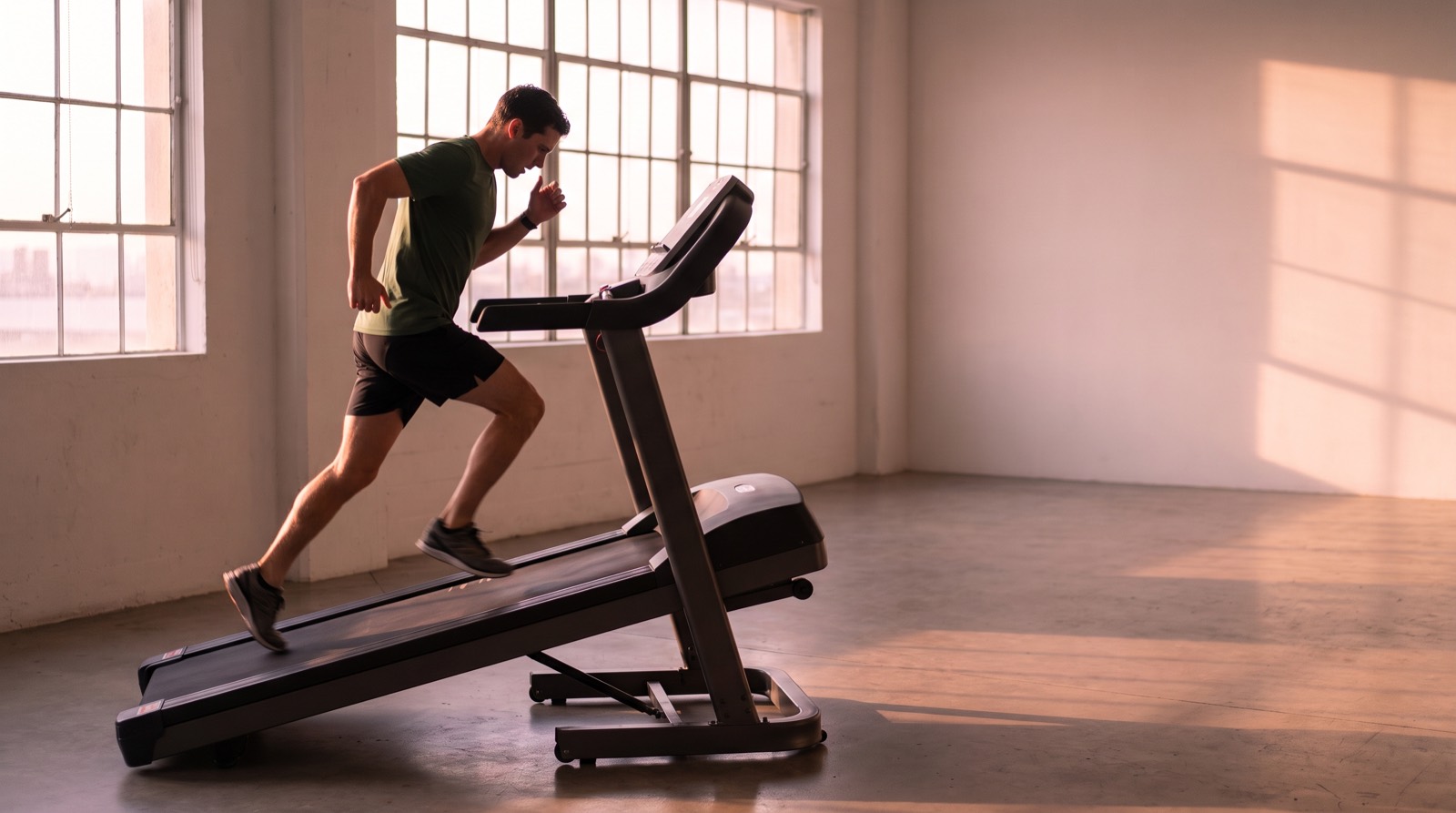
Climb is the number you can compare
A treadmill hill has no length or height until you run it. The belt carries ground under your feet at the speed you set. The grade turns a share of that ground into height, and the clock decides where the hill ends. Multiply those together and you get your climb per rep.
Climb per hour takes the rep length back out. It is the rate you gain height. On this page it is the rate while you are on the hill. The recovery between reps is not in it. That puts a 60 second rep at 8 percent and a 10 minute hike at 15 percent on one scale. Race profiles and vert goals are written in climb too, so a session logged that way lines up with the race you are training for.
Think of a faucet filling a bucket. The faucet setting sets the rate, and the run time sets how much comes out, so two buckets are compared by the water in them. Your speed and grade are the setting, the rep clock is the time, and the climb is the water.

Run last month through the same arithmetic. At 6.5 mph and 8 percent, each 2 minute rep climbed 91 feet, and the six of them banked 547 feet at about 2,740 feet per hour. This week's eight reps banked 462 feet at about 2,310 feet per hour. Last month was the bigger hill on both counts.
Four reps written out as climb
Settings I chose to show the arithmetic, not reps I measured. Each row holds only if the belt runs the speed shown and the deck sits at its grade.
| Rep | Speed (pace per mile) | Grade | Hill length | Climb per rep | Climb per hour |
|---|---|---|---|---|---|
| 60 seconds | 8.5 mph (7:04) | 8% | 748 ft | 60 ft | 3,580 ft |
| 90 seconds | 7.3 mph (8:13) | 6% | 964 ft | 58 ft | 2,310 ft |
| 3 minutes | 6.3 mph (9:31) | 4% | 1,663 ft | 66 ft | 1,330 ft |
| 10 minute hike | 3.6 mph (16:40) | 15% | 3,168 ft | 470 ft | 2,820 ft |
Climb per hour is rounded to the nearest 10 feet.
Two other settings give the same climb per hour as the 90 second row: 6.0 mph at 7.3 percent, and 8.6 mph at 5.1 percent. So a steep slow session and a fast shallow one can bank the same climb. Matching climb per hour means two sessions gained height at the same rate. It says nothing about how hard each one felt.
What the climb number rests on
Every row in that table multiplies the belt speed. Your display shows the setting the belt was asked to hold. When researchers tested four lab treadmills, including one worn machine, average belt speed ranged from 98 to 103 percent of target. Put the 90 second rep on two belts inside that span.
- On a belt 2 percent slow, the rep is 944 feet long with 57 feet of climb at an 8:23 pace, and eight reps bank 452 feet instead of 462.
- On a belt 3 percent fast, it is 993 feet with 59 feet of climb at a 7:59 pace, and eight reps bank 476.
The climb per hour you hold next month's session against is off by that same share. If next month is on another machine, the change you read as fitness may be the two belts.
Before you trust a block of hill work
The grade is the half you can check at rest, and the guide to treadmill incline accuracy shows how. The belt also reaches each new speed gradually, so start the rep clock when it gets there. The interval pacing guide covers what that ramp takes off a short rep. The speed itself only exists while the belt moves, and nothing on the machine lets you check it. Indoors many smartwatches estimate pace from the watch's own motion sensor, which is why your watch cannot see the speed under your reps. If the belt runs off, the fix falls to your manual or a technician.
Know the speed your climb is built on
The setting you run your reps at is the one worth knowing. Bring the belt to that setting, stay on the floor at the side, and let a current iPhone Pro read the moving surface with its LiDAR sensor and camera. Treadwell reads the speed your belt runs at that setting, with the deck level and nobody on it. It does not test the belt under you at grade. That reading is the starting number your climb per hour is built on.
Put a checked speed under your hill log
Read your belt at the setting your reps use, then work out the climb from that. Treadwell works on a current iPhone Pro, which carries the LiDAR sensor the reading needs.
 Scan with your iPhone Pro to get the app
Tested: in our tachometer tests the app read within about 2 percent of true belt speed.
Quick answers
How big is a treadmill hill repeat? A 90 second treadmill hill repeat at 7.3 mph and 6 percent is a 964 foot hill with 58 feet of climb, if the belt runs the speed shown. Log the session as climb per hour, the one number that lets you compare the climb from reps at any grade or speed, on any belt that runs the speed shown.
What incline should I use for treadmill hill repeats? In one six-week hill study, 20 well-trained runners were split across five hill-interval programs at 18, 15, 10, 7 or 4 percent. Averaged across the five programs, their 5K improved about 2 percent. With groups of three to five runners, that small study could not separate the grades. The authors' own conclusion was that, for now, any form of high-intensity uphill interval training can be assumed to help a 5K, so compare your sessions by climb per hour.
Does climb per hour on a treadmill match a real hill? The climb matches only if the belt runs the speed shown and the deck sits at its grade. In a 2021 study, four lab treadmills, one of them worn, held average belt speeds from 98 to 103 percent of target. A treadmill hill repeat usually has no jog back down the hill between reps, so the recovery is not the same as on a real hill. We found no study comparing a treadmill hill with a road hill for effort, so this page compares climb only.
Sources.
- Belt speed against target: Willwacher S, et al., Sci Rep 11:2244 (2021). On four lab treadmills, one substantially worn, under walking and running, mean belt speed sat within roughly 98 to 103 percent of the speed it was set to.
- Hill-interval grades: Barnes KR, Hopkins WG, McGuigan MR, Kilding AE, International Journal of Sports Physiology and Performance 8(6):639-47, 2013. Twenty well-trained runners, five six-week uphill interval programs at 18, 15, 10, 7 and 4 percent, groups of three to five; mean 5K improvement over all programs 2.0 percent, no clear optimum.
- Indoor pace on the wrist: Apple Support article 105002 says an Apple Watch uses its accelerometer on an indoor run. Garmin's Forerunner 165 manual says its watch works out indoor speed and distance from its own accelerometer.
- The sessions, the four reps, the two off belts and the faucet are examples I made up for this page. Hill length is speed times time, and climb is that length times the sine of the slope angle; I did the arithmetic myself.