Guides · Treadmill incline accuracy
Is your treadmill incline accurate?
You are on round three of hill repeats. You press 6, the deck climbs, and the display settles on 6.0. It feels steeper than the same number did at your old gym, and nothing on either machine can say which one was right.
Maybe, and your treadmill cannot tell you. Treadmills move the deck from their own zero point and show the grade you asked for, and none of the makers I checked publishes how close that lands. You can check it yourself with your phone on the stopped deck.
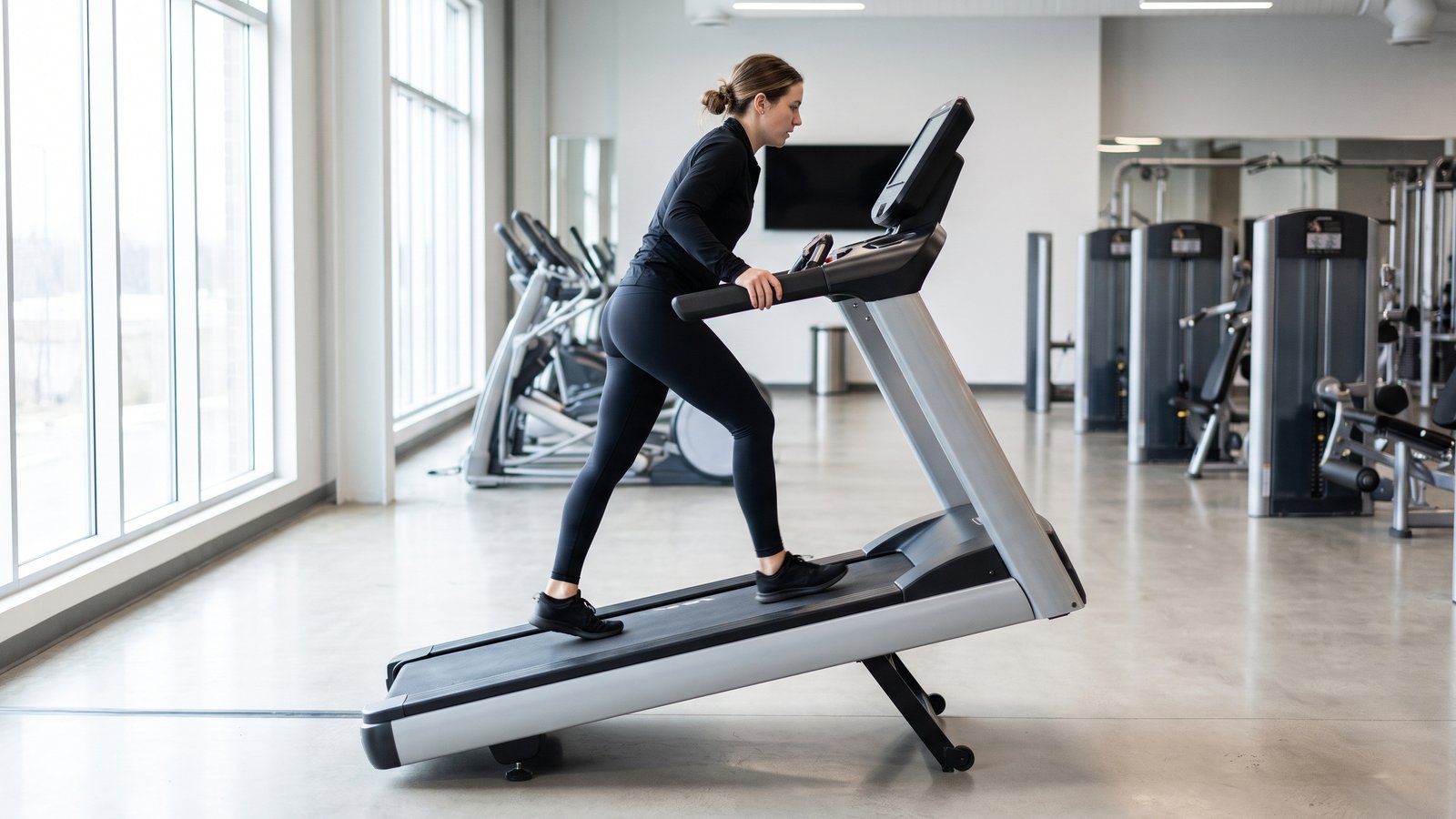
Your treadmill counts its way up the hill
You count ten steps from the bed to the bathroom in a dark hotel room, and if you started from the wrong corner, every step after that is off. You only find out when you touch the wall.
Your treadmill finds its incline the same way. It starts from a zero point and runs a small lift motor until the deck has moved far enough to match the number you pressed. Some machines have a sensor that reports where the deck sits. Others count how many turns the motor made and trust the count. Either way, everything is measured from the machine's own zero. If that zero has slipped, the display still reads 6.0, because 6.0 is what you asked for.
The machine also judges slope against its own frame, not against the ground. If the floor under it is not level, the slope you actually run on is the display plus the floor. A garage floor that runs slightly downhill toward the door can add or remove a point before the deck even moves.
Makers list how high their decks can go. The ones I checked never say how close the deck lands, and I could not find a study that measured the gap.
What a couple of points cost your hill session
Grade is not a small setting. Exercise scientists estimate treadmill effort with a standard running equation. By that equation, each point of grade at a speed of 7.0, an 8:34 mile, adds about as much work as running 4.5 percent faster on the flat.
Same session, two decks
Speed set to 7.0, an 8:34 mile. The flat pace that takes the same work, by the standard running equation.
Worked arithmetic on an example deck sitting 2 points low, not a reading I took. The equation estimates average effort for running; your own body will differ.
On that deck you finish tired and log it as hill repeats. Week after week, your progress gets measured against a hill you never climbed. The error can run the other way too, and then your easy hill day was a hard one.
That whole chart also assumes the speed of 7.0 on the display is a real 7.0. The equation multiplies speed by grade, so a belt running slow takes a second bite out of the same session.
A slipped zero also reaches the 1 percent you might leave on for every run to make up for the missing wind. That habit comes from one study, and it only helps if 1 on your display is really 1. On a deck whose zero sits a point low, you run flat while believing you added the fix. The treadmill pace vs road pace guide covers where that rule does and does not apply.
How to check your treadmill incline with your phone
Slope has one thing speed does not. It holds still long enough to measure. A recent iPhone has a level in its Measure app, and it reads the angle of whatever the phone is lying on.
- Stop the belt completely. Never put a phone or a hand on a moving belt.
- With the deck at 0, lay the phone flat on the belt near the middle, pointing along its length, and open the Level. Write down the reading.
- Raise the deck to the grade you train at. Stop the belt again and take a second reading in the same spot.
- Subtract the first reading from the second and find the result in the table.
Taking the zero reading first cancels out your floor, so the difference is the deck's own climb. One degree on the phone is about 1.75 points of grade, so treat this as a check for a deck that is clearly off, not a way to settle half a point.
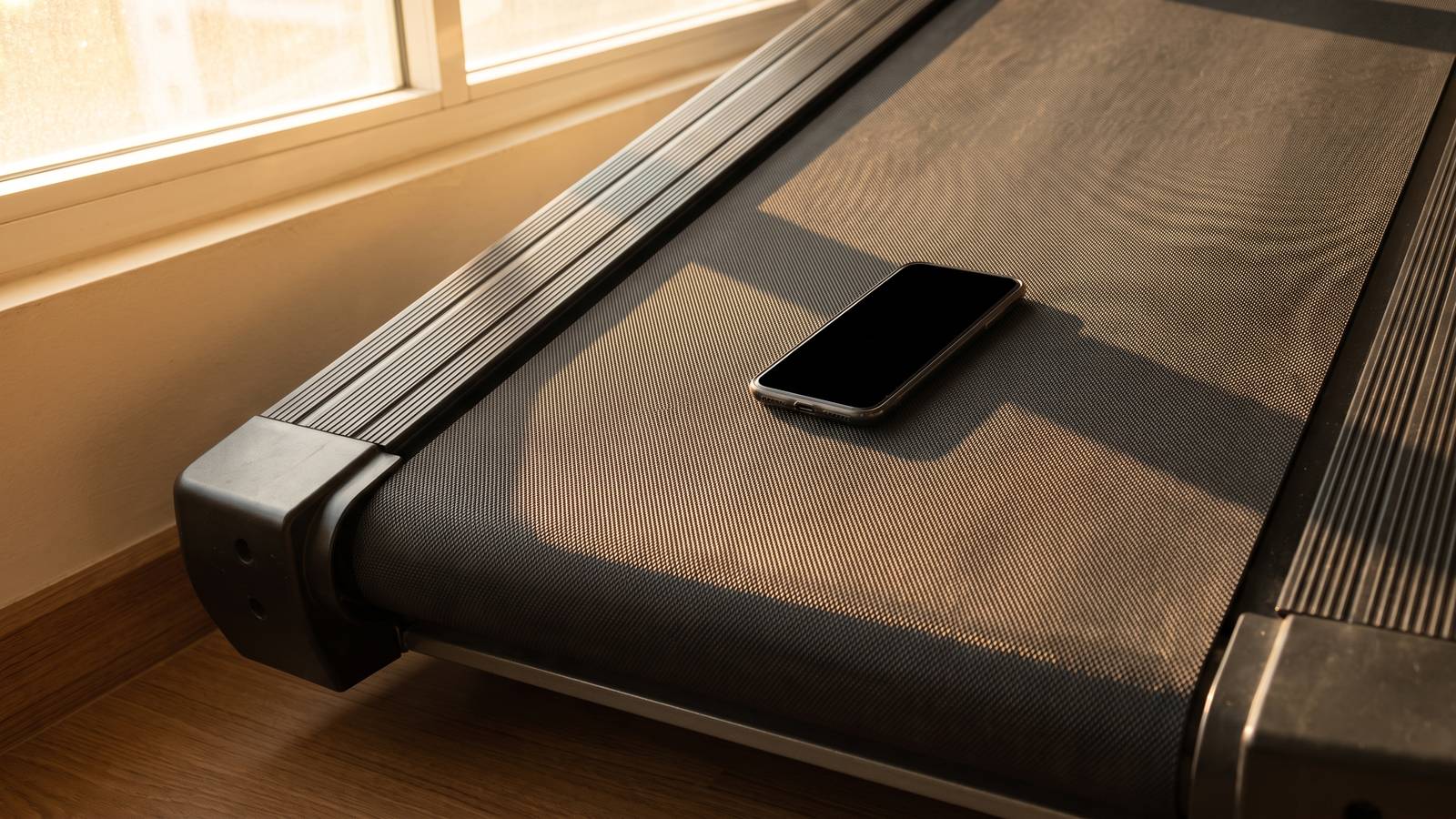
Degrees on your phone, percent on your treadmill
Treadmills show grade as a percent: the rise over the run, times 100. Your phone shows degrees.
| Phone reads | Grade | Phone reads | Grade |
|---|---|---|---|
| 1° | 1.7% | 6° | 10.5% |
| 2° | 3.5% | 7° | 12.3% |
| 3° | 5.2% | 8° | 14.1% |
| 4° | 7.0% | 9° | 15.8% |
| 5° | 8.7% |
Grade equals the tangent of the angle, times 100. One degree is about 1.75 points of grade.
If your machine drops the deck back to flat whenever the belt stops, this check will not work on it.
If your reading lands a couple of points away from the display, the fix belongs to your owner's manual or a technician. Many machines have an incline zero or calibration step, and the manual is where that step lives.
The number a stopped belt cannot show you
Every hill session has two settings, the grade and the speed. Your phone's level handles the grade, because a stopped deck keeps its slope. Speed only exists while the belt moves, so a phone lying on a stopped deck learns nothing about it. Your watch guesses it from your arm swing, and from outside the machine you cannot tell whether anything inside checks it at all.
Treadwell reads it. With the belt empty and running at your session's speed, stand at the side of the machine and hold an iPhone Pro steady above the moving belt. The camera and LiDAR sensor read how fast the surface is really going. On a hotel treadmill it had never seen, our reading matched a calibrated tachometer within half a percent. Check the grade with the level and the speed with the app, and both halves of your hill session become numbers you know.
Know the speed under your hill
See what your treadmill's belt really does, on the machine you train on. You need an iPhone Pro with LiDAR.
Quick answers
Is my treadmill incline accurate? Maybe, and your treadmill cannot tell you. Treadmills move the deck from their own zero point and show the grade you asked for, and none of the makers I checked publishes how close that lands.
Is treadmill incline in percent or degrees? Treadmills show incline in percent, which is the rise over the run times 100. A 10 percent incline is a little under 6 degrees, so a phone level reading has to be converted before you compare it with the display.
Sources.
- Incline is set from a stored zero rather than measured against the ground: Precor's TRM 700 service manual monitors lift position with a potentiometer and raises a lift-position-out-of-range fault when it disagrees; the Trackmaster manual counts elevation motor turns from a calibrated zero and states that no closed loop control is done for elevation; Sole's own calibration guide describes a grade return setting that sends the deck back to zero when Stop is pressed.
- No incline accuracy figure: the spec sheets I checked, from Precor, Matrix and Life Fitness, list incline range (such as 0 to 15 percent), never a tolerance. One 2024 biomechanics study (International Journal of Exercise Science, volume 17) measured its treadmill's slope a single time with an inclinometer and published no displayed-versus-true figure.
- The effort estimates use the running equation in the American College of Sports Medicine's Guidelines for Exercise Testing and Prescription: oxygen cost equals 3.5, plus 0.2 times speed, plus 0.9 times speed times grade, with speed in meters per minute.
- The 1 percent rule is Jones and Doust, Journal of Sports Sciences, volume 14, 1996, pages 321 to 327: nine trained male runners at six speeds from about 5:22 to 9:11 per mile.
- Indoors, a running watch has no GPS signal and estimates pace from arm motion and its accelerometer, per Apple Support article 105002.
- The iPhone Level is part of Apple's Measure app and reports how many degrees an object varies from level, per Apple's iPhone User Guide.
- The half-percent result is our own reading's accuracy on a hotel treadmill on June 30, 2026, checked the same day against a calibrated handheld tachometer. It describes our measurement, not that treadmill.