Guides · Does incline affect distance?
Does incline affect distance on a treadmill?
You finish 45 minutes at 8 percent and the display says 3.0 miles, the same as last week's flat run at that speed. It felt like twice the work, so you wonder whether the hill should have counted for more.
No. Incline does not affect distance on a treadmill. It adds climb and effort instead. At the same speed for the same time, the belt carries you the same length of ground whether the deck is flat or tilted.
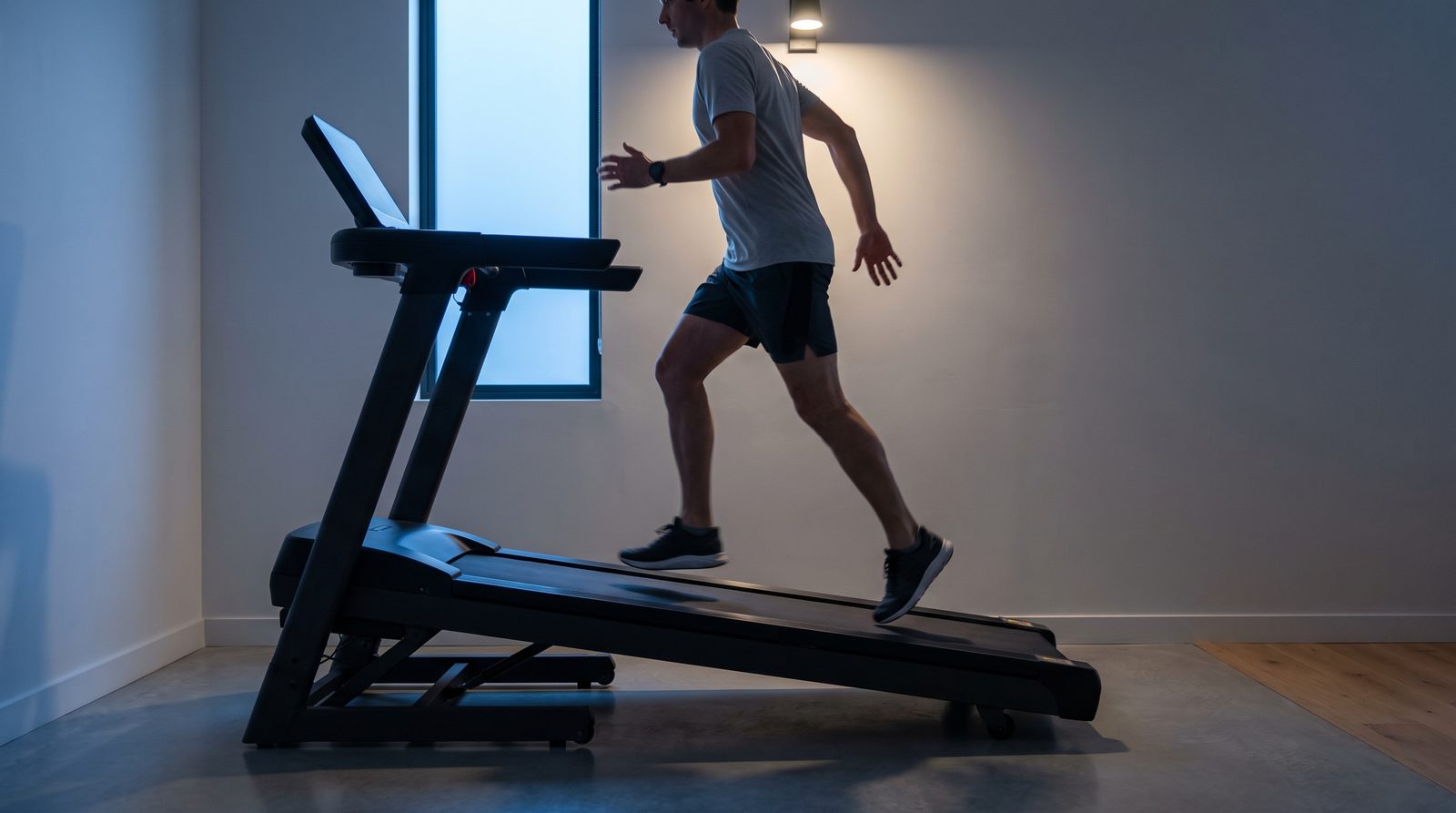
What incline adds is climb
Picture a ramp and a hallway, both 100 feet long. You walk 100 feet either way. The ramp also lifts you, so the same 100 feet costs more.
A tilted treadmill is that ramp, with one twist. Every stride lifts your body a little, and the belt carries you back down before the next one, so you finish at the height you started. The ground under your feet is the same mile it would be on the flat. The extra work you felt went into lifting yourself, over and over.
How much you climb in one mile of belt
Height gained on a real hill at the same grade, per mile you run along the slope.
| Grade | Climb per mile | Grade | Climb per mile |
|---|---|---|---|
| 1% | 53 ft | 6% | 316 ft |
| 2% | 106 ft | 8% | 421 ft |
| 3% | 158 ft | 10% | 525 ft |
| 4% | 211 ft | 12% | 629 ft |
| 5% | 264 ft | 15% | 783 ft |
Climb equals 5,280 feet times the sine of the slope angle. A 1 percent grade raises you about 1 foot for every 100 you run.
Tilting the deck does not shorten the mile either, not by any amount that matters. At 15 percent, a mile along the slope still covers 0.989 miles of level ground, a gap of about 1 percent even at that steep a grade.
So if you want your hill day to count for more, count it as climb and as effort, not as distance. The treadmill incline guide shows what each point of grade costs in pace.
The trap in the vertical feet number
Some treadmills show a vertical feet or vertical meters readout next to your distance. It stands for the height a real hill at your grade would have given you. If you train for a hilly race, you may log it as the week's climb. The climb your legs actually did depends on where the deck really sat, and nothing on the display lets you check that.
The deck reaches its grade by moving from the machine's own reference point, not by checking the slope against the floor. If that reference point has slipped 2 points, a deck showing 10 is sitting at 8. Over a 3 mile session, you climbed about 310 fewer feet than your 10 percent plan called for. Build a hilly race block on that machine and every week comes up short by the same share. You can check where your deck really sits with your phone's level on the stopped belt, and the incline guide walks through it.
Your watch will not catch it. You finish the session at the same height you started, so a watch that tracks climb from changes in height sees none at all.
The number incline cannot touch
Tilting the deck changes how hard a mile is. It does nothing to prove the mile was a mile. Speed has the same problem as grade, because the display shows the number you pressed and nothing on it lets you check what the belt did with that number. On one of the machines I run on, the display said 5 miles when I had run 4, the largest gap in my own tests, so I definitely under-ran my marathon training.
Treadwell checks that part. Lower the deck to flat, run the belt empty at your hill session speed, and hold an iPhone Pro over it from beside the machine. Its camera and LiDAR sensor read the belt's own speed. Then the 3.0 on your hill day rests on a speed you checked, and the climb on top of it stays a separate number with its own check.
Measure the belt under your hill
See what the belt is really doing at the speed you climb at. You need an iPhone Pro with LiDAR.
Quick answers
Does incline affect distance on a treadmill? No. Incline does not affect distance on a treadmill. It adds climb and effort instead. At the same speed for the same time, the belt carries you the same length of ground whether the deck is flat or tilted.
What is vertical distance on a treadmill? Vertical distance, shown on some treadmills as vertical feet or vertical meters, is the height you would have gained climbing a real hill at that grade. At 10 percent it comes to about 525 feet for every mile of belt.
Does a mile at incline count as a mile? Yes. A mile at incline is the same mile of ground as a flat mile at the same speed. Log it as a mile, and if you train for a hilly race, log the climb beside it as a separate number.
Sources.
- The vertical readout: the ProForm Trainer 8.0 owner's manual lists Vertical Distance (VRT FT or VRT M) as the distance you have walked or run in vertical feet or vertical meters, and the NordicTrack NTL17915 owner's manual lists a display option showing the number of vertical feet you have climbed.
- The deck reaches its grade from its own reference point: Precor's TRM700-16 Base service manual tracks lift position with a potentiometer; the Trackmaster manual, from a clinical and stress-test treadmill maker, counts elevation motor turns from a calibrated zero with no closed loop control for elevation; the NordicTrack NTL17915 manual's incline calibration runs the deck to its maximum and back to its minimum. None of them describes checking the slope against the floor. The incline guide covers this in full.
- Climb per mile is trigonometry: 5,280 feet times the sine of the slope angle, where the angle is the arctangent of the grade. Level ground covered is 1 mile times the cosine of the same angle.
- The 5 miles versus 4 run is one of our own tests, and the largest gap among them. The machine, the date and whether a recording was captured were not logged.