Guides · Treadmill vs indoor track
Treadmill vs indoor track: which one gives you a real mile?
The first icy week moves your workout inside. The plan says six 800s, and the rec center gives you two choices: a row of treadmills, or the oval track upstairs. You want the one where an 800 is really 800 meters.
An indoor track gives you a distance you can count yourself: count laps, stay in lane 1 close to the inside edge, and use the lap length the track posts. A treadmill gives you a number from the display, and the machine gives you no way to see what the belt really did. Indoors, your watch has no usable GPS on either surface.
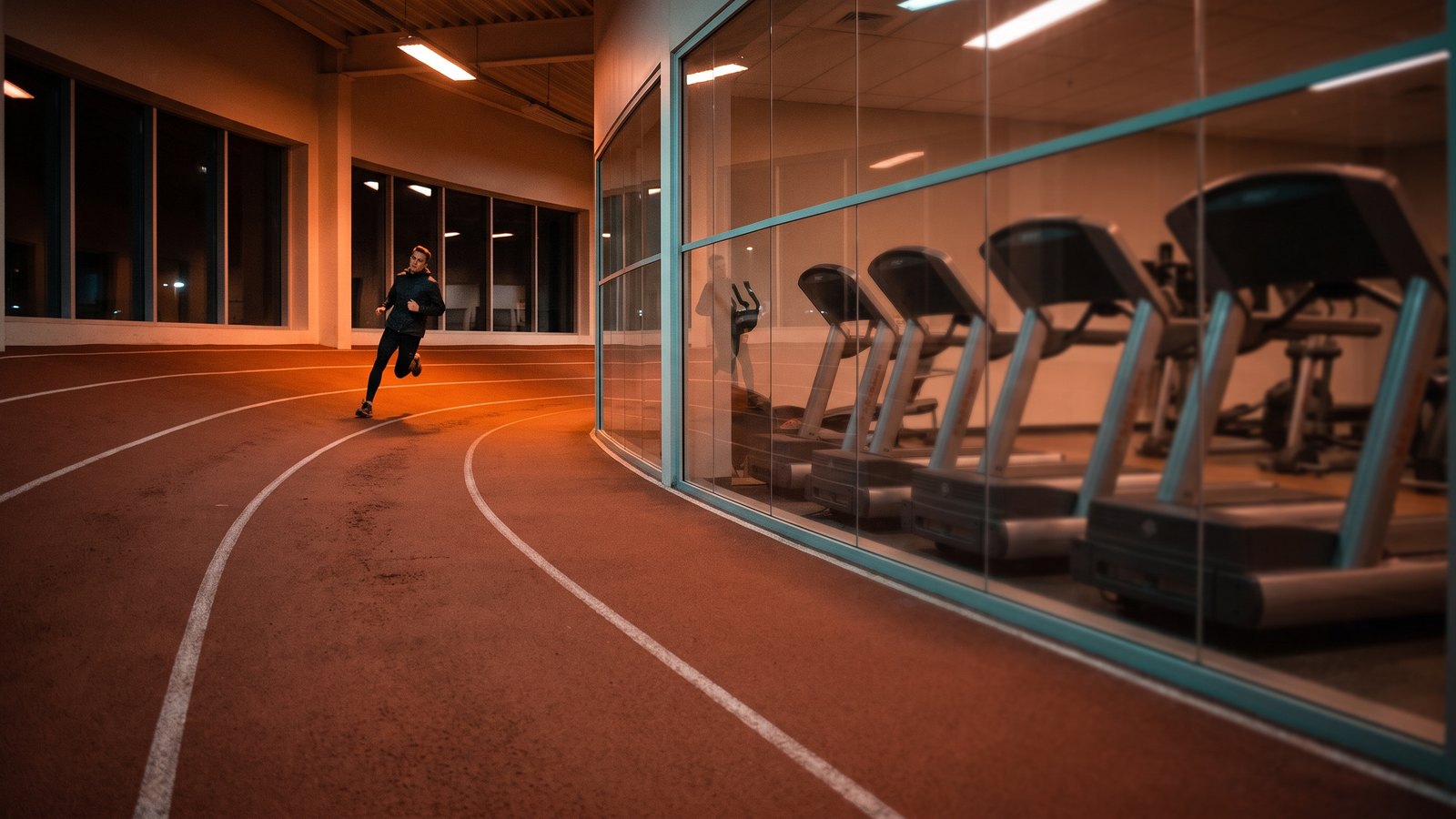
Where a track's distance comes from
A track's distance is marked on the ground before anyone runs on it. On a competition track, the lap is measured along a line 20 to 30 centimeters out from the inside edge. A qualified surveyor checks those markings. The standard indoor track for competition is a 200 meter oval, with two straights and two bends that may be banked. On a track built that way, four laps along the measured line make 800 meters, and you can count every one.
A gym or rec center track is its own case. Its lap length is whatever the sign on the wall says. If the sign says nine laps make a mile, nine laps is the mile you are counting, and the sign is the number you trust.
Think of paying cash at a store. The register shows a total, and you can still count the coins in your hand. On a track, you count the coins. On a treadmill, you only get to see the register.
How a track mile still goes wrong
A lap count is only honest if you run the line the lap was measured on. On an oval, a straight is the same length in every lane. Only the bends add distance, and the two bends together make one full circle. Run a meter wider than the line, and every lap grows by about 6 meters. That extra is the same on any oval, big or small. On a 200 meter lap, it comes to about 3 percent.
How wide you run, and what eight laps become
Eight laps of a 200 meter track, logged as 1,600 meters. The extra comes from the circle the two bends make. This is my arithmetic, not a measurement of any real track.
| Where you run | Extra per lap | Eight laps really were |
|---|---|---|
| On the measured line | 0 m | 1,600 m |
| Half a meter wide | about 3 m | about 1,625 m |
| One meter wide | about 6 m | about 1,650 m |
Say you swing wide on the bends to pass people, and your 800 split reads 3:20. If you were a meter out on every bend, you covered about 825 meters. You ran farther than the 800 you logged, so your real pace was faster than your splits. The split says 6:42 a mile, and you actually ran about 6:30. Stay close to the inside edge when you can, and the count stays honest.
Your watch's distance is no help here. A watch's outdoor track mode is built for an outdoor track, where it has satellites. Indoors, even in an indoor mode, the watches I checked estimate distance from the motion sensor inside them, the same guess they make on a treadmill. Your lap count and stopwatch are the measurement. For more on that, read why your watch and the treadmill disagree.
The treadmill side, in short
A treadmill holds a pace, and you never count a lap, which makes it a good place for a long, steady run. The display gives you a pace and a distance, and the machine offers no way to check either against the belt. A belt a few percent off turns into seconds on every mile. In one four-treadmill lab study, each belt averaged roughly 98 to 103 percent of its setting, and what that does to a mile time works out the seconds. Effort differs as well, since in a separate study trained men rated a treadmill at 1 percent incline harder than an indoor track at the same speed, and treadmill pace vs road pace covers that side.
Which one to use for what
When the number matters, use the track. Your 800s, your mile repeats and any timed effort belong in lane 1, counted in laps with the lap button. Leave the watch's distance out of it.
Long, steady runs can go on the treadmill, where the belt is set to one speed and there are no tight bends. If the pace you write down from those runs matters to you, check the belt before you trust it. For where that number comes from, read what the distance on your treadmill means.
A gym track with only a sign is honest to the sign. Run the same track every week, and your splits will still compare with each other.
A check for the belt
On the track, your own count checks the distance. A treadmill needs something that reads the moving belt. Treadwell does that from an iPhone Pro, using the phone's LiDAR sensor and its camera together. Leave the belt turning empty at the speed you run, and, standing on the floor next to the deck, aim the phone down at it. That reading is the belt's speed at that setting with nobody on it, and it is the number to check before you trust a treadmill pace. Unlike a lap count, it cannot tell you the exact distance you ran with your weight on the belt.
Check what your setting runs
Read the empty belt at the speed you train at. It works on an iPhone Pro, 12 Pro or later, because the reading depends on the LiDAR sensor.
 Scan with your iPhone Pro to get the app
Tested: in our tachometer tests the app read within about 2 percent of true belt speed.
Quick answers
Is a treadmill or an indoor track better for accurate pace? An indoor track gives you a distance you can count yourself: count laps, stay in lane 1 close to the inside edge, and use the lap length the track posts. A treadmill gives you a number from the display, and the machine gives you no way to see what the belt really did. Indoors, your watch has no usable GPS on either surface.
Why can my Garmin's distance be off on an indoor track? Indoors there is no usable GPS, so your watch estimates the distance from its motion sensor instead of measuring it. The outdoor track mode is built for satellites. On an indoor track, count your laps and press the lap button each time you cross your line.
Is a treadmill mile the same as a track mile? Not always. On a competition track, a mile is a set of laps you can count, measured just off the inside edge. A treadmill mile is the distance the display shows. It matches a track mile only if the belt carried you at the speed you set.
Is running on a track better than a treadmill? For pace work, yes, because you can count the distance yourself. For long, steady runs, the treadmill holds an even pace with no tight bends. The effort is not the same on both, and in one study trained men rated a treadmill at 1 percent incline harder than an indoor track at the same speed.
Sources.
- How a track is measured: World Athletics Technical Rules, Book C2.1, Rule 14 (Track Measurements). The lap is measured 0.30 m out from the curb, or 0.20 m from the inside line where a bend has no curb. Rule 10 says a qualified surveyor checks the markings of competition facilities.
- The indoor oval: World Athletics, Competition and Technical Rule Amendments, August 2023 (Short Track), in force from 1 November 2023. The standard indoor track is a 200 m oval with two straights and two bends, which may be banked.
- The extra distance from running wide is my arithmetic. The two bends of an oval add up to one circle, so each meter outward adds about 6.3 m per lap.
- Watch track modes: the Garmin Forerunner 965 owner's manual says its outdoor Track Run mode is for a standard 400 m outdoor track and waits for satellites, and that for indoor activities GPS is off, with distance taken from the accelerometer inside the watch. The Apple Watch user guide says the watch offers a Track workout when you start an Outdoor Run, and Apple's measurement-accuracy support page says the watch uses its accelerometer on indoor runs.
- Effort on an indoor track and a treadmill: Pind R and co-authors, Research Quarterly for Exercise and Sport 90(4):470-478, 2019. Seventeen male endurance athletes ran 4-minute bouts at 11, 13 and 15 km/h on an indoor track and on a treadmill at 1 percent incline. They used less energy on the track, and they rated the treadmill harder at every speed.
- Belts against their settings: Scientific Reports 11:2244 (2021), Willwacher S and colleagues. The study measured four treadmills, including one with a badly worn belt and deck, while people walked and ran on them. Averaged over each run, each belt landed in a range of roughly 98 to 103 percent of its own setting.
- The six 800s, the 3:20 split and the nine-lap sign are made up to show the arithmetic. I measured no track for this guide.