Guides · Treadmill miles vs outdoor miles
Treadmill miles vs outdoor miles: are they the same distance?
The first frozen morning of the season moves your long run indoors, and the plan still says 12 miles. Ninety minutes later the display reads 12.0, your watch reads something close, and you log it the way you logged every outdoor mile this year. Whether those were the same miles is a fair question, and it has two different answers.
They are not quite the same, in two separate ways. On a treadmill the distance is a different kind of number. Outdoors your watch measured the ground you covered and came within a few percent. On a treadmill the miles come from a machine that never checks its own belt, and on one machine I measured, the treadmill and my watch both said 5.6 miles when the belt had moved 5.0. The effort is the other half, and a 1 percent incline is the usual fix.
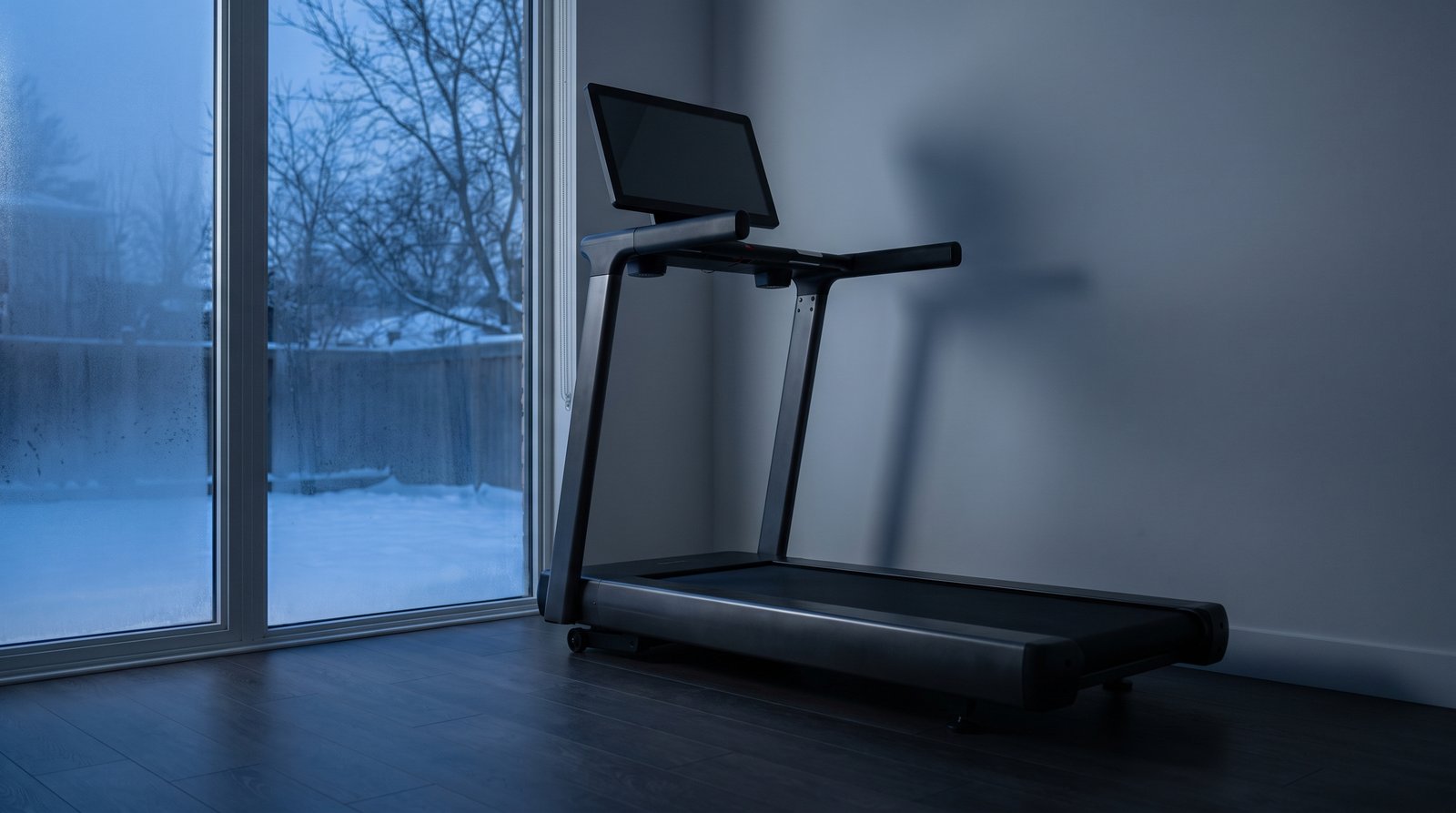
Two questions hiding in one
When runners ask whether treadmill miles count, they usually mean effort. Is an indoor mile as hard as an outdoor one? That has a settled answer and a cheap fix. The question underneath it is the one a winter block turns on. Is a treadmill mile the same length as an outdoor mile? Nobody at the gym has checked, and the machine cannot check itself.
The effort half, and its fix
Indoors there is no air to push through, so the same speed costs a little less energy than it does on the road. Runners fix that with a 1 percent incline. In the study behind the rule, nine trained runners at paces between about 5:22 and 9:11 per mile matched their outdoor energy cost on the belt with that small grade. The study did not test slower paces. There the 1 percent is a convention, and a flat deck is the usual advice. If effort is your question, the guide on treadmill pace vs road pace covers it fully.
The incline settles the effort. It does nothing to the distance, and it assumes the speed it is correcting is true.
Where each mile comes from
An outdoor mile is a measurement. Your watch checks your position against satellites the whole way round and adds up the ground you covered. It is not perfect. A study of eight sport watches found them 3 to 6 percent off outdoors. It is still a measurement of the ground, taken by something watching you move across it.
A treadmill mile is a report. When you press 6.0, the machine runs the motor at whatever it has stored for 6.0, and the display shows 6.0 because that is what you asked for. Some machines watch a part turning near the motor. As far as I have been able to find out, nothing on any of them watches the belt surface your feet are on. The display works like the volume knob on an old amplifier. The number on the dial is where you turned it, and nothing inside the amplifier listens to how loud the room is. Turn two amplifiers to 6 and you get two volumes. Press 6.0 on two treadmills and you can get two belt speeds, each showing you the same number.
Two kinds of mile
| An outdoor mile | A treadmill mile | |
|---|---|---|
| What measured it | Your watch, from satellites, the whole way round. | Nothing. The display shows the speed you set. |
| How far off | 3 to 6 percent, in a study of eight sport watches. | Unknown until someone measures the belt. One machine I measured read 12 percent high. |
| What checks it | The route. A known loop, a race course, a track. | Nothing on the machine. Your watch has no GPS indoors, and some watches copy the machine's number. |
The 12 percent is one machine I train on, graded against its tachometer table. It is in this table because it is the run I have, not because 12 percent is typical.
Your watch does not settle it indoors. With no satellites to reach, it estimates distance from your arm swing, and some watches ask you to type in what the treadmill said so they can match it. On one machine I train on, the treadmill and my Apple Watch both read 5.6 miles at the end of a run. The belt had moved 5.0. The two numbers agreed with each other and both were wrong.
What a winter of that costs
A machine's error does not come and go with the weather. On one treadmill I checked with a tachometer twice, nine days apart, all three speeds I tested landed within 0.6 percent of the first reading. That is one machine, three settings and two dates, so it is not a law. It is what you would expect from a setting nobody has touched. Whatever your machine is doing in November, it is most likely still doing in February.
Nothing in a normal service catches it either. A service checks belt tension and lubrication. No service schedule I have found holds the display against the belt, so a freshly serviced machine can carry the same gap out of the shop.
That is the part that matters for a winter block, because a treadmill plan is written in the display's speed and the clock. Forty miles a week at a displayed 6.0 is about six hours and forty minutes on the belt. If the belt really runs 5 percent slow, those same hours move 38 miles of belt under you, and twelve weeks of them come to 24 miles you planned and never ran. Those are round numbers for a typical block, not a machine I measured, and a belt can run fast as easily as slow. What does not change is the shape of the problem. Every workout is set off the display, every session runs to the minute, and your spring race gets paced off a number your legs never ran.
Twelve weeks on a belt running 5 percent slow
Worked arithmetic on a typical block planned by display speed and time, not a machine I measured.
A belt 5 percent fast turns the same block into 24 miles you ran and never planned. Either way, every pace on the plan was set off a number nothing checked.
What you can do about it
The incline fixes effort and your watch cannot referee indoors, so neither one tells you what the belt did. If you rotate between machines at a gym, each one is its own setting, and the one you know tells you nothing about the one beside it. The only way to know what a treadmill mile is worth is to measure the belt itself.
Treadwell does that from beside the machine. Point your phone at the moving belt and its camera and LiDAR sensor time the surface as it passes, so the speed it gives you belongs to the belt and not to the setting. Do it once on the machine you will spend the winter on, and every mile after that is a mile you can count alongside the outdoor ones. You need an iPhone Pro for it, since the LiDAR sensor only ships on the Pro models.
Know what your winter miles are worth
Treadwell measures your treadmill's real belt speed in seconds, on the machine you are about to spend the season on. It requires an iPhone Pro with LiDAR.
Quick answers
Are treadmill miles the same as outdoor miles? They are not quite the same, in two separate ways. On a treadmill the distance is a different kind of number. Outdoors your watch measured the ground you covered and came within a few percent. On a treadmill the miles come from a machine that never checks its own belt, and on one machine I measured, the treadmill and my watch both said 5.6 miles when the belt had moved 5.0. The effort is the other half, and a 1 percent incline is the usual fix.
Is treadmill distance the same as outdoor distance? No. Outdoor distance is measured from your position by GPS, and a study of eight sport watches found it 3 to 6 percent off outdoors. Treadmill distance comes from the machine's own settings with nothing checking the belt, and on one machine I measured the display sat 12 percent above what the belt had moved. That is one machine, not a rule, and a belt can run fast as well as slow.
Does a 1 percent incline make a treadmill mile equal to an outdoor mile? It matches the effort, not the distance. The study behind the rule tested trained runners between about 5:22 and 9:11 per mile, so outside that band the 1 percent figure is a convention rather than a tested result. At any pace, the incline changes nothing about how far the belt moved.
Can my watch tell me the real distance on a treadmill? No. Indoors the watch has no GPS, so it estimates distance from your arm swing. Typing the treadmill's distance into the watch does not fix that, because it only teaches the watch to repeat the treadmill's number, and as far as I have been able to find out, nothing on the treadmill checks that number against the belt either.
Sources.
- Jones AM, Doust JH, "A 1% treadmill grade most accurately reflects the energetic cost of outdoor running," Journal of Sports Sciences 14(4):321-327, 1996. Nine trained male runners, six speeds from about 5:22 to 9:11 per mile, treadmill grades of 0 to 3 percent against a level outdoor road; a 1 percent grade equalized the energy cost across that range. The paper does not cover slower or faster paces, and the point that the correction stops mattering below that range is the usual reading of it, not a result it reports.
- "Accuracy of Distance Recordings in Eight Positioning-Enabled Sport Watches," JMIR mHealth and uHealth 8(6):e17118, 2020. Eight watches from Apple, Coros, Garmin, Polar and Suunto, outdoors; mean absolute distance error from 3.2 to 6.1 percent.
- Garmin Forerunner owner's manuals (165, 255, 265, 955, 965 and 970), Indoor Activities: GPS is turned off for indoor activities and speed and distance are calculated using the accelerometer. The same manuals carry a Calibrating the Treadmill Distance step that asks the wearer to read the treadmill display and enter the distance into the watch. Checked for these Forerunner models only.
- Apple Support article 105002: Apple Watch uses its accelerometer for indoor runs.
- Horizon Fitness service manuals (2003-2004 Series T20, T30 and T40; RST5.6 and RCT7.6), Matrix T3x-03 and T7xE-03 service manuals, all on Johnson Health Tech's own content site, and the Precor Experience Series service manual (TRM 885.v2, 835.v2 and 811.v2). Between them: a speed sensor on the front roller pulley, an optical sensor on the motor, a motor sensor the manual says not to connect, and an AC drive base with no speed sensor at all. That none of these watches the belt's running surface is my own reading of those documents, and it covers the manuals I could reach rather than every treadmill made.
- That a service never holds the display against the belt is my own reading of seven makers' published maintenance schedules (Precor, Cybex, Life Fitness, Matrix, True, Bowflex and NordicTrack), which are listed in full on the how-often-serviced guide linked above. Every scheduled item keeps the belt moving smoothly; none compares displayed speed to belt speed.
- The 5.6 against 5.0 is my own run on a machine I train on regularly, June 2026, on an iPhone 17 Pro. The treadmill display and my Apple Watch both read 5.6 miles; the belt's true distance was 5.0, graded against that machine's standing tachometer table rather than a same-day handheld reading.
- The nine-day repeat is my own check on a different machine I train on: a handheld tachometer at three speed settings on 2026-06-28 and again on 2026-07-07, every setting within 0.6 percent of the first reading. One machine, three settings, two dates.
- The 40-mile week and the 5 percent figure are worked arithmetic on a typical block, chosen to show the shape of the cost, not a machine I measured.