Guides · Gerkin treadmill test
Gerkin Treadmill Test: Does Belt Speed Matter?
Say you take the Gerkin protocol, the firefighter treadmill test, at one fire station, then retake it months later on another station's treadmill. Nothing about you changed, but your score did. The test has its own error. A belt may also run at a different speed than its label shows. This is not a verdict on any department's test. It is what the score assumes about the belt.
The Gerkin test scores how many minutes you last before your heart rate hits about 85 percent of your predicted max. Each extra minute raises the VO2 max estimate. Reasoning, not a measured result: a belt running a little slow would make the early stages easier and add minutes, and a fast one would take them away.
How the Gerkin protocol turns minutes into a score
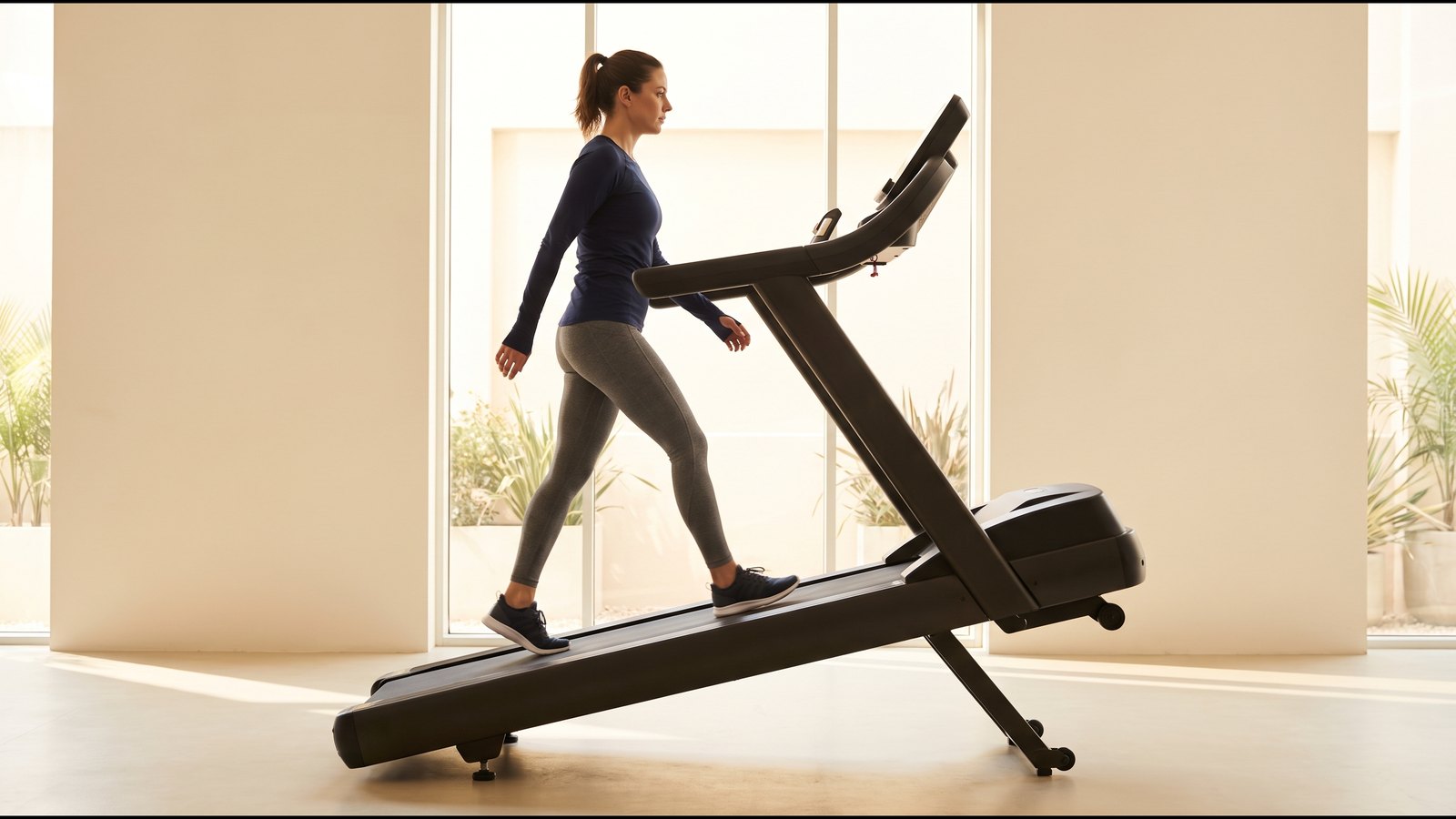
The Gerkin is a walk that gets harder each minute. A 2024 study takes its equation from a paper on the firefighter WFI treadmill test. In its version, you warm up for 3 minutes at 3 mph (4.8 km/h) on a flat belt. After that, the speed or the grade goes up each minute. Your department's protocol sheet sets the steps. The test ends when your heart rate reaches about 85 percent of your predicted max.
The study prints the score as VO2 max = 56.981 + 1.242 x minutes minus 0.805 x BMI (body mass index). So every extra minute is worth about 1.2 points. The equation never looks at the belt. It trusts that each stage ran at its printed speed.
How belt speed could reach your score through your heart
This link is reasoning, not a measured result. No study has timed it.
Say someone quietly made every step of a stair climb a little shorter. You reach each floor less tired, so you keep climbing longer and look fitter than you are. A slow belt does the same here. Each stage is easier than its label. Your heart rate rises more slowly, so the clock keeps running. A fast belt does the opposite. Your heart rate climbs sooner, so the clock stops early.

How far off can a belt be?
Four lab treadmills in one study ran, on average, somewhere between 98 and 103 percent of their dial setting as people walked and ran on them. As an example, set a belt to 4.5 mph. If it runs 2 percent slow, it really moves at about 4.41 mph. That is about 13:36 a mile instead of 13:20, and the display would still say 4.5.
Made up for illustration: say the clock ran 30 seconds longer. The equation adds 1.242 x 0.5, about 0.6 points. No study says how many seconds a given belt error adds, so treat the size as unknown.
A fraction of a point can still matter. One study notes that some fire departments use about 42 ml/kg/min as a fitness-for-duty line. Near that line, a small shift could put a result on either side.
What extra seconds are worth in the equation
This is our arithmetic from the printed equation. It only turns seconds into points. No study ties a belt error to seconds.
| Clock runs longer by | Math | VO2 max points added |
|---|---|---|
| 15 seconds | 15 x 1.242 / 60 | about 0.31 |
| 30 seconds | 30 x 1.242 / 60 | about 0.62 |
| 60 seconds | 60 x 1.242 / 60 | about 1.24 |
If the clock stops that much sooner, the same points come off.
The test already has wiggle room
A 2024 study of only 24 firefighters found the Gerkin over-predicted by about 6 percent on average. Any belt error would add to that.
Know the belt you practice on
The test is fixed, so check the belts you practice on. If your department also runs the 1.5 mile run on a treadmill, the same belt question applies. If your watch gives you a VO2 max figure, see whether treadmill runs throw that number off.
Treadwell measures how fast a belt really moves, using an iPhone Pro's LiDAR and camera. Take readings at the settings the early stages use, from 3 to 6 mph. Each reading shows how that setting compares with its label. Then you know the speed behind your practice minutes. The speed-to-pace chart turns each true speed into the pace you really walked.
See what your belt really runs
Read each early-stage setting before practice. Treadwell is built for the iPhone Pro, whose LiDAR sensor sits behind every reading.
 Scan with your iPhone Pro to get the app
Quick answers
How does belt speed affect the Gerkin treadmill test? The Gerkin test scores how many minutes you last before your heart rate hits about 85 percent of your predicted max. Each extra minute raises the VO2 max estimate. Reasoning, not a measured result: a belt running a little slow would make the early stages easier and add minutes, and a fast one would take them away.
What heart rate ends the Gerkin test? The test stops when your heart rate reaches about 85 percent of your predicted max. In the 2024 study, that predicted max came from a formula based on age. Your department's protocol sheet gives the exact formula it uses.
Is the Gerkin test accurate? It is an estimate, not a direct measurement of VO2 max. A 2015 study of 59 men put the error of the firefighter WFI treadmill test at about 11 percent. The 2024 study used that test's equation. That same study, in 24 firefighters, found the Gerkin estimate over-predicted by about 6 percent on average. A 2010 study found newer equations predicted better and called direct measurement the better choice.
Does it matter which treadmill I practice on? It can. Four treadmills in one lab study each averaged somewhere between 98 and 103 percent of the dial setting, with walkers and runners on the belt. Two machines on the same setting may not move the same. Know each belt's true speed before you compare a practice day with test day.
Sources.
- Protocol, equation and end point: Donahue and colleagues, "Using a Walking Test to Assess Firefighter Fitness," International Journal of Exercise Science, 2024 (volume 17, issue 4, pages 285 to 297; PMC11042844). Warm-up of 3 minutes at 4.8 km/h and 0 percent grade, then the speed or the incline rose each minute, ending at 85 percent of maximal heart rate. In 24 firefighters the Gerkin estimate averaged 40.48 against 38.1 ml/kg/min measured directly.
- WFI treadmill test error: Dolezal and colleagues, "Validation of the firefighter WFI treadmill protocol for predicting VO2 max," Occupational Medicine, 2015 (volume 65, issue 2, pages 143 to 146; PMID 25567508). In 59 men, about 11 percent error, with values clustering around 42 ml/kg/min, which the authors describe as a criterion some fire departments use for fitness for duty.
- Newer equations: Tierney and colleagues, Journal of Strength and Conditioning Research, 2010 (volume 24, issue 3, pages 757 to 764; PMID 20145563). Two new submaximal equations predicted peak VO2 more accurately than the Gerkin equation; direct measurement remained the better option.
- Treadmill speed versus its setting: Willwacher and others, Scientific Reports volume 11 (2021), paper 2244. With volunteers walking and running on four lab treadmills, mean belt speeds sat near 98 to 103 percent of each target.
- My own notes: the retake at a second station, the 4.5 mph stage at 2 percent slow and the 30 extra seconds are made-up examples, not a test I ran. The stair climb is an illustration. The link from belt speed to test time is reasoning, not a finding.