Guides · Treadmill incline walking calories
Treadmill incline walking calories burned, and what moves that number
You walk 30 minutes at 12 and 3.0, and the display says you burned about 300 calories. Last week the other machine gave you a different total for the same settings, and now you wonder what went into that number.
By the standard equation, 30 minutes at 3.0 mph and 12% incline burns about 295 calories at 150 pounds and 394 at 200. The incline makes most of that. At 12%, each point of grade moves the figure about 5%, and the display shows the machine's own grade setting, not a slope checked against level ground.
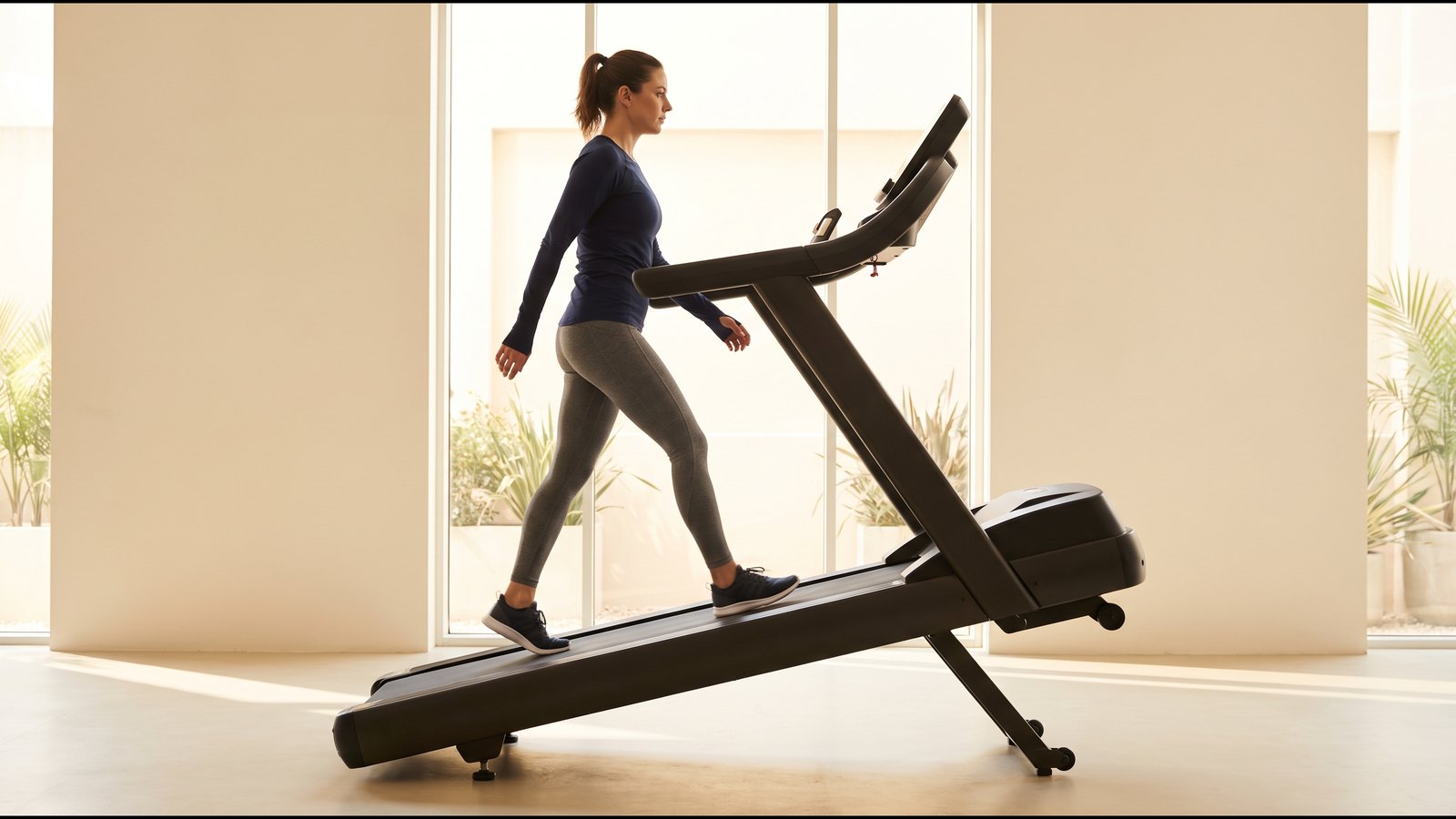
The number comes from your speed, your grade and your weight
A walking calorie figure comes from a formula. The standard walking equation splits your effort into three parts. The first part is the small cost of being alive, which you would burn sitting in a chair. The second part pays for moving forward, and it grows with speed. The third part pays for lifting your body up the hill, and it grows with speed times grade. Your weight scales the whole sum.
Picture a taxi meter on a hill route where most of the fare is a climbing surcharge. The miles add a little to the bill. The surcharge line is most of it. If the meter gets the hill wrong, your fare moves far more than a small slip in the miles ever could.

Your treadmill most likely works from the same three settings: the speed you set, the grade you set and whatever weight it has for you. We found no maker that publishes which formula a given machine uses, so the table below runs the standard equation that many online calculators say they use. Whether any formula fits your own body is a separate question. Our guide on whether treadmill calories are accurate takes that one on.
Calories by incline at 3.0 mph
Calories for a 30 minute walk at 3.0 mph
A 3.0 setting is a 20:00 mile. These are gross calories from the standard equation, so they include what you would burn standing still. They are estimates, not measurements of any real walker.
| Incline | 150 lb walker | 200 lb walker |
|---|---|---|
| 0% | 118 | 157 |
| 3% | 162 | 216 |
| 5% | 192 | 256 |
| 8% | 236 | 315 |
| 10% | 266 | 354 |
| 12% | 295 | 394 |
| 15% | 340 | 453 |
Look at the 12% row. About 60% of that figure is the climb, and the rest is the flat walk plus the cost of standing still.
Why one point of incline moves the number more than a slow belt
Stay at 3.0 and 12% and change one input at a time. Say the belt runs 2% slow. In one lab test, four treadmills carrying people who walked and ran kept their belts within 98 to 103 percent of each setting. A belt 2% slow sits at the bottom of that range. By the equation, the slower belt trims the real cost of your walk by under 2%.
Now say the deck sits one point low, at 11% while the display reads 12. A figure built from the 12 setting assumes 12. Your body did the work of 11, so your walk really cost about 5% less than that figure. Two points low makes it 10%. Both numbers are our arithmetic from the standard equation, not readings from any machine.
Belt speed at least has a published lab range. We could find no published range for how close a deck sits to the grade it shows. The display shows the grade the machine was told to reach, and it judges that climb from its own idea of level. So on a steep walk, the grade is the setting we would trust least. The guide to checking treadmill incline accuracy walks through testing the slope.
What it costs you
Say you walk 12 and 3.0 at the gym during the week and on your home treadmill on Saturday. If one deck sits a point or two off the other, the same 12 and 3.0 costs your body about 5 or 10% more on one machine than on the other, and the two calorie totals may not show it. A week that looks like progress, or one that looks like a slump, may only be two decks that disagree.
Even with perfect settings, the formula is still an estimate. When researchers fed the same weight and speeds over gentle hills into four published walking equations, the totals came out as much as 37% apart. The gaps were widest at slow walking speeds, and we found no such test on steep grades. That gap is between formulas, not an error in any treadmill. Compare calorie totals only from the same machine.
If you log distance from these walks, the guide to reading treadmill distance shows what that total is really counting. The 12-3-30 speed guide shows what a belt error does to it.
Check both settings under your number
Two settings sit under that calorie figure. In our examples, the grade moves it more, and you can check the grade on a stopped deck. The speed moves it less, but you can only check it while the belt is moving. It also builds the miles on your display. Treadwell reads the moving belt with the camera and LiDAR sensor of an iPhone Pro. Lower the deck to flat, set your walking speed, keep the belt empty and take the reading standing beside the machine. Then raise the deck and start your walk. You now know what speed the belt runs at with no one on it.
Measure the belt speed behind your calorie total
Take the reading with the deck flat at your walking speed, then climb. Treadwell needs an iPhone Pro to work.
 Scan with your iPhone Pro to get the app
Tested: in our tachometer tests the app read within about 2 percent of true belt speed.
Quick answers
How many calories does treadmill incline walking burn? By the standard equation, 30 minutes at 3.0 mph and 12% incline burns about 295 calories at 150 pounds and 394 at 200. The incline makes most of that. At 12%, each point of grade moves the figure about 5%, and the display shows the machine's own grade setting, not a slope checked against level ground.
Does incline walking burn more calories than running? Walking at 3.0 mph on a 15% incline costs about the same per minute as running flat at 5.5 mph, a 10:55 mile. Running flat at 6.0 mph, a 10:00 mile, costs more. That is our arithmetic from the two standard equations, and it compares effort per minute only. It says nothing about which workout trains you better.
Is a treadmill walking calorie calculator more accurate than the machine? Neither one looks at your treadmill. A calculator builds its figure from the speed, grade and weight you type in, and your treadmill most likely works from the same three settings, so a wrong setting misleads both. Calculators can also run different equations, so two of them can give different totals for the same walk.
Does holding the rails change incline walking calories? If a machine builds its figure from your settings, leaning on the rails does not change it. Your body does less work when you lean on the rails, so the real cost of the walk can drop below that figure.
Sources.
- The standard walking equation, from the ACSM Guidelines (Exercise Testing and Prescription), sets oxygen cost in mL per kg per minute at 3.5 + 0.1 x speed + 1.8 x speed x grade, with speed in metres per minute and grade as a fraction. These are the resting, forward and lifting parts.
- Equation values checked against Stoedefalke K, Hawkins MA, J Am Coll Health 70(1):130-133, 2022, which prints the equation's values at 3.0 mph for 2 and 4 percent grade.
- Calories from oxygen: the usual conversion of about 5 calories per litre of oxygen.
- Equations that disagree: Weyand PG, Ludlow LW, Nollkamper JJ, Buller MJ, J Appl Physiol 131(4):1272-1285, 2021. Given identical weight, speed and gradient inputs, four walking equations gave predictions up to 37 percent apart (between two of the four, at slow speeds, on gentle gradients, in computed comparisons). Against measured unloaded outdoor walking on gentle hills, the ACSM equation overpredicted by 13 percent.
- Better-fitting equations: Ludlow LW, Weyand PG, J Appl Physiol 123(5):1288-1302, 2017, and Lankford DE and co-authors, Eur J Appl Physiol 120(9):2095-2104, 2020.
- Belt speed range: Willwacher et al., Sci Rep 11:2244 (2021). Four lab treadmills kept stride-averaged belt speed inside a 98 to 103 percent window around target.
- Incline: our search found no published accuracy range for treadmill incline.
- The table, the 60 percent share, the 5 percent per point, the slow belt example and the walking versus running comparison are our own arithmetic from the standard ACSM walking and running equations. The taxi meter is an example we built for this page.