Guides · New treadmill feels faster?
New treadmill feels faster? New means unworn, not checked
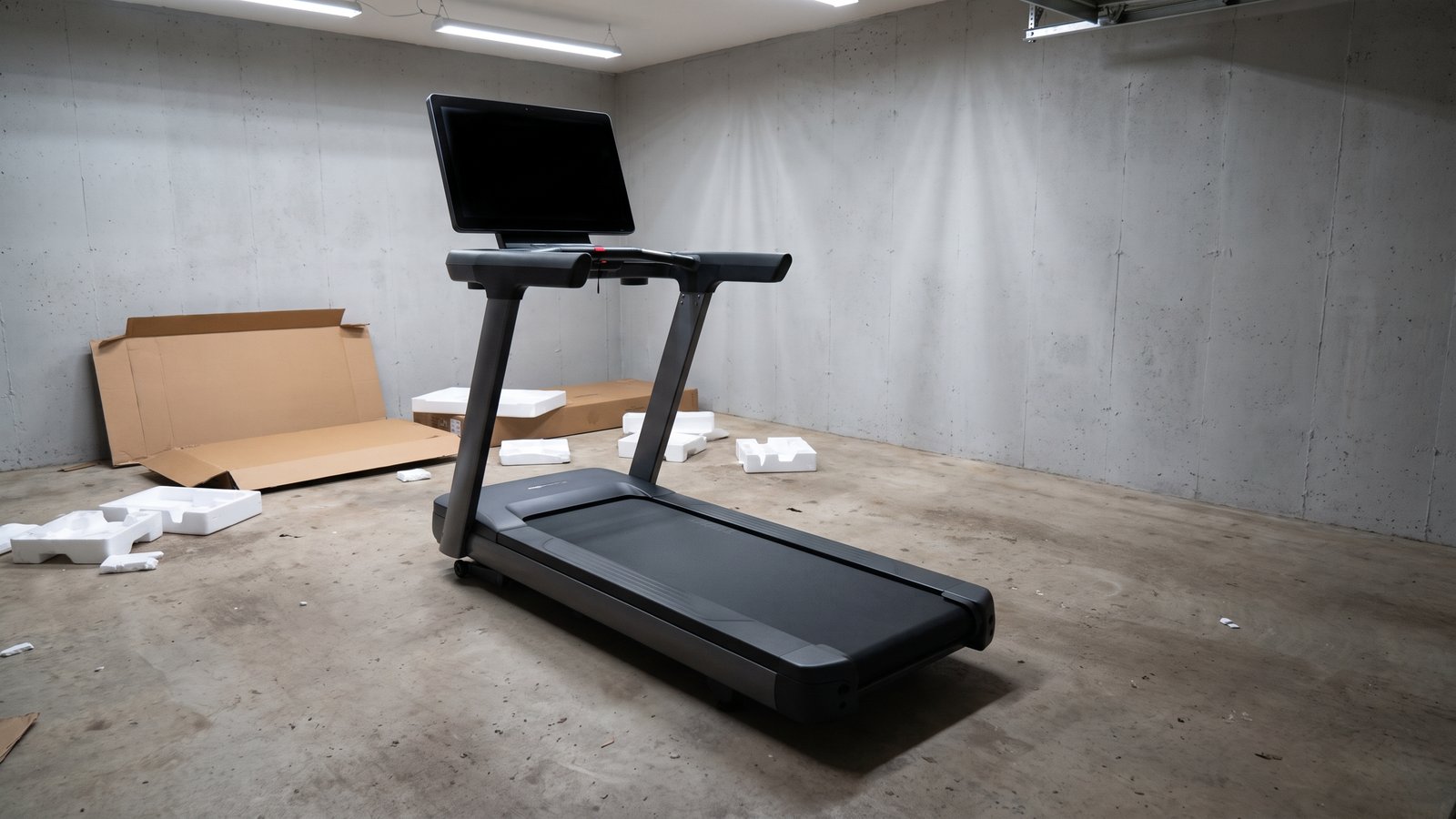
The new treadmill is finally set up in the garage. You press the 6.2 you ran at the gym for years, and within a mile it feels quicker than the gym’s 6.2 ever did. Your watch disagrees with the new display too. One of the two belts must be off, and new was supposed to settle which.
If your new treadmill feels faster than the gym’s, the belt can be why. The display shows the speed you picked, and I have found nothing on a treadmill, new or old, that checks that number against the belt’s own moving surface. New means unworn, not checked. Measure yours in week one.
Is a new treadmill accurate out of the box? New rules out wear, not the number
A different deck or a room with still air can make a new machine feel quicker. The guide on why two treadmills feel different covers both, and neither one can be put to a number. The belt can.
New does buy you something. A worn belt or deck can stop an old machine from holding a fast setting, and a new machine has neither. It does not buy you a checked number. A new display is as unchecked as a ten-year-old one, and the guide on whether your treadmill is accurate covers that question for any machine.
Why a new machine’s number is still a setting
A new treadmill shows 6.2 because you asked for 6.2. That number is your request. Some machines count a roller turning under the deck, and a roller is still not the belt under your shoes. Nothing I have found on any treadmill, new or old, looks at the belt’s own moving surface.
The factory sets how tight the belt leaves the plant, which says nothing about whether the display matches it. At least one home machine treats a speed that reads wrong as a problem the owner may run into. Its fix stores new speed values, which is what calibration does, and the guide on how to calibrate a treadmill covers it.
Think of a new pair of jeans marked 32. New means nobody has worn them. The 32 is what the maker calls that cut, and nobody at the store held the pair up against you. Two makers’ 32s rarely fit the same, and you only find out when you put them on. Measuring the belt is how you try the treadmill on.

Price does not change this. The standard that grades treadmills rates toughness and display accuracy separately, as the guide on how treadmills measure speed explains.
Break-in is real. It is not a speed check
A new belt is expected to stretch a little and settle. Makers expect an early look at it, after the first few weeks on some machines and at the first 500 miles on others. That check asks whether the belt grips and runs straight, never whether 6.2 on the display is 6.2 on the belt.
Waiting out break-in will not hand you a checked number. The guide on calibrating a treadmill names the one check no service visit makes. A loose belt announces itself as a slip under your foot, and the guide on a slipping belt describes that feel. A wrong number announces itself as nothing at all.
What an unchecked first month costs
Say you set every easy run on the new machine at 6.2 mph, so the display shows a 9:41 mile.
One easy-run setting of 6.2 mph on three belts
Every row displayed 9:41 a mile. The belts are made up, not machines I tested.
| Belt | Actual mph | Actual pace | Gap per mile |
|---|---|---|---|
| True | 6.20 | 9:41 | None |
| 2 percent slow | 6.08 | 9:52 | 11 seconds slower |
| 2.5 percent fast | 6.36 | 9:26 | 15 seconds faster |
All paces are per mile. When researchers timed four lab treadmills in known condition, belt speed came in at 98 to 103 percent of the setting on average. Both made-up belts here fall inside that band.
On the slow belt, a month of easy runs goes into the log 11 seconds a mile faster than you ran them, and every pace you plan from that log is off by the same amount. On the fast belt, you ran 15 seconds a mile faster than the log says, and the log undersells every one of those runs. A fast belt is one way a new treadmill can feel faster at the old setting. Either way, you are comparing two belts nobody measured, and feel cannot settle that.
The distance on the new display is just as unchecked, and the guide on what your treadmill’s distance number is counting shows how that number is built. Your watch cannot settle it either, because indoors it has no GPS. The guide on why your watch cannot check the belt has the rest.
When to check a new treadmill
- Check it in week one, so the log is measured from its first entry.
- Check it again after the early belt check your manual calls for, or after any service visit, so the belt you measured is the belt you are running on.
- Check the gym’s machine too, if you still split runs between the two. The guide on pacing across two machines shows why a second belt resets what you know.
If a belt turns out to be off, your manual or a technician owns the fix.
Give the new belt its first real number
Treadwell measures your belt’s true speed with the phone’s camera and LiDAR sensor, so the first entry in your new log can be a real pace. Set the speed you use most and let the belt run with nobody on it. Then, with both feet on the floor next to the deck, point an iPhone Pro down at the running belt.
Know your new belt from the first run
See the speed your new belt really holds at your usual setting, before a month of runs goes into the log. Treadwell works on iPhone Pro models, since the measurement uses their LiDAR sensor.
 Scan with your iPhone Pro to get the app
Tested: in our tachometer tests the app read within about 2 percent of true belt speed.
Quick answers
Why does my new treadmill feel faster than the gym’s? If your new treadmill feels faster than the gym’s, the belt can be why. The display shows the speed you picked, and I have found nothing on a treadmill, new or old, that checks that number against the belt’s own moving surface. New means unworn, not checked. Measure yours in week one.
Does a new treadmill need to be calibrated? Only a measurement of the belt can tell you. Calibration changes a number the machine keeps in memory, and that works the same on a new machine as on an old one. Measure first, and let the result decide whether your manual or a technician has anything to do. The guide on how to calibrate a treadmill covers who does that work.
Is a new treadmill accurate out of the box? Nobody can say until the belt is measured, because new means unworn, not checked. The early belt check a maker asks for is about tension and tracking, not speed. If your new machine and the gym’s disagree at the same setting, either belt could be the one that is off.
Sources.
- New belts stretching and settling: two home-treadmill guides from one maker, the Horizon T701 owner’s manual (Rev. 1.6, 2008) and the Horizon Elite Series user’s guide (1.2T to 5.2T), both say treadmills thump as the belt rides the rollers, new ones most of all, and that the belt stretches over time.
- The factory promise and the break-in period: the Tuff Tread CardioFit 4600 Series owner’s manual, section 5.4, says belts are set at the factory, may stretch or drift off center, and that stretching during break-in is normal. It is about belt tension, and it says nothing about speed.
- The 500-mile check: the Cybex CX-445T owner’s manual (LT-19800-4) schedules a belt tension and tracking check at the first 500 miles and leaves maintenance to qualified personnel. Neither this manual nor the Tuff Tread one uses the word calibrate.
- The troubleshooting row: the Horizon T701 owner’s manual lists “operating speed appears inaccurate” as a problem, and its fix is a routine that stores speed values. That covers the 2008 model only, and the steps are left in the manual on purpose.
- Separate grades for toughness and display accuracy: ISO 20957-1:2024, clause 4, which sets usage class and accuracy class as independent labels.
- The 98 to 103 percent band: Willwacher et al., Scientific Reports 11:2244, 2021, where seven people walked and ran on four lab treadmills. Two were force-measuring research machines, and one was documented as worn.
- Watches indoors: Apple says its watch relies on the accelerometer for indoor runs (Apple Support article 105002), and Garmin’s Forerunner 165 owner’s manual says GPS is off for indoor activities.
- Nothing comparing the display with the belt’s own moving surface: this rests on the owner’s and service manuals I could obtain, and it holds for those manuals, not for every treadmill ever sold.
- The 6.2 mph runner, the three belts and the jeans were made up to show the idea. None of the belts is a machine I tested.