Guides · Does entering your weight make a treadmill more accurate?
Does entering your weight make a treadmill more accurate?
The machine asks for your weight on the way in, so you put in the real figure rather than a rounder one. It feels like the step that makes everything on the screen honest.
Entering your weight makes the calorie estimate better and leaves every other number exactly as it was. Your weight is an ingredient in the calorie sum. Speed and distance are worked out without it. So the one figure the machine invites you to correct is the one your training needs least.
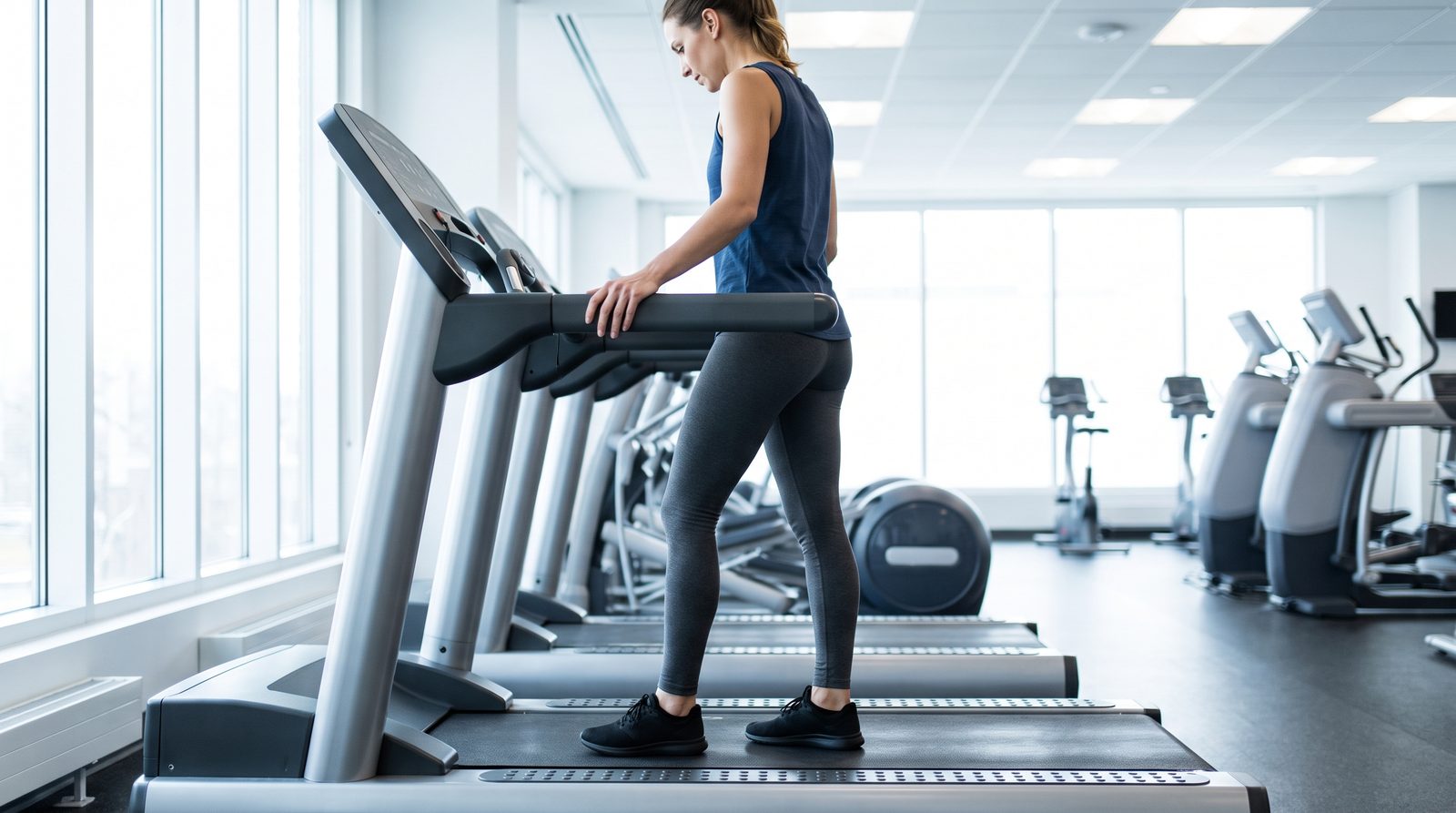
Skip the box and the machine picks a person for you
Walk on, press start, and enter nothing, and the machine does not stop or flag it. It reaches for a stored fallback weight and carries on.
On the machines we checked, that fallback sits between about 150 and 155 pounds. It is an ordinary setting with a default value, the same way a new phone comes set to a language before you pick one. If you weigh 190, the machine spent your whole run costing out a stranger who weighs 150, and it had no way to notice.
That is the difference between a figure built from you and a figure that assumed you. It also tells you what the weight box is for.
Two jobs, and only one of them asked about you
A treadmill is doing two unrelated jobs while you run, and they barely speak to each other.
The first job is turning the belt. You asked for 6.0, so the motor is told to aim for 6.0 and keeps aiming at it for the whole run. Your weight is nowhere in that. The belt is an escalator laid flat: it is told to hold the speed it was set to whether nobody is on it or three people are, and it never asks who is riding.
The second job is guessing what the effort costs. A guess like that needs a body, and the machine does not have one, so it uses the figure you typed. The calorie count is built on that entry. On machines that show power in watts, the same number feeds that too.
So the weight box is not a calibration. It is one ingredient in one estimate, and it never leaves that estimate.
The number that sets your pace has no box at all
The calorie estimate has a way to get better. You type a truer weight, the sum gets a truer input, the answer improves. It is a rough figure either way, and it is at least a rough figure aimed at you.
Speed has no equivalent. Nothing asks you to confirm that the belt is really carrying you at 6.0, and nothing on the machine checks. Distance is just that speed multiplied by the clock, so it inherits whatever the speed is doing. A belt running slightly slow credits you with a run you came up short on, every run, with the same confidence it showed you 6.0.
That is the number your training is built on. It is the one input the machine does not offer.
One run, one corrected input, one uncorrected one
A run at a shown 6.0 mph, with your real weight entered and the belt running 3% slow.
An illustrative example, not a logged test. It applies a 3% error to one speed, and nobody ran these miles. Paces are rounded to the nearest second. The calorie estimate on this run did improve, because that is the number the weight box reaches.
What a real gap looked like when I measured one
On a treadmill I measure regularly, the display finished a run at 2.3 miles when the belt had carried 2.0. My watch showed 2.3 as well. It had no more view of the belt than the display did.
No weight entry could have touched that. Pace and mileage only improve if something measures the belt.

How to check the number the machine never asks about
You can do it with a stopwatch and patience. Find a mark already on the belt, measure the loop, then time how long a set number of passes takes and work the speed out yourself. It costs nothing but a slow ten minutes, and you would want to repeat it at each speed you actually use.
Treadwell is the box the machine never gave you for speed. Hold an iPhone Pro over the belt for a few seconds and it watches the belt itself, so the reading has nothing to do with what the display was told to show. It also refuses to do what the machine does with a skipped weight: if it has not seen the belt clearly, it will not fill the gap with a guess.
Check the belt, not the box
Treadwell measures your treadmill's real belt speed in seconds, so your pace and distance come from the belt instead of the display. Requires an iPhone Pro with LiDAR.
Quick answers
Does entering your weight make a treadmill more accurate? It makes one number better and leaves the rest alone. Your weight is an ingredient in the calorie estimate, so a truer weight gives a truer estimate. Speed and distance are worked out without it, so they are exactly as right or as wrong as they were before you typed anything.
What does a treadmill use your weight for? It feeds the energy figures. The calorie count is calculated from the weight you enter, and on machines that show power in watts the same entry feeds that too. The machine has no way to weigh you, so the number you type is the only body it has to work with.
What happens if you do not enter your weight on a treadmill? It uses a stored default and says nothing. The stored fallback is about 150 to 155 pounds on the machines we checked, and it goes into the calorie sum whenever a runner skips the entry. A lighter or heavier runner gets a figure built for somebody else.
Does your weight affect treadmill speed or distance? No, your weight never reaches either one. Distance is worked out from speed, and speed is aimed at by a control circuit that never consults a body weight.
Sources.
- That a weight reflecting the user's actual weight must be entered because the calorie count and several other calculations are based on that entry: Precor C934 commercial treadmill owner's manual (44132-107). This describes that machine, not every treadmill.
- That the entered weight is the value used to calculate caloric expenditure, and a settings table naming a default weight of 150 lb used in calorie calculations: Matrix T3x-03 treadmill manual, Johnson Health Tech.
- A stored fallback weight of 150 lb listed among the quick-start defaults on both a club machine and a home machine: the Precor C934 owner's manual, and the Precor TRM 211 owner's manual (305307-101), whose part number is that of the addendum bundled with the full manual in one download.
- A fallback weight of 155 lb, applied to the watts figure rather than to a line labelled calories: Woodway Force 1.0 owner's manual.
- That distance is calculated from speed, stated in a manual that never links weight to either: Precor TRM 211 owner's manual. The Woodway Force 1.0 manual likewise defines speed and distance without reference to weight while tying its watts reading to the entered weight.
- Speed targeted and corrected by a closed control loop reading a turning part many times a second, described as velocity-loop feedback with an encoder: Woodway motorized performance and fitness treadmill service manual. That document was read from a third-party parts host rather than the maker's own site, and it describes performance and fitness machines rather than home equipment.
- We found no manual, across three makers, that ties an entered weight to the speed or the distance readout. That is an absence in the documents we read rather than a statement about every treadmill ever built.
- None of the manuals we read mention a force plate, a load cell, or any bodyweight sensing in the deck. They are silent on it, which is not the same as ruling it out.
- The 2.3 against 2.0 run is our own test on a treadmill we measure regularly, graded against that machine's standing tachometer table rather than a fresh tachometer reading taken that day. The Apple Watch was worn on that run and echoed the display.
- The run at a shown 6.0 mph is a worked example. It applies a 3% error to one speed, and nobody ran those miles to log them.