Guides · Are treadmill calorie counts accurate?
Are treadmill calorie counts accurate?
You step off soaked, and the machine tells you what it cost. That number sits right next to your distance and your time, so it looks like the same kind of fact. It is not. Nothing on that treadmill watched you burn anything.
A treadmill's calorie figure is a formula, not a measurement. It runs on your speed setting, the incline and whatever weight you typed in. Tests against measured oxygen use found it off by under one percent at an easy walk and by more than twenty percent at maximum effort. Read it as a rough guide, never as a count.
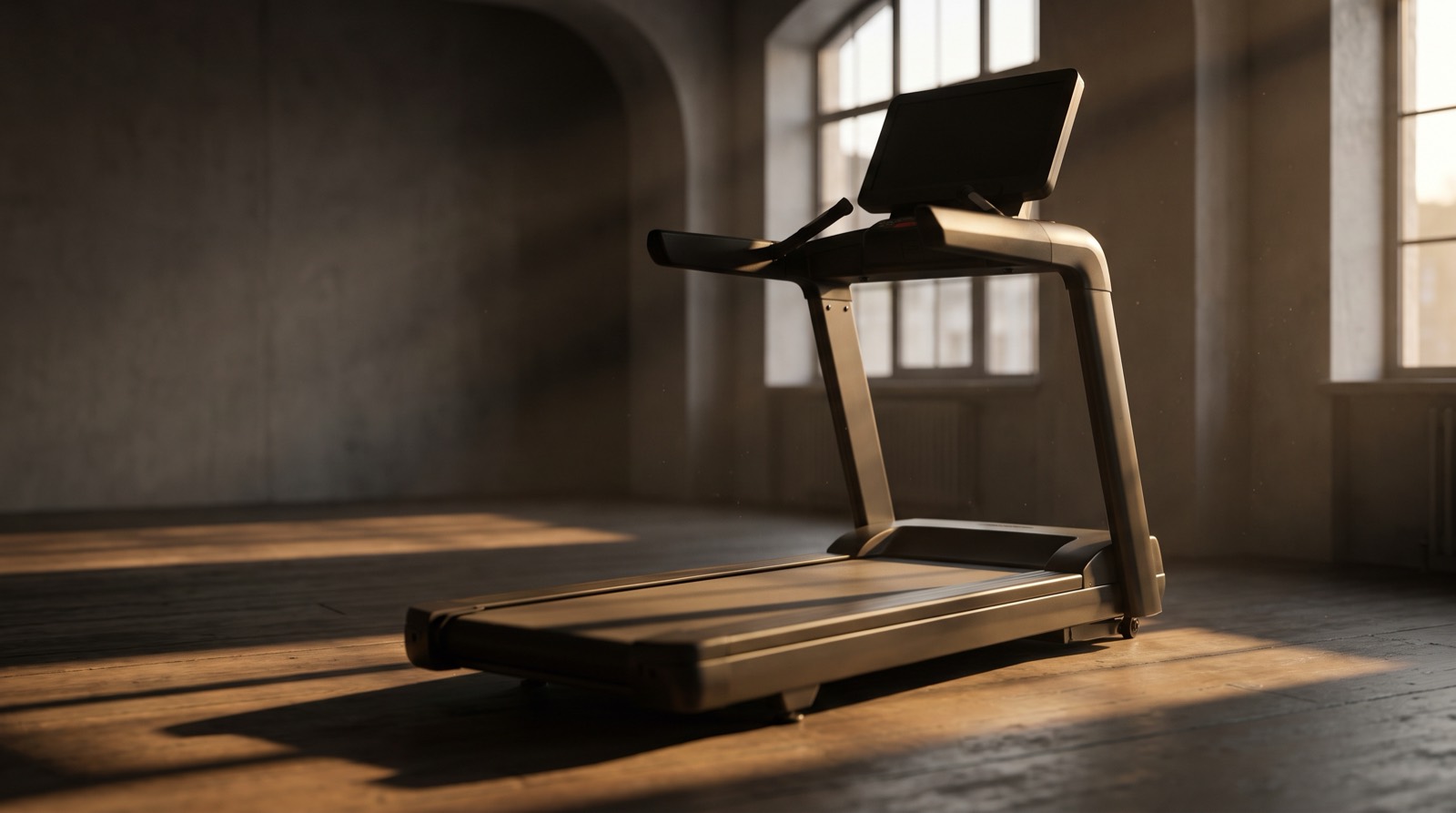
The number is a recipe, not a scale
Real energy measurement works through your breath. You wear a mask, a cart measures the oxygen you take in and the carbon dioxide you put out, and your energy use falls out of the chemistry. That equipment lives in laboratories, and it is the truth every study below was measured against.
A treadmill has none of it. It works the way a recipe calculator does. You type in the ingredients, it looks up standard values, and it hands you a number that never touched your actual food. The treadmill's ingredients are its speed setting, its incline setting and your weight.
What the machine has, and what it is missing
Everything on the right changes how much energy you actually use.
What it works from
- It has the speed it was set to.
- It has the incline it was set to.
- It has whatever body weight you entered.
What it cannot see
- How efficiently you run stays invisible to it.
- Your body composition never reaches it.
- Your form and how much you bounce go unseen.
- It has no idea whether you are holding the rails.
- It cannot tell that you are having a bad day.
The formula itself is no secret. It is a standard published equation that turns speed and grade into an estimated oxygen cost, and it has been checked against real people many times.
What happens when that formula meets real people
The most thorough treadmill study we found tracked 103 adults for 24 weeks. All the way through, it checked the standard walking formula against their real oxygen use.
| Effort level | At the start | After 24 weeks |
|---|---|---|
| Sitting at rest | 30.4% high | 27.9% high |
| Easy walking, fixed workload | 0.44% high | 5.1% high |
| Moderate to hard effort | 9.2% high | 12.6% high |
| All out | 20.3% high | 21.5% high |
Look at what training did. On every row where the group was actually moving, the estimate drifted further from the truth instead of closer.
The likeliest reason is that training made them more efficient, and the formula never found out. A formula that never finds out they got fitter keeps charging them the old price. Twenty-four weeks of training bought those walkers a bigger gap between what the machine said and what they spent.
Those figures are not your treadmill's error. They come from adults with overweight or obesity, walking rather than running, in a supervised study. Read them for the shape of the thing: small at easy efforts, wide when you push, and moving the wrong way as you improve.
There is no single percentage to correct for
The comfortable version of this story is that machines flatter you. Mostly they do, and it is not a rule. A study of 200 college students ran the same equation at three inclines, and at 2 percent the walkers were using more energy than it predicted, so the machine would have read low. At 6 percent the relationship flipped and it read high. The same people produced opposite errors, in the same study.
The reason no correction factor can rescue this is that two runners of the same weight, at the same speed, on the same machine, do not burn the same amount. Most of what makes your energy cost yours is invisible even to researchers filming you, and a treadmill is not looking at you at all.
The one input you can actually fix
The formula runs on speed, and speed is the number treadmills get wrong. I have measured that with a handheld contact tachometer, which touches the running surface instead of asking the machine what it believes.
One gym treadmill read 2.3 miles for a run that was really 2.0. The next day the same machine read 5.6 against a true 5.0. On a different machine I use regularly, the display said 5 miles when I had really run 4. I definitely under-ran my marathon training.
If a machine is wrong about its own belt speed, the speed reaching its energy formula may be wrong too, and that error would sit underneath every error the formula already carries.
Your watch is not the answer either
The obvious move is to trust the thing on your wrist instead, since it knows your weight, your age and your heart rate. It does not rescue you. In a 2017 study, 62 people ran on treadmills wearing consumer trackers while a laboratory cart measured their real energy use alongside them, and every device read significantly high.
What the calorie number is still good for
- Compare it to itself. Bump the speed or the incline on the same machine, with the same weight entered, and the number rises with it. That relative signal is real. Nothing else you do on the belt reaches it.
- Do not compare it across machines or against your watch. Two devices running different formulas on different inputs will disagree, and the disagreement tells you nothing.
- Enter your weight anyway. The arithmetic needs it, and leaving a default in place guarantees the number belongs to somebody else.
- Fix the speed underneath it. It is the one input you can verify. That will not rescue the calorie figure, because every other assumption in the formula stays where it was. It does fix your pace and your distance, which is the part of your training you can act on.
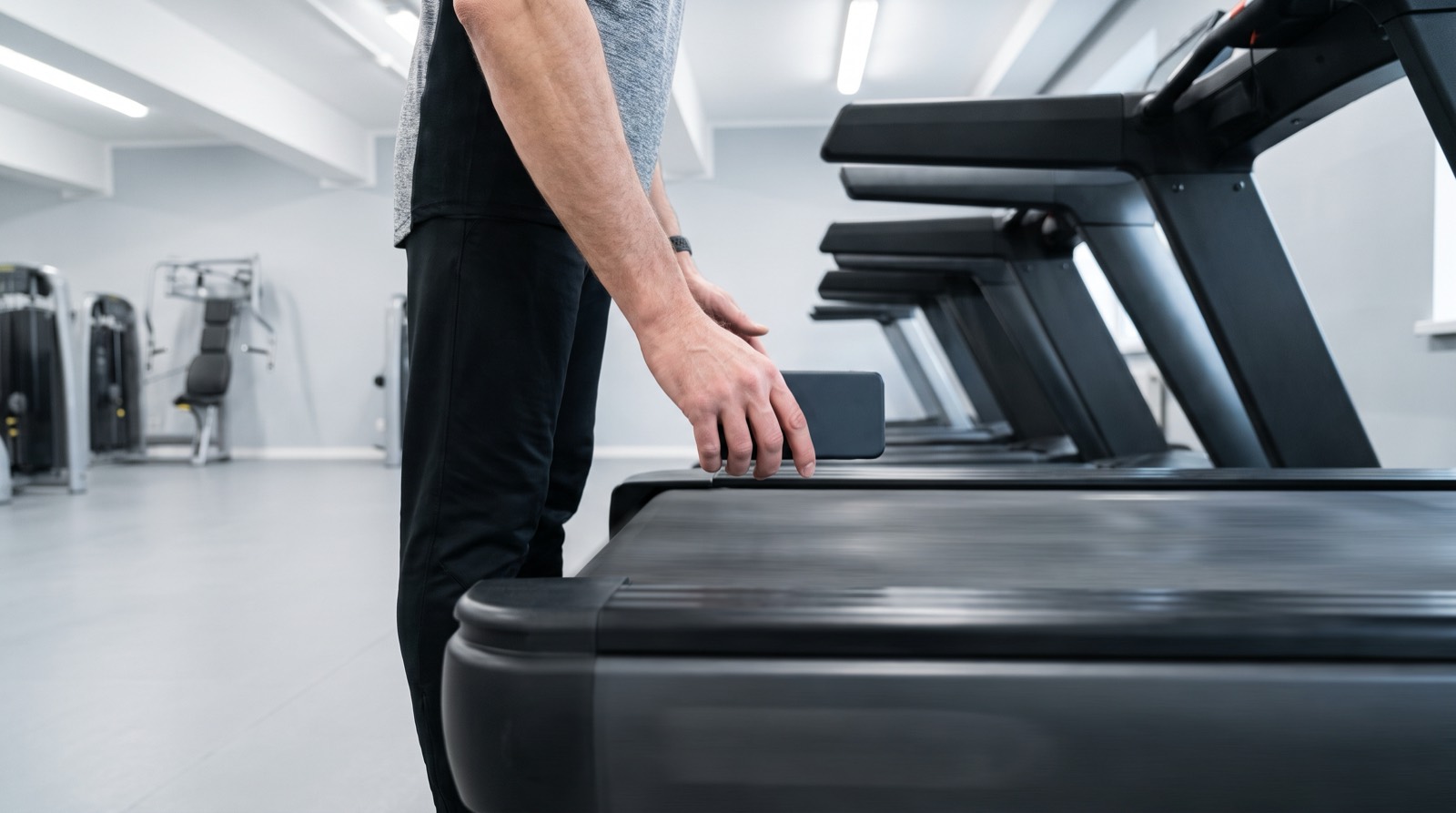
Measure the number that can be measured
Treadwell never estimates calories from a formula. If you run with the Treadwell watch app on your Apple Watch, the app shows you the watch's own calorie figure beside your heart rate, and it tells you plainly which number came from where.
What Treadwell measures for itself is the one thing on a treadmill that can honestly be measured, which is how fast the belt is really moving. You stand beside the machine and hold your phone above the belt, and it reads the real speed through the camera and the LiDAR sensor. On a hotel treadmill it had never seen, with nothing set up for that machine beforehand, its reading came within half a percent of my tachometer. That figure is how close our reading was, not a verdict on the hotel's display.
When it cannot get a reading it trusts, it says so instead of inventing one. You need an iPhone Pro, because that is the phone carrying the LiDAR sensor it measures with.
Start with the number that can be checked
Measure any treadmill's true speed in seconds, with your iPhone Pro.
The calorie readout was never a measurement, it gets less reliable the harder you work, and in the one long study that checked, it drifted further off as the walkers got fitter. Your pace and your distance are different. Those can be pinned down, and they are what your training is actually made of.
Quick answers
Are treadmill calorie counts accurate? Treat a treadmill's calorie figure as a rough guide rather than a count, because nothing on the machine measures what you burned. Published tests of the standard formula against measured oxygen use found errors ranging from under one percent at an easy walking pace to more than twenty percent at maximum effort.
Does a treadmill know how many calories I burned? A treadmill cannot know. Measuring energy burn means measuring the oxygen you breathe, which takes a mask and a laboratory cart. A treadmill has only its speed setting, its incline setting and whatever weight you entered, and no way to observe you at all.
Do treadmills overestimate calories? Treadmills usually overestimate calories, but the direction can flip. One study of 200 college students found the standard equation reading low at a 2 percent incline and high at 6 percent, in the same people.
Does entering my weight make the calorie count accurate? Enter your weight anyway, because the arithmetic needs it and a default belongs to somebody else. Do not expect it to fix the estimate. In the most thorough treadmill study we found, the things that explained who was furthest off were body fat, fitness, age, race and sex, and body weight on its own was never even tested.
Is my watch more accurate than the treadmill for calories? It is not reliably better. A 2017 study put 62 people on treadmills wearing consumer trackers and compared them against laboratory measurement. Every device read significantly high, with error ranges wide enough that none of them could be trusted for this.
Sources.
- The overestimates were 30.4% falling to 27.9% at rest, 0.44% rising to 5.1% at a fixed easy walking workload, 9.2% rising to 12.6% at relative workload, and 20.3% rising to 21.5% at maximum. The significant predictors were fat mass at every workload, VO2peak at rest, race and sex at three of the four workloads, and age at maximum effort. Resting metabolic rate, lean mass and body fat percentage were tested and never came out significant, and body weight on its own was never tested. Source: Matthews et al., "Modulators of Energy Expenditure Accuracy in Adults with Overweight or Obesity," Medicine & Science in Sports & Exercise 57(3):470-480 (2025). 103 adults, 24 week supervised programme, walking, compared against indirect calorimetry. That training made the walkers more efficient while the formula did not find out is our reading of the result, not a claim the study makes. Fitness was a significant predictor only at rest in that data.
- The equation read low at a 2% incline and high at 6%. Source: Stoedefalke and Hawkins, Journal of American College Health (2022), PMID 32150498. 200 college students, treadmill walking at three inclines against indirect calorimetry.
- The running equation overestimated at two hard efforts and worsened with intensity. Source: Cunha et al., European Journal of Applied Physiology (2012), PMID 22170015. 28 men.
- Running biomechanics explained roughly 4% to 12% of person-to-person variation in running economy. Source: Van Hooren et al., "The Relationship Between Running Biomechanics and Running Economy," Sports Medicine (2024), PMID 38446400. Systematic review of 51 studies, 1,115 participants.
- Consumer trackers read significantly high for energy expenditure on a treadmill protocol. Source: Dooley, Golaszewski and Bartholomew, JMIR mHealth and uHealth (2017), PMID 28302596. 62 participants, compared against a laboratory metabolic cart.
- That a wrong belt speed would carry into a calorie calculation is our own reasoning, not a documented mechanism. No manufacturer document we found states which speed value a calorie calculation reads. The closest evidence either way is one field service manual whose communication protocol tracks a measured belt speed and a commanded belt speed as two separate values without saying which feeds anything downstream, and whose calorie query returns zero. Source: Trackmaster FVX/TMX Series Field Service Manual, Rev. 5 (2006), Chapter 9.
- The 2.3 against 2.0 run and the 5.6 against 5.0 run are our own tests on the same gym treadmill, one day apart, each graded against that machine's standing tachometer table rather than a fresh tachometer reading on the day.
- The 5 miles against 4 is my own run on a machine I use regularly, reported from my own training rather than from a captured test file.
- The hotel treadmill figure is the accuracy of our own reading against a handheld tachometer taken that day, on a machine we had never measured before. It is not a statement about that treadmill's display.
- The widely repeated claim that cardio machines are off by 7% to 42% is not used here. We traced it to a 2010 television segment built on testing at the UCSF Human Performance Center, announced in UCSF's own press release of 28 February 2010, rather than to a published study, with no methods and no sample size we could check. The four figures in those accounts are 7% for a stationary bike, 12% for a stair climber, 13% for a treadmill and 42% for an elliptical, so the 42% never belonged to a treadmill in the first place.